







Question: allocate the support costs to the client services areas using direct and step-down method. Ellis Bradley (EB) is a regional CPA firm that provides client
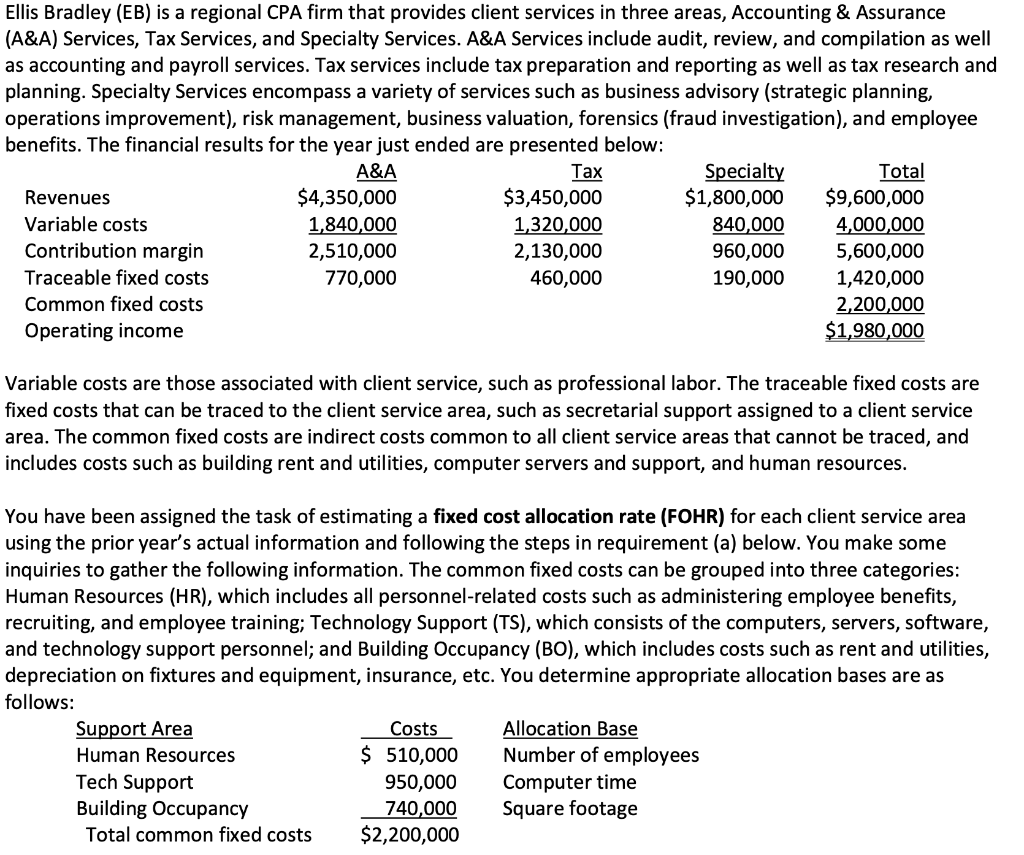
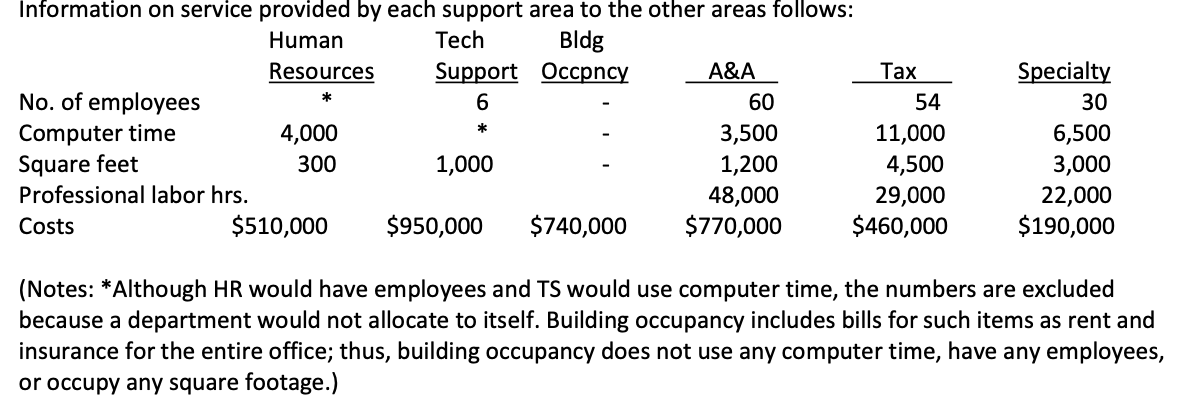
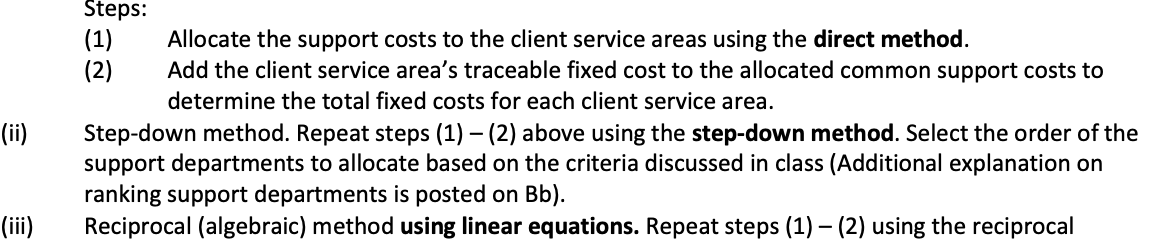
Ellis Bradley (EB) is a regional CPA firm that provides client services in three areas, Accounting & Assurance (A&A) Services, Tax Services, and Specialty Services. A&A Services include audit, review, and compilation as well as accounting and payroll services. Tax services include tax preparation and reporting as well as tax research and planning. Specialty Services encompass a variety of services such as business advisory (strategic planning, operations improvement), risk management, business valuation, forensics (fraud investigation), and employee benefits. The financial results for the year just ended are presented below: A&A Tax Specialty Total Revenues $4,350,000 $3,450,000 $1,800,000 $9,600,000 Variable costs 1,840,000 1,320,000 840,000 4,000,000 Contribution margin 2,510,000 2,130,000 960,000 5,600,000 Traceable fixed costs 770,000 460,000 190,000 1,420,000 Common fixed costs 2,200,000 Operating income $1,980,000 Variable costs are those associated with client service, such as professional labor. The traceable fixed costs are fixed costs that can be traced to the client service area, such as secretarial support assigned to a client service area. The common fixed costs are indirect costs common to all client service areas that cannot be traced, and includes costs such as building rent and utilities, computer servers and support, and human resources. You have been assigned the task of estimating a fixed cost allocation rate (FOHR) for each client service area using the prior year's actual information and following the steps in requirement (a) below. You make some inquiries to gather the following information. The common fixed costs can be grouped into three categories: Human Resources (HR), which includes all personnel-related costs such as administering employee benefits, recruiting, and employee training; Technology Support (TS), which consists of the computers, servers, software, and technology support personnel; and Building Occupancy (BO), which includes costs such as rent and utilities, depreciation on fixtures and equipment, insurance, etc. You determine appropriate allocation bases are as follows: Support Area Costs Allocation Base Human Resources $ 510,000 Number of employees Tech Support 950,000 Computer time Building Occupancy 740,000 Square footage Total common fixed costs $2,200,000 Bldg Tax * Information on service provided by each support area to the other areas follows: Human Tech Resources Support Occpncy A&A No. of employees 6 60 54 Computer time 4,000 3,500 11,000 Square feet 300 1,000 1,200 4,500 Professional labor hrs. 48,000 29,000 Costs $510,000 $950,000 $740,000 $770,000 $460,000 * Specialty 30 6,500 3,000 22,000 $190,000 (Notes: *Although HR would have employees and TS would use computer time, the numbers are excluded because a department would not allocate to itself. Building occupancy includes bills for such items as rent and insurance for the entire office; thus, building occupancy does not use any computer time, have any employees, or occupy any square footage.) (ii) Steps: (1) Allocate the support costs to the client service areas using the direct method. (2) Add the client service area's traceable fixed cost to the allocated common support costs to determine the total fixed costs for each client service area. Step-down method. Repeat steps (1) (2) above using the step-down method. Select the order of the support departments to allocate based on the criteria discussed in class (Additional explanation on ranking support departments is posted on Bb). Reciprocal (algebraic) method using linear equations. Repeat steps (1)-(2) using the reciprocal (iii) Ellis Bradley (EB) is a regional CPA firm that provides client services in three areas, Accounting & Assurance (A&A) Services, Tax Services, and Specialty Services. A&A Services include audit, review, and compilation as well as accounting and payroll services. Tax services include tax preparation and reporting as well as tax research and planning. Specialty Services encompass a variety of services such as business advisory (strategic planning, operations improvement), risk management, business valuation, forensics (fraud investigation), and employee benefits. The financial results for the year just ended are presented below: A&A Tax Specialty Total Revenues $4,350,000 $3,450,000 $1,800,000 $9,600,000 Variable costs 1,840,000 1,320,000 840,000 4,000,000 Contribution margin 2,510,000 2,130,000 960,000 5,600,000 Traceable fixed costs 770,000 460,000 190,000 1,420,000 Common fixed costs 2,200,000 Operating income $1,980,000 Variable costs are those associated with client service, such as professional labor. The traceable fixed costs are fixed costs that can be traced to the client service area, such as secretarial support assigned to a client service area. The common fixed costs are indirect costs common to all client service areas that cannot be traced, and includes costs such as building rent and utilities, computer servers and support, and human resources. You have been assigned the task of estimating a fixed cost allocation rate (FOHR) for each client service area using the prior year's actual information and following the steps in requirement (a) below. You make some inquiries to gather the following information. The common fixed costs can be grouped into three categories: Human Resources (HR), which includes all personnel-related costs such as administering employee benefits, recruiting, and employee training; Technology Support (TS), which consists of the computers, servers, software, and technology support personnel; and Building Occupancy (BO), which includes costs such as rent and utilities, depreciation on fixtures and equipment, insurance, etc. You determine appropriate allocation bases are as follows: Support Area Costs Allocation Base Human Resources $ 510,000 Number of employees Tech Support 950,000 Computer time Building Occupancy 740,000 Square footage Total common fixed costs $2,200,000 Bldg Tax * Information on service provided by each support area to the other areas follows: Human Tech Resources Support Occpncy A&A No. of employees 6 60 54 Computer time 4,000 3,500 11,000 Square feet 300 1,000 1,200 4,500 Professional labor hrs. 48,000 29,000 Costs $510,000 $950,000 $740,000 $770,000 $460,000 * Specialty 30 6,500 3,000 22,000 $190,000 (Notes: *Although HR would have employees and TS would use computer time, the numbers are excluded because a department would not allocate to itself. Building occupancy includes bills for such items as rent and insurance for the entire office; thus, building occupancy does not use any computer time, have any employees, or occupy any square footage.) (ii) Steps: (1) Allocate the support costs to the client service areas using the direct method. (2) Add the client service area's traceable fixed cost to the allocated common support costs to determine the total fixed costs for each client service area. Step-down method. Repeat steps (1) (2) above using the step-down method. Select the order of the support departments to allocate based on the criteria discussed in class (Additional explanation on ranking support departments is posted on Bb). Reciprocal (algebraic) method using linear equations. Repeat steps (1)-(2) using the reciprocal (iii)
Step by Step Solution
There are 3 Steps involved in it

Get step-by-step solutions from verified subject matter experts
 Study Help