







Question: Allocating Joint Costs Using the Net Realizable Value Method A company manufactures three products, L-Ten, Triol, and Pioze, from a joint process. Each production run
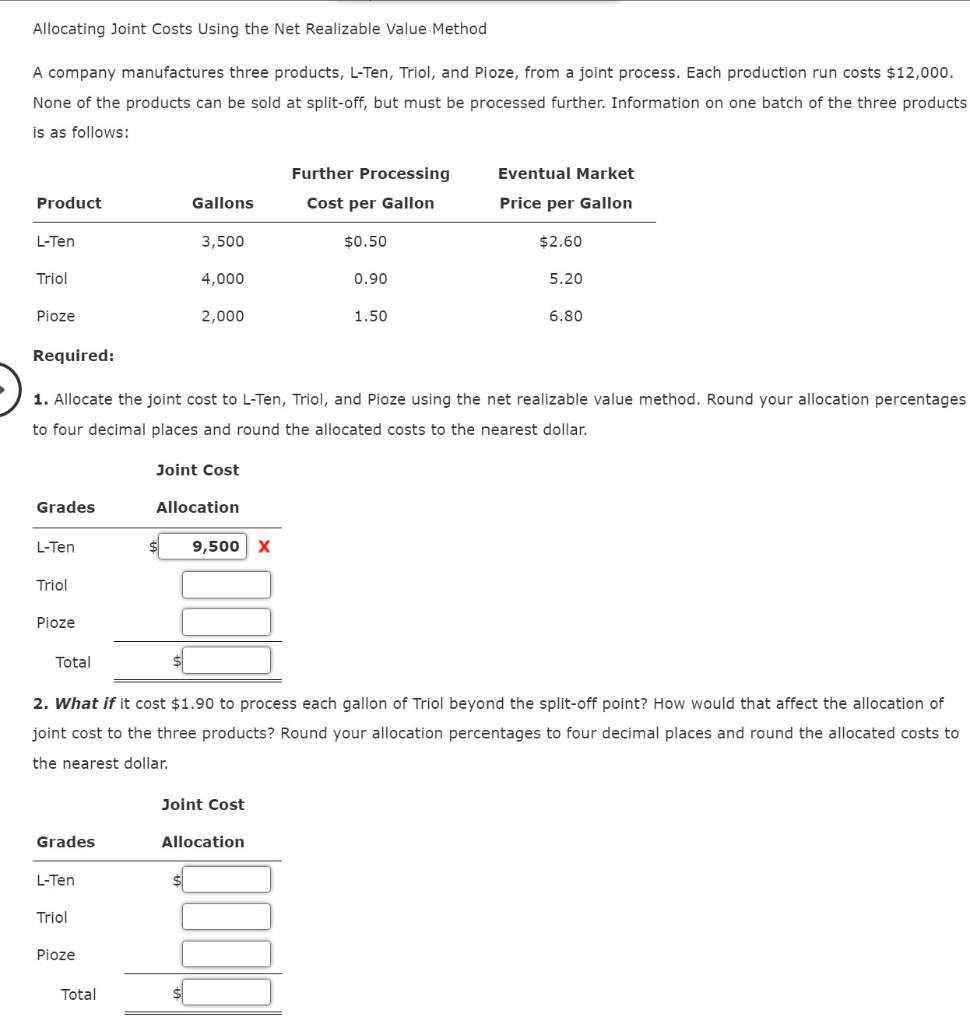
Allocating Joint Costs Using the Net Realizable Value Method A company manufactures three products, L-Ten, Triol, and Pioze, from a joint process. Each production run costs $12,000. None of the products can be sold at split-off, but must be processed further. Information on one batch of the three products is as follows: Required: 1. Allocate the joint cost to L-Ten, Triol, and Pioze using the net realizable value method. Round your allocation percentages to four decimal places and round the allocated costs to the nearest dollar. 2. What if it cost $1.90 to process each gallon of Triol beyond the split-off point? How would that affect the allocation of joint cost to the three products? Round your allocation percentages to four decimal places and round the allocated costs to the nearest dollar. Allocating Joint Costs Using the Net Realizable Value Method A company manufactures three products, L-Ten, Triol, and Pioze, from a joint process. Each production run costs $12,000. None of the products can be sold at split-off, but must be processed further. Information on one batch of the three products is as follows: Required: 1. Allocate the joint cost to L-Ten, Triol, and Pioze using the net realizable value method. Round your allocation percentages to four decimal places and round the allocated costs to the nearest dollar. 2. What if it cost $1.90 to process each gallon of Triol beyond the split-off point? How would that affect the allocation of joint cost to the three products? Round your allocation percentages to four decimal places and round the allocated costs to the nearest dollar
Step by Step Solution
There are 3 Steps involved in it

Get step-by-step solutions from verified subject matter experts
 Study Help