







Question: ( Allocation , Allocation base , Allocation rate , Cost , Cost accumulation , Cost driver , Cost objects , Cost pool , Direct costs
( Allocation ,
Allocation base ,
Allocation rate ,
Cost ,
Cost accumulation ,
Cost driver ,
Cost objects ,
Cost pool ,
Direct costs ,
Indirect costs ,
Joint costs ,
Joint product ,
Overhead costs ,
Split-off point )
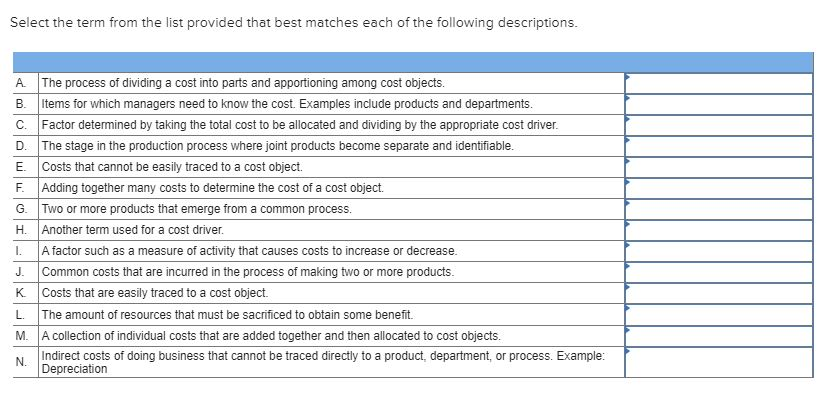
Select the term from the list provided that best matches each of the following descriptions. A. The process of dividing a cost into parts and apportioning among cost objects. B. Items for which managers need to know the cost. Examples include products and departments C. Factor determined by taking the total cost to be allocated and dividing by the appropriate cost driver. D. The stage in the production process where joint products become separate and identifiable. E. Costs that cannot be easily traced to a cost object. F. Adding together many costs to determine the cost of a cost object. G. Two or more products that emerge from a common process. H. Another term used for a cost driver. I. Afactor such as a measure of activity that causes costs to increase or decrease. J. Common costs that are incurred in the process of making two or more products. K Costs that are easily traced to a cost object. L. The amount of resources that must be sacrificed to obtain some benefit. M. A collection of individual costs that are added together and then allocated to cost objects. N. Indirect costs of doing business that cannot be traced directly to a product department, or process. Example: Depreciation
Step by Step Solution
There are 3 Steps involved in it

Get step-by-step solutions from verified subject matter experts
 Study Help