







Question: With the evidence given in each case listed below, tell whether stress-corrosion cracking, corrosion- fatigue cracking, hydrogen-induced cracking or a combination of them may
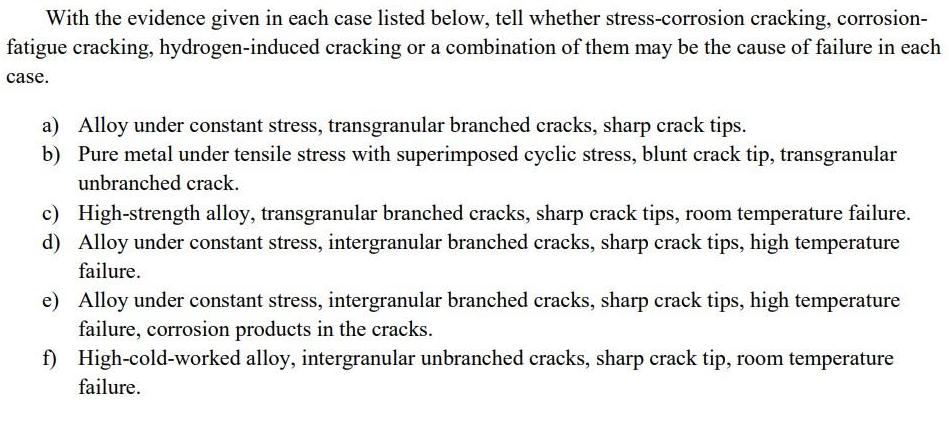
With the evidence given in each case listed below, tell whether stress-corrosion cracking, corrosion- fatigue cracking, hydrogen-induced cracking or a combination of them may be the cause of failure in each case. a) Alloy under constant stress, transgranular branched cracks, sharp crack tips. b) Pure metal under tensile stress with superimposed cyclic stress, blunt crack tip, transgranular unbranched crack. c) High-strength alloy, transgranular branched cracks, sharp crack tips, room temperature failure. d) Alloy under constant stress, intergranular branched cracks, sharp crack tips, high temperature failure. e) Alloy under constant stress, intergranular branched cracks, sharp crack tips, high temperature failure, corrosion products in the cracks. f) High-cold-worked alloy, intergranular unbranched cracks, sharp crack tip, room temperature failure.
Step by Step Solution
3.38 Rating (160 Votes )
There are 3 Steps involved in it
a Stress Corrosion Cracking is a cause of failure of alloy under constant stress transgranular branc... View full answer

Get step-by-step solutions from verified subject matter experts
 Study Help