







Question: All-Pay Contest Consider a one-shot game where two players simultaneously choose their respective effort levels Xi 2 0, fori = 1,2. The player who chooses
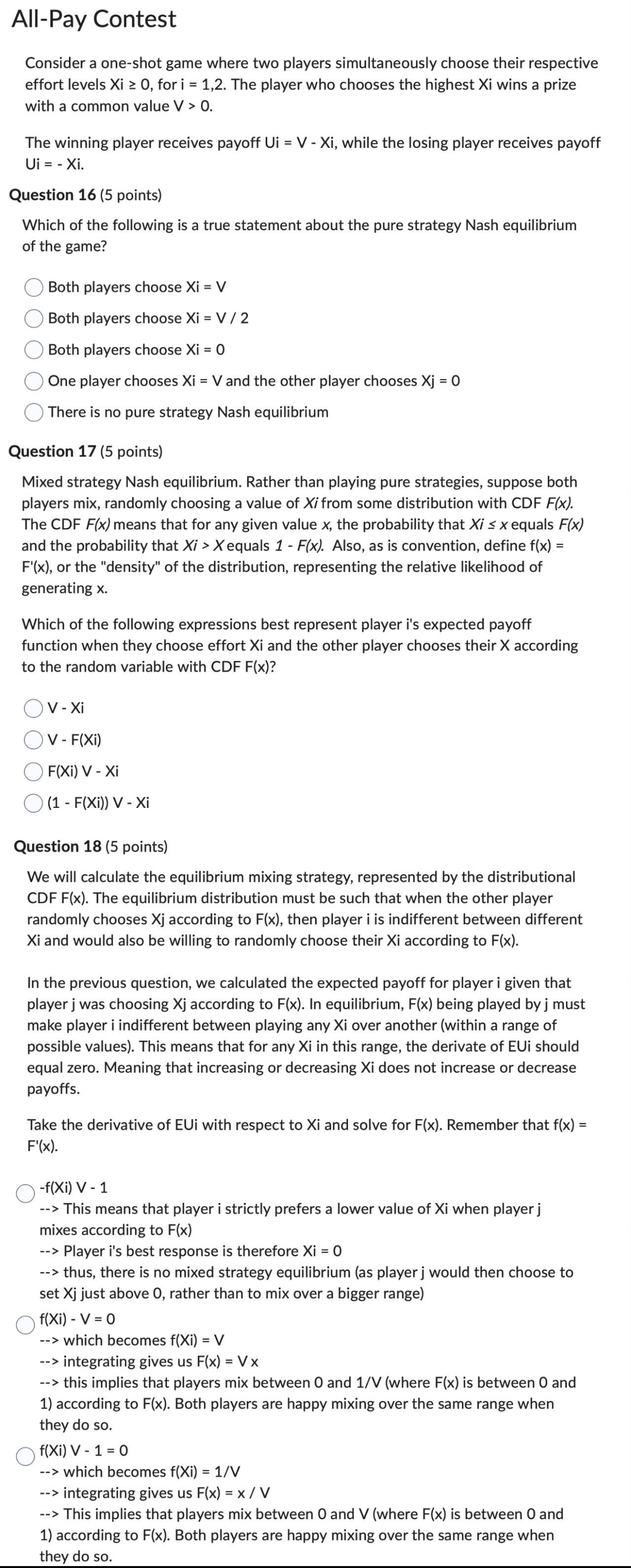
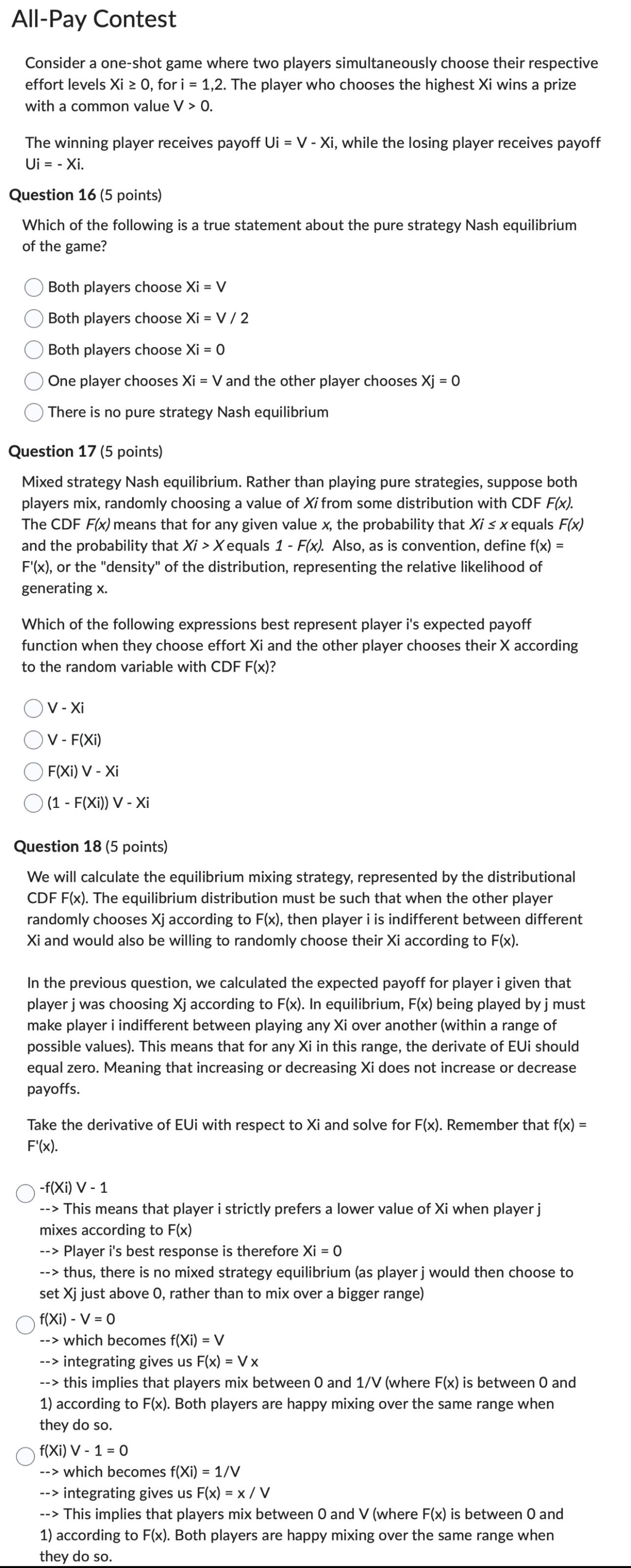
All-Pay Contest Consider a one-shot game where two players simultaneously choose their respective effort levels Xi 2 0, fori = 1,2. The player who chooses the highest Xi wins a prize with a common value V > 0. The winning player receives payoff Ui = V - Xi, while the losing player receives payoff Ui = - Xi. Question 16 (5 points) Which of the following is a true statement about the pure strategy Nash equilibrium of the game? O Both players choose Xi = V 0 Both players choose Xi = V/ 2 0 Both players choose Xi = O 0 One player chooses Xi = V and the other player chooses Xj = 0 Q There is no pure strategy Nash equilibrium Question 17 (5 points) Mixed strategy Nash equilibrium. Rather than playing pure strategies, suppose both players mix, randomly choosing a value of Xifrom some distribution with CDF F(x). The CDF F(X) means that for any given value x, the probability that Xi 5x equals FM and the probability that Xi > Xequals 1 F(x). Also, as is convention, define f(x) = F'(X), or the "density" of the distribution, representing the relative likelihood of generating x. Which of the following expressions best represent player i's expected payoff function when they choose effort Xi and the other player chooses their X according to the random variable with CDF F(x)? O V - Xi O V - F(Xi) Q F(Xi) v - Xi Q (1 - F(Xi)) v - Xi Question 18 (5 points) We will calculate the equilibrium mixing strategy, represented by the distributional CDF F(x). The equilibrium distribution must be such that when the other player randomly chooses Xj according to F(x), then player i is indifferent between different Xi and would also be willing to randomly choose their Xi according to F(x). In the previous question, we calculated the expected payoff for player i given that player] was choosing Xj according to F(x). In equilibrium, F(x) being played by] must make player i indifferent between playing any Xi over another (within a range of possible values). This means that for any Xi in this range, the derivate of EUi should equal zero. Meaning that increasing or decreasing Xi does not increase or decrease payoffs. Take the derivative of EUi with respect to Xi and solve for F(x). Remember that f(x) = F'(x). -f(Xi) V - 1 O -> This means that playeri strictly prefers a lower value of Xi when playerj mixes according to F(X) --> Player i's best response is therefore Xi = 0 --> thus, there is no mixed strategy equilibrium (as player] would then choose to set X] just above 0, rather than to mix over a bigger range) 0 f(Xi) - V = 0 --> which becomes f(Xi) = V -> integrating gives us PM = Vx ~> this implies that players mix between 0 and 1/V (where F(x) is between 0 and 1) according to F(x). Both players are happy mixing over the same range when they do so. 0 f(Xi) V 1 = 0 --> which becomes f(Xi) = NV --> integrating gives us F(x) = X / V --> This implies that players mix between 0 and V (where F(X) is between 0 and 1) according to F(x). Both players are happy mixing over the same range when they do so
Step by Step Solution
There are 3 Steps involved in it

Get step-by-step solutions from verified subject matter experts
 Study Help