







Question: Although big-O notation determines a growth rate of a function, sometimes a worse algorithm may outperform a better algorithm for very small input sizes
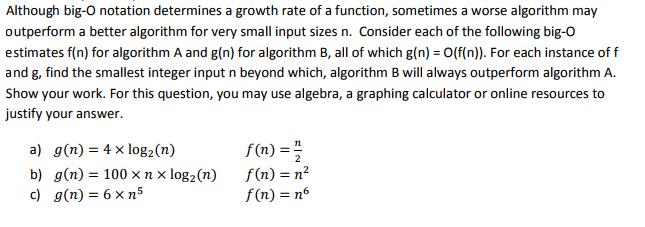
Although big-O notation determines a growth rate of a function, sometimes a worse algorithm may outperform a better algorithm for very small input sizes n. Consider each of the following big-O estimates f(n) for algorithm A and g(n) for algorithm B, all of which g(n) = O(f(n)). For each instance of f and g, find the smallest integer input n beyond which, algorithm B will always outperform algorithm A. Show your work. For this question, you may use algebra, a graphing calculator or online resources to justify your answer. = a) g(n) 4x log2(n) = b) g(n) 100 x nx log (n) c) g(n) 6xn5 f(n) = f(n) = n f(n) = n6
Step by Step Solution
3.52 Rating (155 Votes )
There are 3 Steps involved in it
Certainly Lets analyze each pair of functions to find the smallest integer input n beyond which algo... View full answer

Get step-by-step solutions from verified subject matter experts
 Study Help