







Question: Always True: Explain why the statement must be in true in general, in other words you can't just give one example of why it
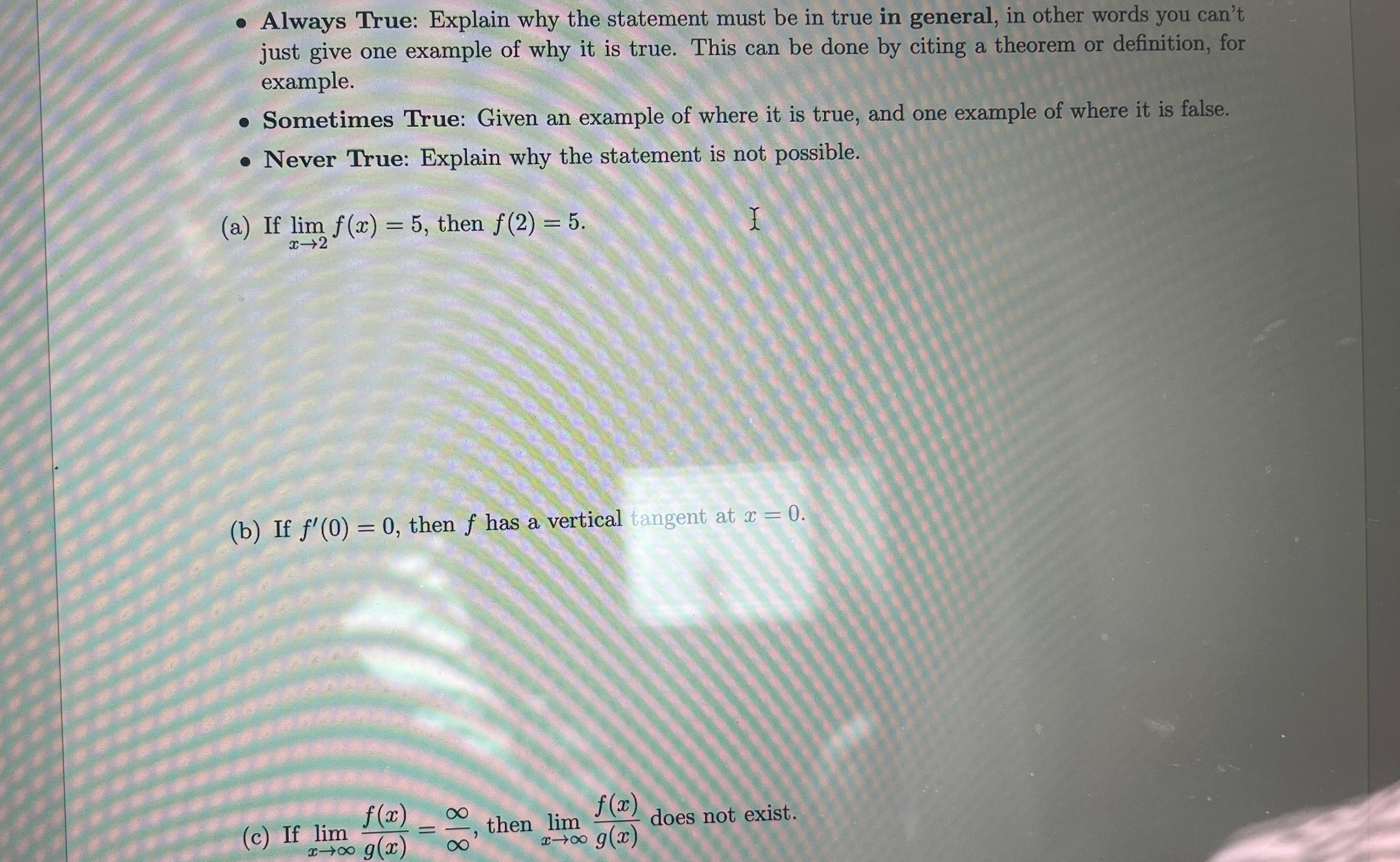
Always True: Explain why the statement must be in true in general, in other words you can't just give one example of why it is true. This can be done by citing a theorem or definition, for example. Sometimes True: Given an example of where it is true, and one example of where it is false. Never True: Explain why the statement is not possible. (a) If lim f(x) = 5, then f(2) = 5. x2 I (b) If f'(0) = 0, then f has a vertical tangent at x = 0. f(x) = f(x) then lim xx g(x) does not exist. (c) If lim x+00 g(x) XX
Step by Step Solution
There are 3 Steps involved in it
1 Expert Approved Answer
Step: 1 Unlock

Question Has Been Solved by an Expert!
Get step-by-step solutions from verified subject matter experts
Step: 2 Unlock
Step: 3 Unlock
 Study Help