







Question: am getting requirement five wrong please help Save son: d costs) orchester Pharmacy, part of a large chain of pharm stomers. The complexity of prescriptions
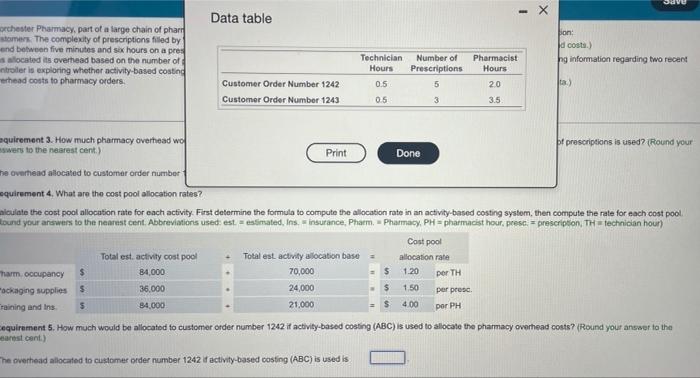
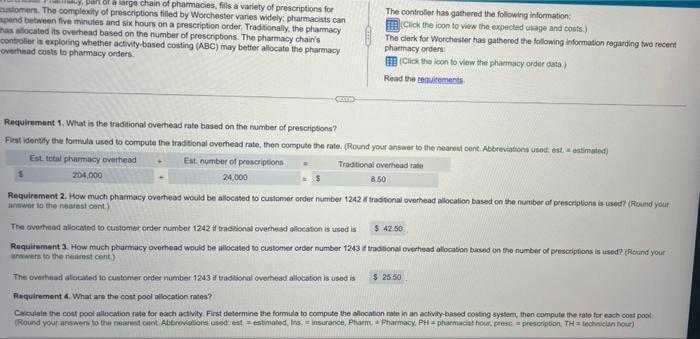
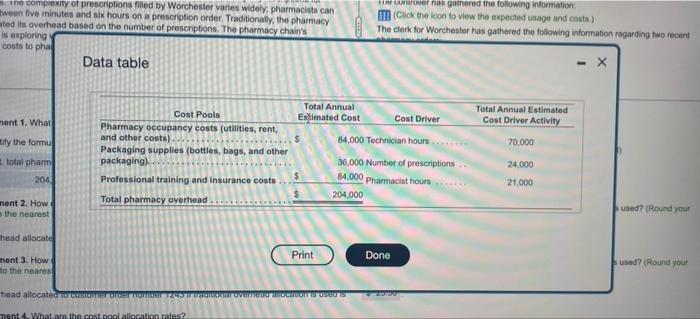
Save son: d costs) orchester Pharmacy, part of a large chain of pharm stomers. The complexity of prescriptions filled by f end between five minutes and six hours on a pres sallocated its overhead based on the number of d introiler is exploring whether activity-based costing erhead costs to pharmacy orders. ng information regarding two recent Technician Number of Pharmacist Hours Prescriptions Hours 0.5 5 2.0 ta.) Customer Order Number 1242 Customer Order Number 1243 0.5 3 3.5 quirement 3. How much pharmacy overhead wo nswers to the nearest cent.) of prescriptions is used? (Round your Print Done the overhead allocated to customer order number 7 equirement 4. What are the cost pool allocation rates? alculate the cost pool allocation rate for each activity. First determine the formula to compute the allocation rate in an activity-based costing system, then compute the rate for each cost pool. tound your answers to the nearest cent. Abbreviations used: est estimated, Ins. insurance, Pharm. Pharmacy, PH=pharmacist hour, presc. = prescription, TH technician hour) Cost pool Total est. activity cost pool Total est activity allocation base = 84,000 harm, occupancy $ "ackaging supplies S Training and Ins 70,000 24,000 allocation rate = $ 1.20 per TH $ 1.50 36,000 per presc. $ 84,000 21,000 = $ 4.00 per PH equirement 5. How much would be allocated to customer order number 1242 if activity-based costing (ABC) is used to allocate the pharmacy overhead costs? (Round your answer to the wearest cent.) The overhead allocated to customer order number 1242 if activity-based costing (ABC) is used is Data table -X The controller has gathered the following information: (Click the icon to view the expected usage and costs.) uy, part of a large chain of pharmacies, fills a variety of prescriptions for customers. The complexity of prescriptions filled by Worchester varies widely, pharmacists can mpend between five minutes and six hours on a prescription order. Traditionally, the pharmacy has allocated its overhead based on the number of prescriptions. The pharmacy chain's controller is exploring whether activity-based costing (ABC) may better allocate the pharmacy overhead costs to pharmacy orders. The clerk for Worchester has gathered the following information regarding two recent pharmacy orders: (Click the icon to view the pharmacy order data) Read the requirements CELESS Requirement 1. What is the traditional overhead rate based on the number of prescriptions? First identify the formula used to compute the traditional overhead rate, then compute the rate. (Round your answer to the nearest cent. Abbreviations used: est. estimated) Est. total pharmacy overhead Est. number of prescriptions Traditional overhead rate 204,000 24,000 8.50 Requirement 2. How much pharmacy overhead would be allocated to customer order number 1242 if traditional overhead allocation based on the number of prescriptions is used? (Round your answer to the nearest cent.) $ 42.50 The overhead allocated to customer order number 1242 if traditional overhead allocation is used is Requirement 3. How much pharmacy overhead would be allocated to customer order number 1243 if traditional overhead allocation based on the number of prescriptions is used? (Round your answers to the nearest cent.) $ 25.50 The overhead allocated to customer order number 1243 if traditional overhead allocation is used is Requirement 4. What are the cost pool allocation rates? Calculate the cost pool allocation rate for each activity. First determine the formula to compute the allocation rate in an activity-based costing system, then compute the rate for each cost pool (Round your answers to the nearest cent Abbreviations used: est estimated, Ins, insurance, Pharm. Pharmacy, PH=pharmacist hour, presc= prescription, TH= technician hour) the complexity of prescriptions filled by Worchester varies widely; pharmacists can tween five minutes and six hours on a prescription order. Traditionally, the pharmacy ated its overhead based on the number of prescriptions. The pharmacy chain's is exploring costs to pha Data table Cost Pools Total Annual Estimated Cost ment 1. What Pharmacy occupancy costs (utilities, rent, and other costs) tify the formu Packaging supplies (bottles, bags, and other packaging). total pharm 204, Professional training and insurance costs... Total pharmacy overhead ment 2. How i the nearest head allocate Print ment 3. How c to the neares head allocated to customer order number 1245 ir tradicionar overead alocation is used IS ment 4. What are the cost.pool. allocation rates? the contrower nas gathered the following information: (Click the icon to view the expected usage and costs) The clerk for Worchester has gathered the following information regarding two recent X Total Annual Estimated Cost Driver Activity Cost Driver 70,000 24,000 21,000 used? (Round your sused? (Round your 84,000 Technician hours 36,000 Number of prescriptions 84,000 Pharmacist hours 204,000 Done 20100
Step by Step Solution
There are 3 Steps involved in it

Get step-by-step solutions from verified subject matter experts
 Study Help