







Question: Amy is a first-year student at Mac. Excluding time spent in taking classes, she has 50 hours per week that she can freely use.
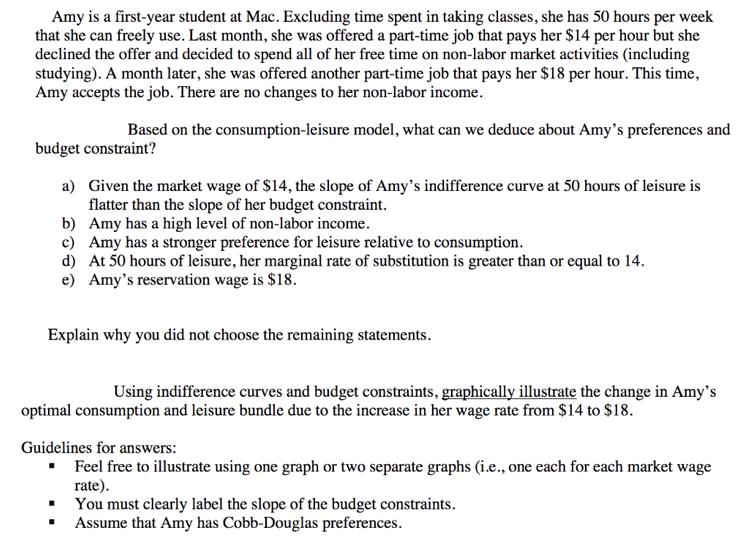
Amy is a first-year student at Mac. Excluding time spent in taking classes, she has 50 hours per week that she can freely use. Last month, she was offered a part-time job that pays her $14 per hour but she declined the offer and decided to spend all of her free time on non-labor market activities (including studying). A month later, she was offered another part-time job that pays her $18 per hour. This time, Amy accepts the job. There are no changes to her non-labor income. Based on the consumption-leisure model, what can we deduce about Amy's preferences and budget constraint? a) Given the market wage of $14, the slope of Amy's indifference curve at 50 hours of leisure is flatter than the slope of her budget constraint. b) Amy has a high level of non-labor income. c) Amy has a stronger preference for leisure relative to consumption. d) At 50 hours of leisure, her marginal rate of substitution is greater than or equal to 14. e) Amy's reservation wage is $18. Explain why you did not choose the remaining statements. Using indifference curves and budget constraints, graphically illustrate the change in Amy's optimal consumption and leisure bundle due to the increase in her wage rate from $14 to $18. Guidelines for answers: Feel free to illustrate using one graph or two separate graphs (i.e., one each for each market wage rate). You must clearly label the slope of the budget constraints. Assume that Amy has Cobb-Douglas preferences.
Step by Step Solution
3.40 Rating (147 Votes )
There are 3 Steps involved in it

Get step-by-step solutions from verified subject matter experts
 Study Help