







Question: An An introduction on this case study needed. CASE STUDY III-1 Managing a Systems Development Project at Consumer and Industrial Products, Inc. companywide emphasis on
An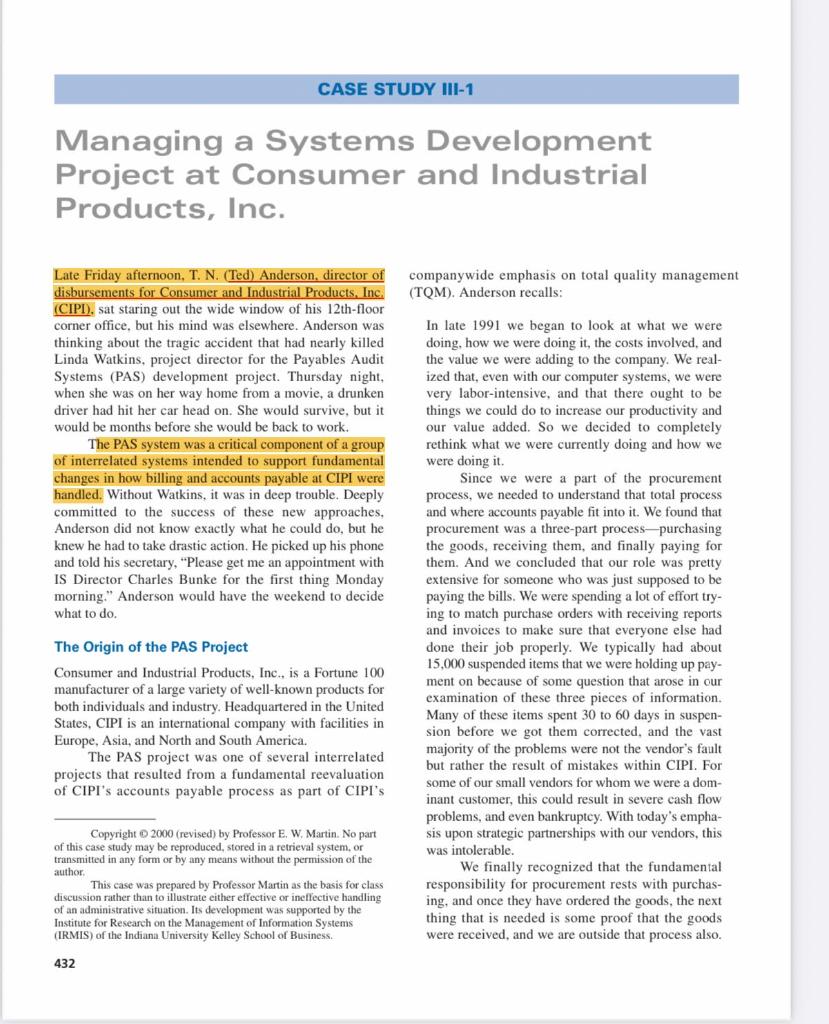
An introduction on this case study needed.
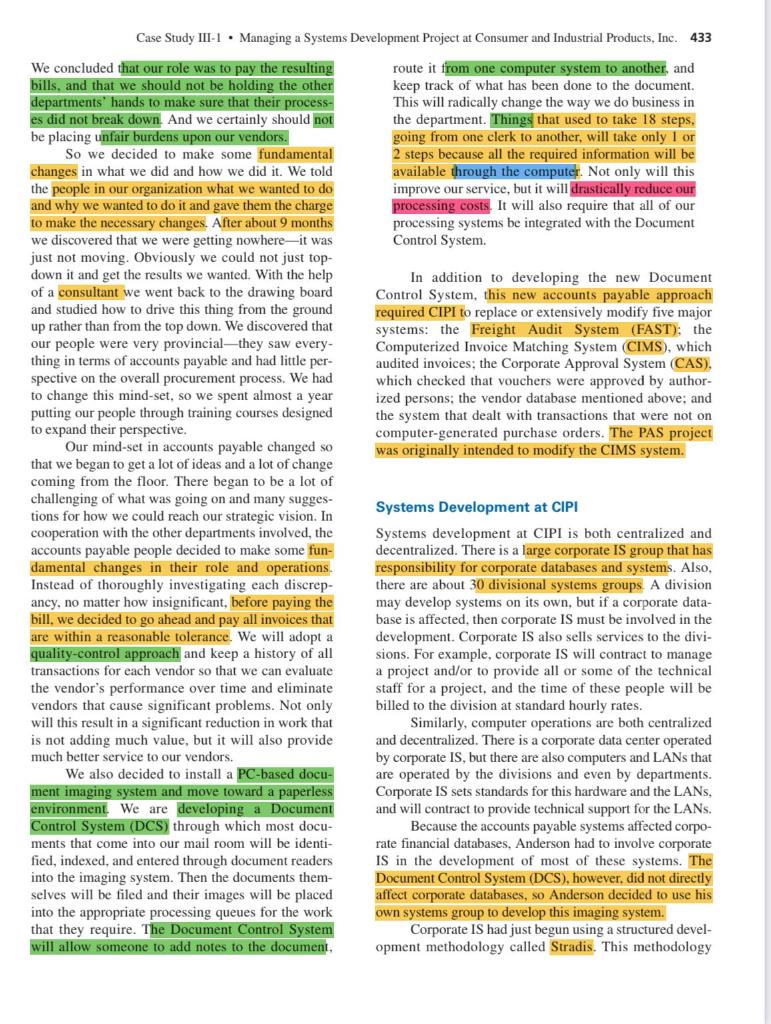
CASE STUDY III-1 Managing a Systems Development Project at Consumer and Industrial Products, Inc. companywide emphasis on total quality management (TQM). Anderson recalls: Late Friday afternoon, T. N. (Ted) Anderson, director of disbursements for Consumer and Industrial Products, Inc. (CIPI), sat staring out the wide window of his 12th-floor corner office, but his mind was elsewhere. Anderson was thinking about the tragic accident that had nearly killed Linda Watkins, project director for the Payables Audit Systems (PAS) development project. Thursday night, when she was on her way home from a movie, a drunken driver had hit her car head on. She would survive, but it would be months before she would be back to work. The PAS system was a critical component of a group of interrelated intended to fundamental changes in how billing and accounts payable at CIPI were handled Without Watkins, it was in deep trouble. Deeply committed to the success of these new approaches, Anderson did not know exactly what he could do, but he knew he had to take drastic action. He picked up his phone and told his secretary, "Please get me an appointment with IS Director Charles Bunke for the first thing Monday morning." Anderson would have the weekend to decide what to do. In late 1991 we began to look at what we were doing, how we were doing it, the costs involved, and the value we were adding to the company. We real- ized that, even with our computer systems, we were very labor-intensive, and that there ought to be things we could do to increase our productivity and our value added. So we decided to completely rethink what we were currently doing and how we were doing it. Since we were a part of the procurement process, we needed to understand that total process and where accounts payable fit into it. We found that procurement was a three-part process-purchasing the goods, receiving them, and finally paying for them. And we concluded that our role was pretty extensive for someone who was just supposed to be paying the bills. We were spending a lot of effort try- ing to match purchase orders with receiving reports and invoices to make sure that everyone else had done their job properly. We typically had about 15,000 suspended items that we were holding up pay- ment on because of some question that arose in our examination of these three pieces of information. Many of these items spent 30 to 60 days in suspen- sion before we got them corrected, and the vast majority of the problems were not the vendor's fault but rather the result of mistakes within CIPI. For some of our small vendors for whom we were a dom- inant customer, this could result in severe cash flow problems, and even bankruptcy. With today's empha- sis upon strategic partnerships with our vendors, this was intolerable. We finally recognized that the fundamental responsibility for procurement rests with purchas- ing, and once they have ordered the goods, the next thing that is needed is some proof that the goods were received, and we are outside that process also. The Origin of the PAS Project Consumer and Industrial Products, Inc. is a Fortune 100 manufacturer of a large variety of well-known products for both individuals and industry. Headquartered in the United States, CIPI is an international company with facilities in Europe, Asia, and North and South America. The PAS project was one of several interrelated projects that resulted from a fundamental reevaluation of CIPI's accounts payable process as part of CIPI's Copyright 2000 (revised) by Professor E. W. Martin. No part of this case study may be reproduced, stored in a retrieval system, or transmitted in any form or by any means without the permission of the author. This case was prepared by Professor Martin as the basis for class discussion rather than to illustrate either effective or ineffective handling of an administrative situation. Its development was supported by the Institute for Research on the Management of Information Systems (IRMIS) of the Indiana University Kelley School of Business. 432 Case Study III-I Managing a Systems Development Project at Consumer and Industrial Products, Inc. 433 We concluded that our role was to pay the resulting route it from one computer system to another, and bills, and that we should not be holding the other keep track of what has been done to the document, departments' hands to make sure that their process- This will radically change the way we do business in es did not break down. And we certainly should not the department. Things that used to take 18 steps. be placing unfair burdens upon our vendors. going from one clerk to another, will take only I or So we decided to make some fundamental 2 steps because all the required information will be changes in what we did and how we did it. We told available through the computer. Not only will this the people in our organization what we wanted to do improve our service, but it will drastically reduce our and why we wanted to do it and gave them the charge processing costs. It will also require that all of our to make the necessary changes. After about 9 months processing systems be integrated with the Document we discovered that we were getting nowhere it was Control System. just not moving. Obviously we could not just top- down it and get the results we wanted. With the help In addition to developing the new Document of a consultant we went back to the drawing board Control System, this new accounts payable approach and studied how to drive this thing from the ground required CIPI to replace or extensively modify five major up rather than from the top down. We discovered that systems: the Freight Audit System (FAST): the our people were very provincial--they saw every- Computerized Invoice Matching System (CIMS), which thing in terms of accounts payable and had little per- audited invoices; the Corporate Approval System CAS), spective on the overall procurement process. We had which checked that vouchers were approved by author- to change this mind-set, so we spent almost a year ized persons, the vendor database mentioned above; and putting our people through training courses designed the system that dealt with transactions that were not on to expand their perspective. computer-generated purchase orders. The PAS project Our mind-set in accounts payable changed so was originally intended to modify the CIMS system. that we began to get a lot of ideas and a lot of change coming from the floor. There began to be a lot of challenging of what was going on and many sugges- tions for how we could reach our strategic vision. In Systems Development at CIPI cooperation with the other departments involved, the Systems development at CIPI is both centralized and accounts payable people decided to make some fun- decentralized. There is a large corporate IS group that has damental changes in their role and operations responsibility for corporate databases and systems. Also, Instead of thoroughly investigating each discrep- there are about 30 divisional systems groups. A division ancy, no matter how insignificant, before paying the may develop systems on its own, but if a corporate data- bill, we decided to go ahead and pay all invoices that base is affected, then corporate IS must be involved in the are within a reasonable tolerance. We will adopt a development Corporate IS also sells services to the divi- quality-control approach and keep a history of all sions. For example, corporate IS will contract to manage transactions for each vendor so that we can evaluate a project and/or to provide all or some of the technical the vendor's performance over time and eliminate staff for a project, and the time of these people will be vendors that cause significant problems. Not only billed to the division at standard hourly rates. will this result in a significant reduction in work that Similarly, computer operations are both centralized is not adding much value, but it will also provide and decentralized. There is a corporate data center operated much better service to our vendors. by corporate IS, but there are also computers and LANs that We also decided to install a PC-based docu- are operated by the divisions and even by departments. ment imaging system and move toward a paperless Corporate IS sets standards for this hardware and the LANs, environment. We are developing a Document and will contract to provide technical support for the LANs. Control System (DCS) through which most docu- Because the accounts payable systems affected corpo- ments that come into our mail room will be identi- rate financial databases, Anderson had to involve corporate fied, indexed, and entered through document readers IS in the development of most of these systems. The into the imaging system. Then the documents them- Document Control System (DCS), however, did not directly selves will be filed and their images will be placed affect corporate databases, so Anderson decided to use his into the appropriate processing queues for the work own systems group to develop this imaging system. that they require. The Document Control System Corporate IS had just begun using a structured devel- will allow someone to add notes to the document, opment methodology called Stradis. This methodologyStep by Step Solution
There are 3 Steps involved in it
1 Expert Approved Answer
Step: 1 Unlock

Question Has Been Solved by an Expert!
Get step-by-step solutions from verified subject matter experts
Step: 2 Unlock
Step: 3 Unlock
 Study Help