







Question: An analyst considers a linear relationship Yi = 0 + 1Xi + ui , and assumes E[ui | X] = 0. Suppose that (Yi ,
An analyst considers a linear relationship Yi = 0 + 1Xi + ui , and assumes E[ui | X] = 0. Suppose that (Yi , Xi) have a joint distribution with the following properties: E[Y | X = 0] = 2, E[Y | X = 2] = 3. In other words, conditional on X = 0, the mean of Y is 1, and conditional on X = 2, the mean of Y is 3. i. Suppose the analyst has a sample of independent and identically distributed observations of the pair (Yi , Xi). The analyst regresses Yi on Xi and obtains the OLS slope coefficient, 1. (Yi is the regressand, and Xi is the regressor.) Using the information above, what do you think 1 should be close to if the sample size is very large?
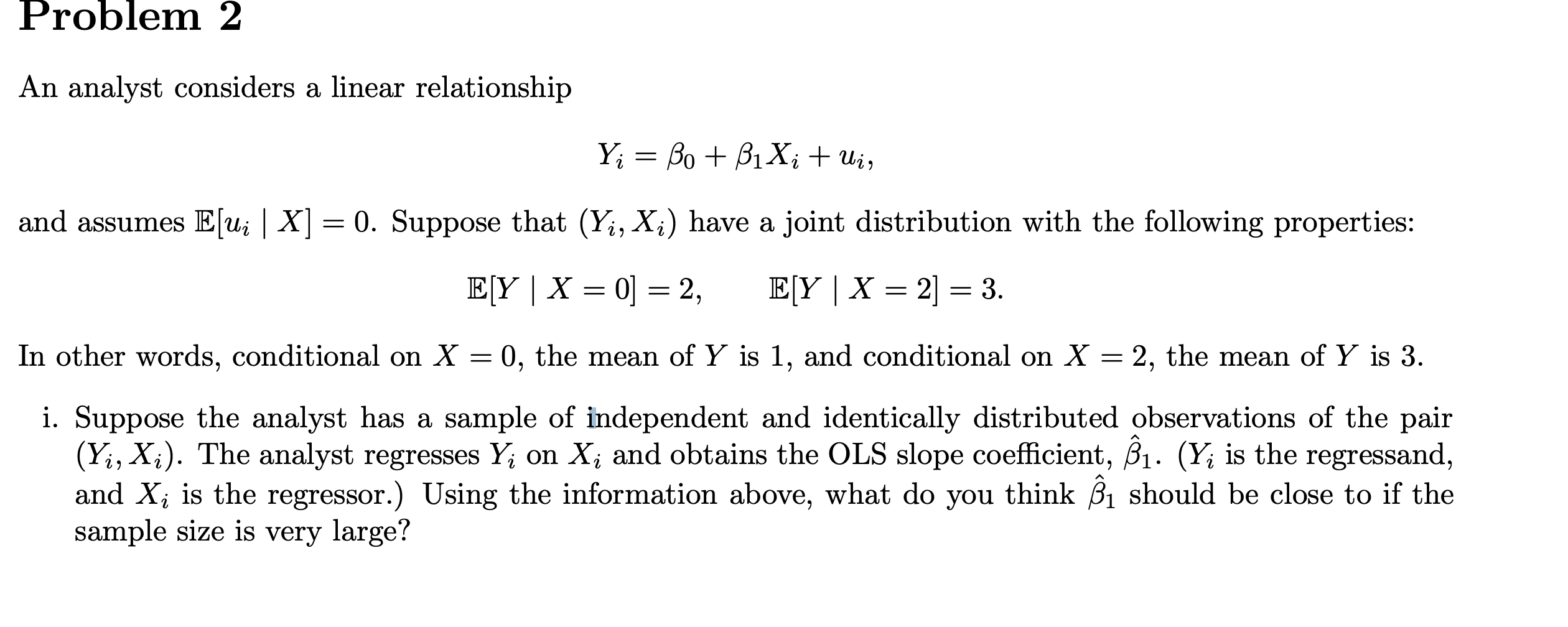
Problem 2 An analyst considers a linear relationship Yi = Bo + BIXit Wi, and assumes Elui | X] = 0. Suppose that (Yi, Xi) have a joint distribution with the following properties: EY | X = 0] = 2, E[Y [ X = 2] = 3. In other words, conditional on X = 0, the mean of Y is 1, and conditional on X = 2, the mean of Y is 3. i. Suppose the analyst has a sample of independent and identically distributed observations of the pair (Yi, Xi). The analyst regresses Y; on Xi and obtains the OLS slope coefficient, B1. (Y; is the regressand, and Xi is the regressor.) Using the information above, what do you think B1 should be close to if the sample size is very large
Step by Step Solution
There are 3 Steps involved in it

Get step-by-step solutions from verified subject matter experts
 Study Help