







Question: An auto maker is interested in information about how long transmissions last. A sample of transmissions are run constantly and the number of miles before
An auto maker is interested in information about how long transmissions last. A sample of transmissions are run constantly and the number of miles before the transmission fails is recorded. The auto maker claims that the transmissions can run constantly for over 150,000 miles before failure. The results of the sample are given below. Miles (1000s of miles)Mean. 151.2Variance. 17.22Observations. 44Hypothesized Mean. 150df. 43t Stat. 1.889P(T 150,000What is the alternative hypothesis Ha? (choose 1)u 150,000Should Ho be rejected or does Ho fail to be rejected? (choose 1)Fail to reject HoReject HoWhat conclusion can be drawn from the data? (choose 1)*evidence does not exist to conclude that the mean life of a transmission is over 150,000 miles*evidence exists to conclude that the mean life of a transmission is over 150,000 milesWhat is the 95% confidence interval for the mean life of a transmission? [_______, ________]Does the confidence interval support the results of the hypothesis test? (choose 1) YesNoWhy? (choose 1)*hypothesized Mean falls outside the bounds of the confidence interval *hypothesized Mean falls within the bounds of the confidence interval
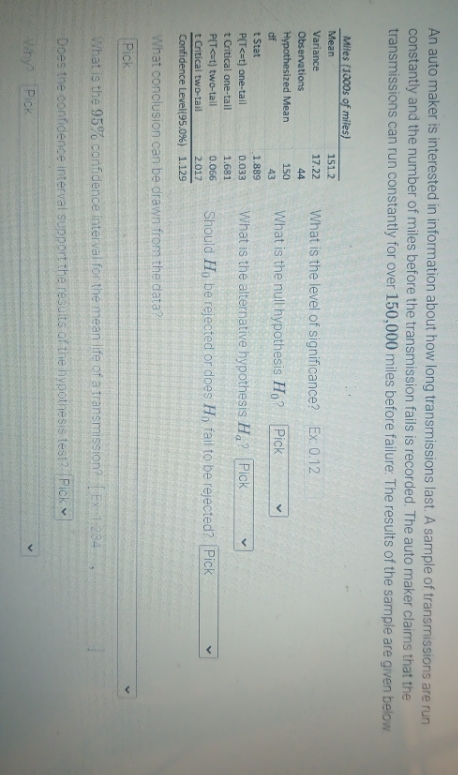
An auto maker is interested in information about how long transmissions last, A sample of transmissions are run constantly and the number of miles before the transmission fails is recorded. The auto maker claims that the transmissions can run constantly for over 150,000 miles before failure: The results of the sample are given below Miles (1000s of miles) Mean 1512 Variance 17.22 What is the level of significance? Ex: 0.12 Observations 44 Hypothesized Mean 150 What is the null hypothesis Ho? Pick t Stat 1.889 P(T
Step by Step Solution
There are 3 Steps involved in it

Get step-by-step solutions from verified subject matter experts
 Study Help