







Question: An electronics manufacturer uses interconnection wire which has a nominal strength of 11 grams (i.e., it takes an average pull force of 11 grams
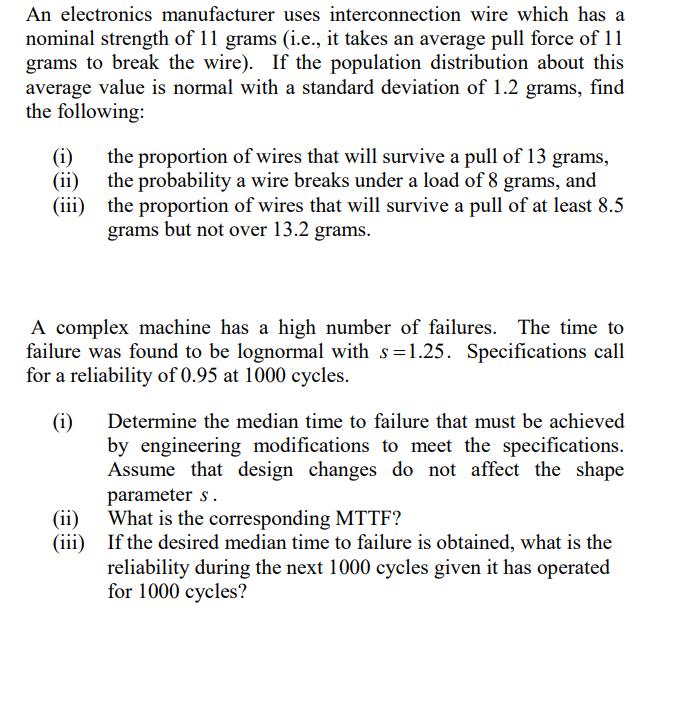
An electronics manufacturer uses interconnection wire which has a nominal strength of 11 grams (i.e., it takes an average pull force of 11 grams to break the wire). If the population distribution about this average value is normal with a standard deviation of 1.2 grams, find the following: (i) (ii) (iii) the proportion of wires that will survive a pull of 13 grams, the probability a wire breaks under a load of 8 grams, and the proportion of wires that will survive a pull of at least 8.5 grams but not over 13.2 grams. A complex machine has a high number of failures. The time to failure was found to be lognormal with s=1.25. Specifications call for a reliability of 0.95 at 1000 cycles. (i) (ii) (iii) Determine the median time to failure that must be achieved by engineering modifications to meet the specifications. Assume that design changes do not affect the shape parameter s. What is the corresponding MTTF? If the desired median time to failure is obtained, what is the reliability during the next 1000 cycles given it has operated for 1000 cycles?
Step by Step Solution
3.43 Rating (166 Votes )
There are 3 Steps involved in it
For the first part of the question Let X be the strength of the interconnection wire Then X N11 122 i To find the proportion of wires that will survive a pull of 13 grams we need to find PX 13 Using s... View full answer

Get step-by-step solutions from verified subject matter experts
 Study Help