







Question: An electronics manufacturing process has historically had a mean completion time of 65 minutes. It is claimed that, due to improvements in the process, the
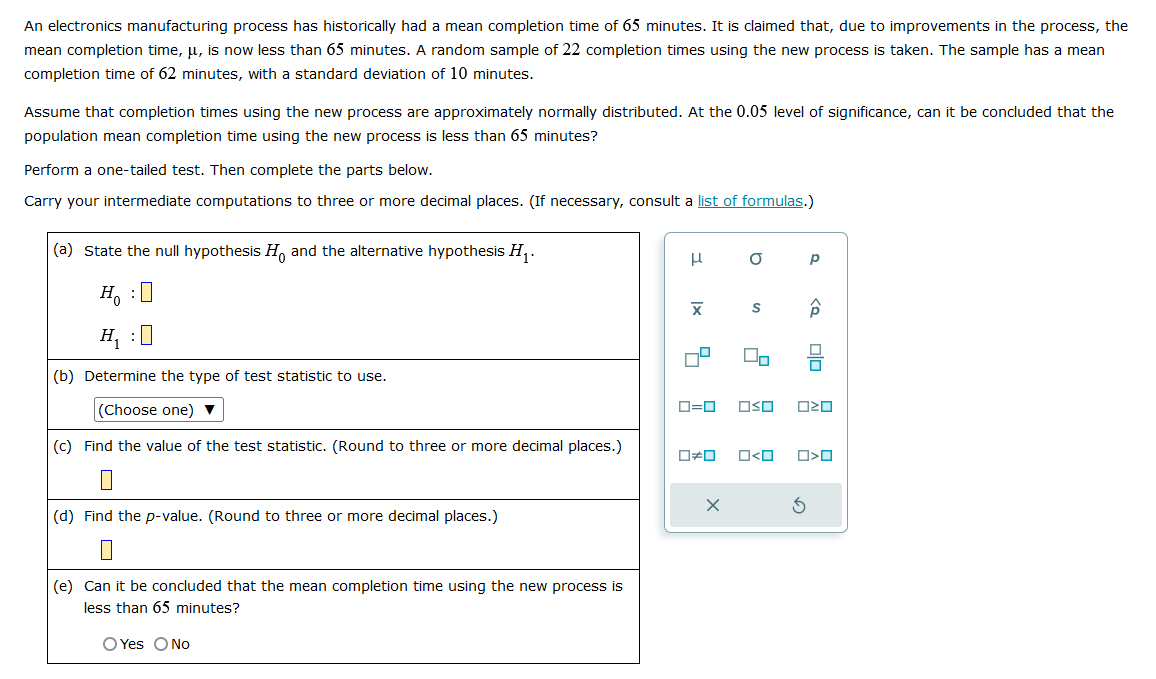
An electronics manufacturing process has historically had a mean completion time of 65 minutes. It is claimed that, due to improvements in the process, the mean completion time, p, is now less than 65 minutes. A random sample of 22 completion times using the new process is taken. The sample has a mean completion time of 62 minutes, with a standard deviation of 10 minutes. Assume that completion times using the new process are approximately normally distributed. At the 0.05 level of significance, can it be concluded that the population mean completion time using the new process is less than 65 minutes? Perform a onetailed test. Then complete the parts below. Carry your intermediate computations to three or more decimal places. (If necessary, consult a list of fomJlas.) (a) State the null hypothesis H0 and the alternative hypothesis H1. l-L C5 .0 H : O Y S 3 H1 (b) Determine the type of test statistic to use. |(Choose one) Y I = 5 3 (c) Find the value of the test statistic. (Round to three or more decimal places.) # . . x 53 (d) Find the pvalue. (Round to three or more decimal places.) (e) Can it be concluded that the mean completion time using the new process is less than 65 minutes? OYes ONo
Step by Step Solution
There are 3 Steps involved in it

Get step-by-step solutions from verified subject matter experts
 Study Help