







Question: An engineer decides to set up a solar pond, which stores thermal energy by making a high salinity layer at the bottom of the pond
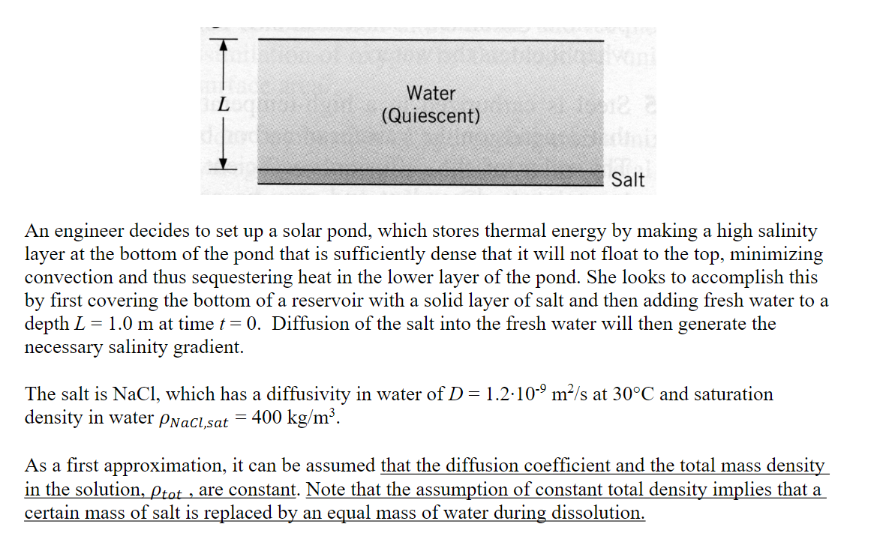
An engineer decides to set up a solar pond, which stores thermal energy by making a high salinity
layer at the bottom of the pond that is sufficiently dense that it will not float to the top, minimizing
convection and thus sequestering heat in the lower layer of the pond. She looks to accomplish this
by first covering the bottom of a reservoir with a solid layer of salt and then adding fresh water to a
depth at time Diffusion of the salt into the fresh water will then generate the
necessary salinity gradient.
The salt is NaCl, which has a diffusivity in water of at and saturation
density in water
As a first approximation, it can be assumed that the diffusion coefficient and the total mass density
in the solution, are constant. Note that the assumption of constant total density implies that a
certain mass of salt is replaced by an equal mass of water during dissolution.
C According to laboratory experiments, the solar pond will start working once the salt
concentration at cm from the bottom reaches of saturation. How long will it take
before the pond is operational?
D If the density of salt is DNaCl kgm calculate by how much the thickness of the salt
layer at the bottom has changed when the pond becomes operational
Step by Step Solution
There are 3 Steps involved in it
1 Expert Approved Answer
Step: 1 Unlock

Question Has Been Solved by an Expert!
Get step-by-step solutions from verified subject matter experts
Step: 2 Unlock
Step: 3 Unlock
 Study Help