







Question: An engineer wants to know if producing metal bars using a new experimental treatment rather than the conventional treatment makes a difference in the tensile
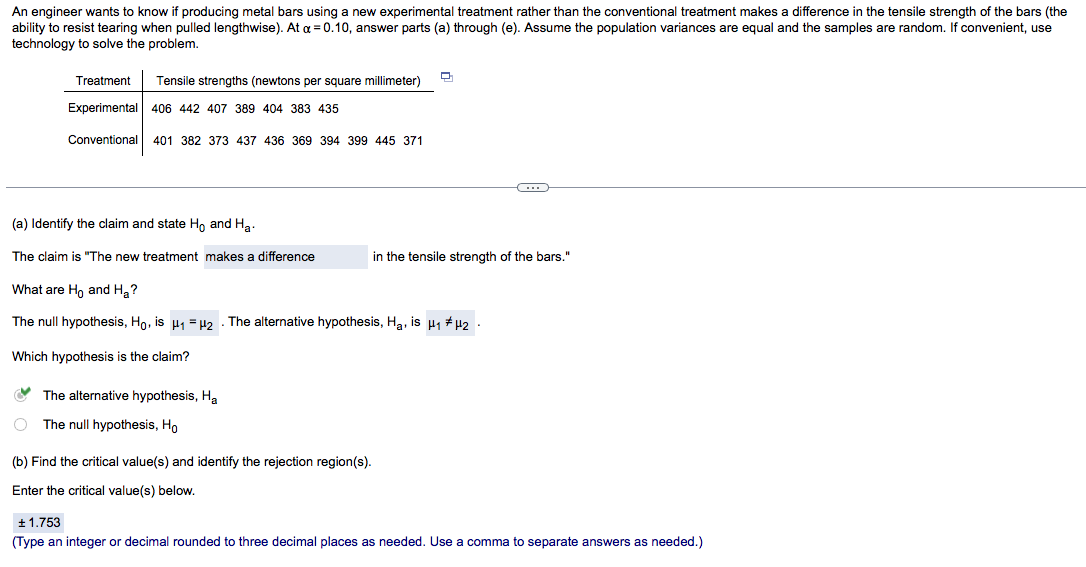
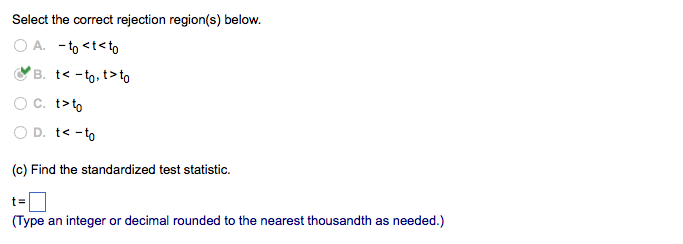
An engineer wants to know if producing metal bars using a new experimental treatment rather than the conventional treatment makes a difference in the tensile strength of the bars (the ability to resist tearing when pulled lengthwise). At a = 0.10, answer parts (a) through (e). Assume the population variances are equal and the samples are random. If convenient, use technology to solve the problem. Treatment Tensile strengths (newtons per square millimeter) Experimental 406 442 407 389 404 383 435 Conventional | 401 382 373 437 436 369 394 399 445 371 (a) Identify the claim and state Ho and Ha. The claim is "The new treatment makes a difference in the tensile strength of the bars." What are Ho and Ha? The null hypothesis, Ho, is #1 = 12 . The alternative hypothesis, Ha, is My # H2 . Which hypothesis is the claim? The alternative hypothesis, Ha O The null hypothesis, Ho (b) Find the critical value(s) and identify the rejection region(s). Enter the critical value(s) below. + 1.753 (Type an integer or decimal rounded to three decimal places as needed. Use a comma to separate answers as needed.)Select the correct rejection region(s) below. O A. - to
Step by Step Solution
There are 3 Steps involved in it

Get step-by-step solutions from verified subject matter experts
 Study Help