



Question: An experiment on memory was performed, in which 16 subjects were randomly assigned to one of two groups, called Sentences or Intentional. Each subject
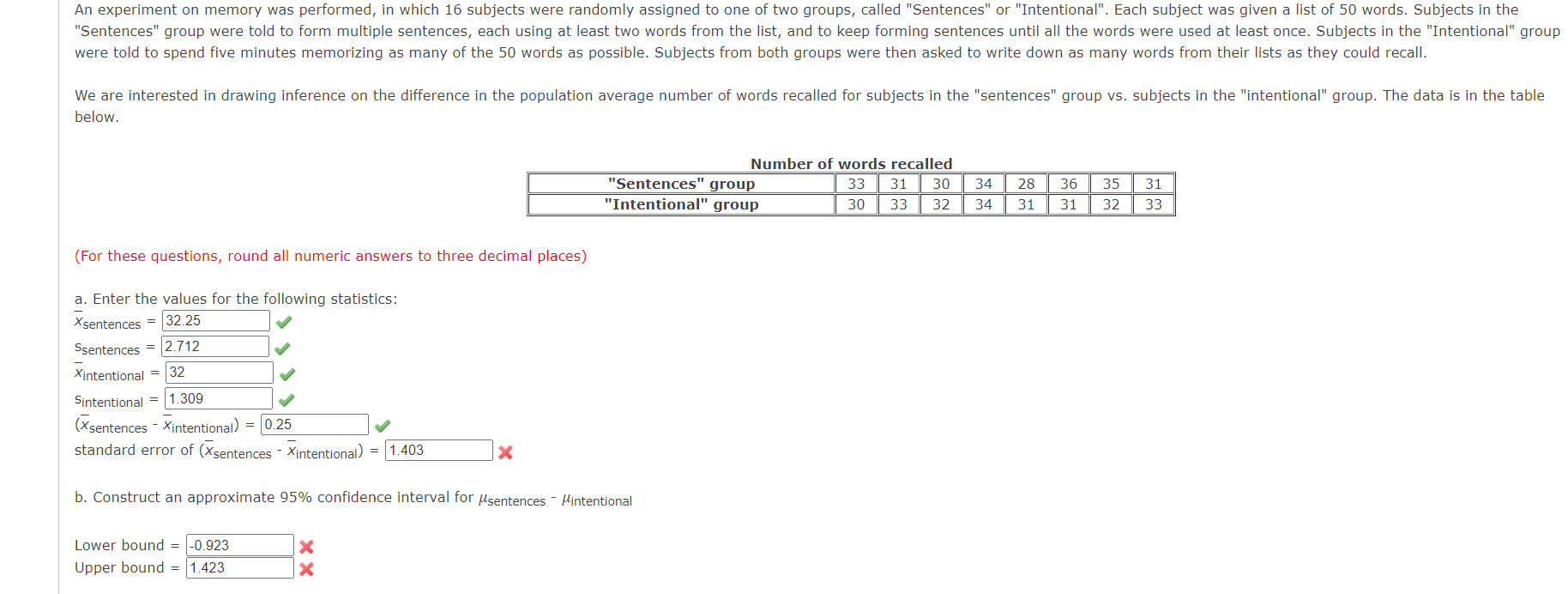
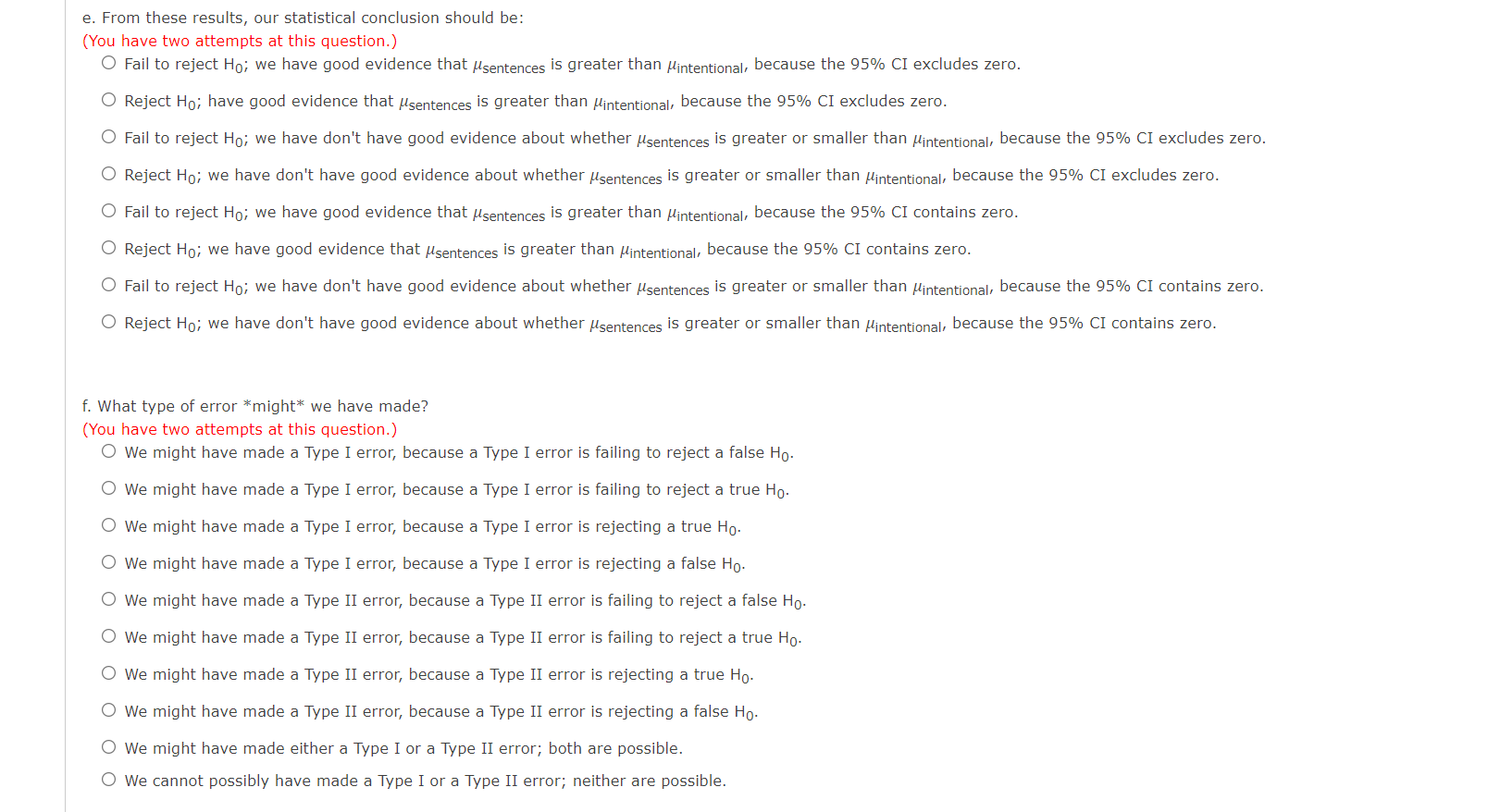
An experiment on memory was performed, in which 16 subjects were randomly assigned to one of two groups, called "Sentences" or "Intentional". Each subject was given a list of 50 words. Subjects in the "Sentences" group were told to form multiple sentences, each using at least two words from the list, and to keep forming sentences until all the words were used at least once. Subjects in the "Intentional" group were told to spend five minutes memorizing as many of the 50 words as possible. Subjects from both groups were then asked to write down as many words from their lists as they could recall. We are interested in drawing inference on the difference in the population average number of words recalled for subjects in the "sentences" group vs. subjects in the "intentional" group. The data is in the table below. (For these questions, round all numeric answers to three decimal places) a. Enter the values for the following statistics: Xsentences = 32.25 Ssentences = 2.712 Xintentional = 32 Sintentional = 1.309 (Xsentences - Xintentional) = 0.25 standard error of (Xsentences - Xintentional) = 1.403 Lower bound = -0.923 Upper bound = b. Construct an approximate 95% confidence interval for sentences Mintentional = 1.423 X X Number of words recalled 33 31 30 30 33 32 "Sentences" group "Intentional" group 34 28 36 35 31 34 31 31 32 33 e. From these results, our statistical conclusion should be: (You have two attempts at this question.) O Fail to reject Ho; we have good evidence that sentences is greater than Mintentional, because the 95% CI excludes zero. O Reject Ho; have good evidence that sentences is greater than intentional, because the 95% CI excludes zero. O Fail to reject Ho; we have don't have good evidence about whether sentences is greater or smaller than intentional, because the 95% CI excludes zero. O Reject Ho; we have don't have good evidence about whether Usentences is greater or smaller than intentional, because the 95% CI excludes zero. O Fail to reject Ho; we have good evidence that sentences is greater than intentional, because the 95% CI contains zero. O Reject Ho; we have good evidence that sentences is greater than intentional, because the 95% CI contains zero. O Fail to reject Ho; we have don't have good evidence about whether sentences is greater or smaller than intentional, because the 95% CI contains zero. O Reject Ho; we have don't have good evidence about whether Usentences is greater or smaller than intentional, because the 95% CI contains zero. f. What type of error *might* we have made? (You have two attempts at this question.) O We might have made a Type I error, because a Type I error is failing to reject a false Ho. O We might have made a Type I error, because a Type I error is failing to reject a true Ho. O We might have made a Type I error, because a Type I error is rejecting a true Ho. O we might have made a Type I error, because a Type I error is rejecting a false Ho. O We might have made a Type II error, because a Type II error is failing to reject a false Ho. O We might have made a Type II error, because a Type II error is failing to reject a true Ho. O We might have made a Type II error, because a Type II error is rejecting a true Ho. O We might have made a Type II error, because a Type II error is rejecting a false Ho. O we might have made either a Type I or a Type II error; both are possible. O We cannot possibly have made a Type I or a Type II error; neither are possible.
Step by Step Solution
3.45 Rating (155 Votes )
There are 3 Steps involved in it
The detailed answer for the above question is provided below a Enter the values for the following st... View full answer

Get step-by-step solutions from verified subject matter experts