







Question: An ideal inductor has a zero resistance. However, almost all practical inductors have non-zero resistance. Therefore, we use the quality factor, Q, to characterize
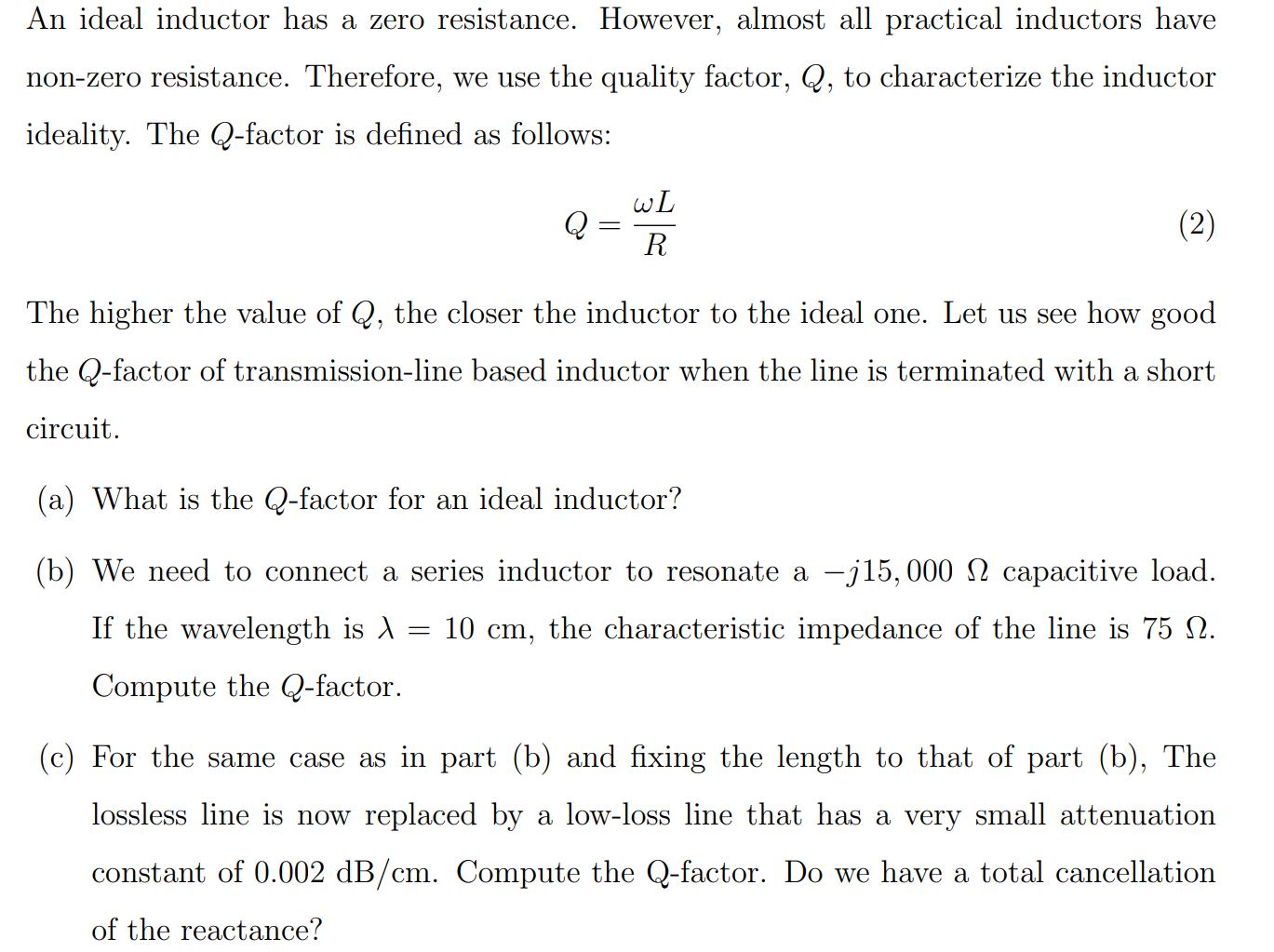
An ideal inductor has a zero resistance. However, almost all practical inductors have non-zero resistance. Therefore, we use the quality factor, Q, to characterize the inductor ideality. The Q-factor is defined as follows: wL R (2) The higher the value of Q, the closer the inductor to the ideal one. Let us see how good the Q-factor of transmission-line based inductor when the line is terminated with a short circuit. (a) What is the Q-factor for an ideal inductor? (b) We need to connect a series inductor to resonate a j15,000 capacitive load. If the wavelength is 10 cm, the characteristic impedance of the line is 75 2. Compute the Q-factor. = a very (c) For the same case as in part (b) and fixing the length to that of part (b), The lossless is now replaced by a low-loss lin that hall attenuation constant of 0.002 dB/cm. Compute the Q-factor. Do we have a total cancellation of the reactance?
Step by Step Solution
There are 3 Steps involved in it

Get step-by-step solutions from verified subject matter experts
 Study Help