







Question: An important contribution to arise from the kernel viewpoint has been the extension to inputs that are symbolic, rather than simply vectors of real numbers.
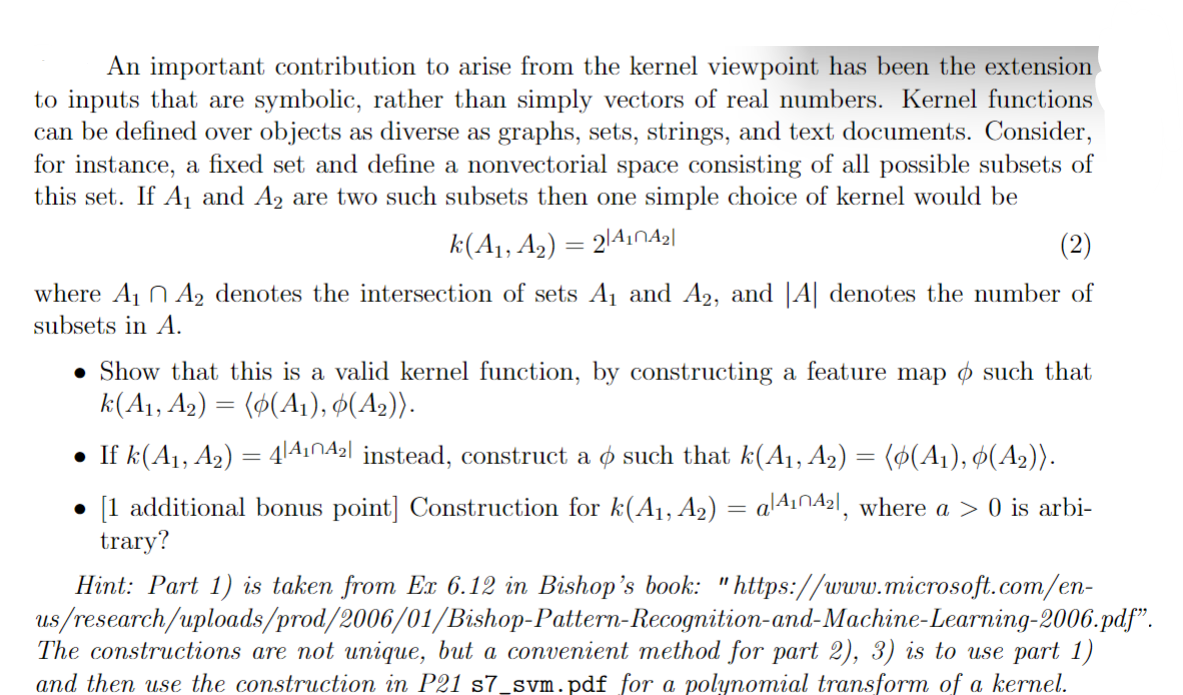
An important contribution to arise from the kernel viewpoint has been the extension to inputs that are symbolic, rather than simply vectors of real numbers. Kernel functions can be defined over objects as diverse as graphs, sets, strings, and text documents. Consider, for instance, a fixed set and define a nonvectorial space consisting of all possible subsets of this set. If A1 and A2 are two such subsets then one simple choice of kernel would be k(A1,A2)=2A1A2 where A1A2 denotes the intersection of sets A1 and A2, and A denotes the number of subsets in A. - Show that this is a valid kernel function, by constructing a feature map such that k(A1,A2)=(A1),(A2) - If k(A1,A2)=4A1A2 instead, construct a such that k(A1,A2)=(A1),(A2). - [1 additional bonus point] Construction for k(A1,A2)=aA1A2, where a>0 is arbitrary? Hint: Part 1) is taken from Ex 6.12 in Bishop's book: "https://www.microsoft.com/enus/research/uploads/prod/2006/01/Bishop-Pattern-Recognition-and-Machine-Learning-2006.pdj The constructions are not unique, but a convenient method for part 2), 3) is to use part 1) and then use the construction in P21 s7_svm.pdf for a polynomial transform of a kernel
Step by Step Solution
There are 3 Steps involved in it

Get step-by-step solutions from verified subject matter experts
 Study Help