







Question: An income statement is a financial statement that shows different measurements of revenues, expenses, and profits for a firm over a specified period of time.
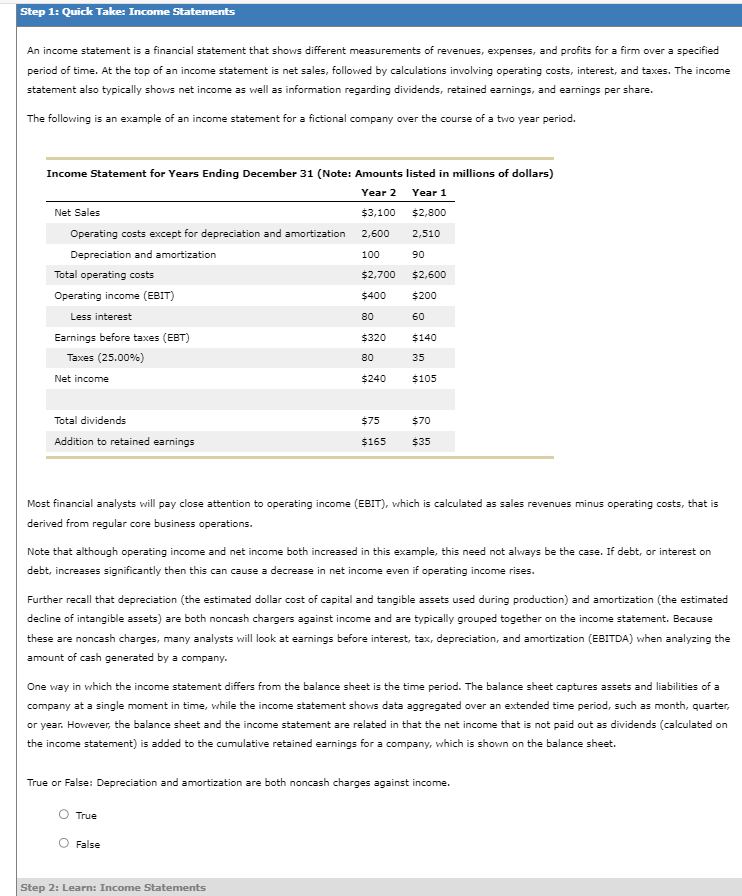
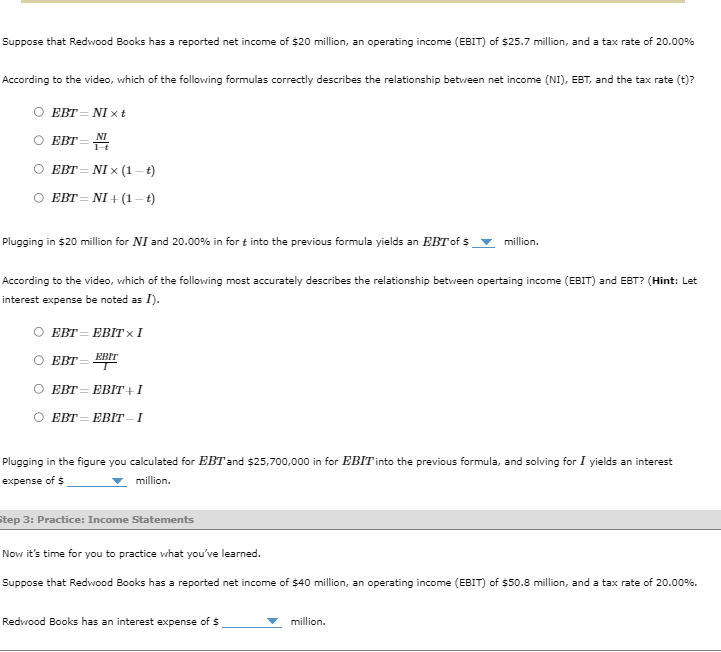
An income statement is a financial statement that shows different measurements of revenues, expenses, and profits for a firm over a specified period of time. At the top of an income statement is net sales, followed by calculations involving operating costs, interest, and taxes. The income statement also typically shows net income as well as information regarding dividends, retained earnings, and earnings per share. The following is an example of an income statement for a fictional company over the course of a two year period. Income Statement for Years Endinq December 31 (Note: Amounts listed in millions of dollars) Most financial analysts will pay close attention to operating income (EBIT), which is calculated as sales revenues minus operating costs, that is derived from regular core business operations. Note that although operating income and net income both increased in this example, this need not always be the case. If debt, or interest on debt, increases significantly then this can cause a decrease in net income even if operating income rises. Further recall that depreciation (the estimated dollar cost of capital and tangible assets used during production) and amortization (the estimated decline of intangible assets) are both noncash chargers against income and are typically grouped together on the income statement. Because these are noncash charges, many analysts will look at earnings before interest, tax, depreciation, and amortization (EBITDA) when analyzing the amount of cash generated by a company. One way in which the income statement differs from the balance sheet is the time period. The balance sheet captures assets and liabilities of a company at a single moment in time, while the income statement shows data aggregated over an extended time period, such as month, quarter, or year. However, the balance sheet and the income statement are related in that the net income that is not paid out as dividends (calculated on the income statement) is added to the cumulative retained earnings for a company, which is shown on the balance sheet. True or False: Depreciation and amortization are both noncash charges against income. True False Step 2: Learn: Income Statements Suppose that Redwood Books has a reported net income of $20 million, an operating income (EBIT) of $25.7 million, and a tax rate of 20.00% According to the video, which of the following formulas correctly describes the relationship between net income (NI), EBT, and the tax rate ( t )? EBT=NItEBT=1tNIEBT=NI(1t)EBT=NI+(1t) Plugging in $20 million for NI and 20.00% in for t into the previous formula yields an EBT of $ million. According to the video, which of the following most accurately describes the relationship between opertaing income (EBIT) and EBT? (Hint: Let interest expense be noted as I ). EBT=EBITIEBT=IEBITEBT=EBIT+IEBT=EBITI Plugging in the figure you calculated for EBT and $25,700,000 in for EBIT into the previous formula, and solving for I yields an interest expense of $ million. tep 3: Practice: Income Statements Now it's time for you to practice what you've learned. Suppose that Redwood Books has a reported net income of $40 million, an operating income (EBIT) of $50.8 million, and a tax rate of 20.00%. Redwood Books has an interest expense of $ million
Step by Step Solution
There are 3 Steps involved in it

Get step-by-step solutions from verified subject matter experts
 Study Help