







Question: An individual with a utility function u = ln w has the opportunity to in a risky asset whose final payoff is distributed as (1
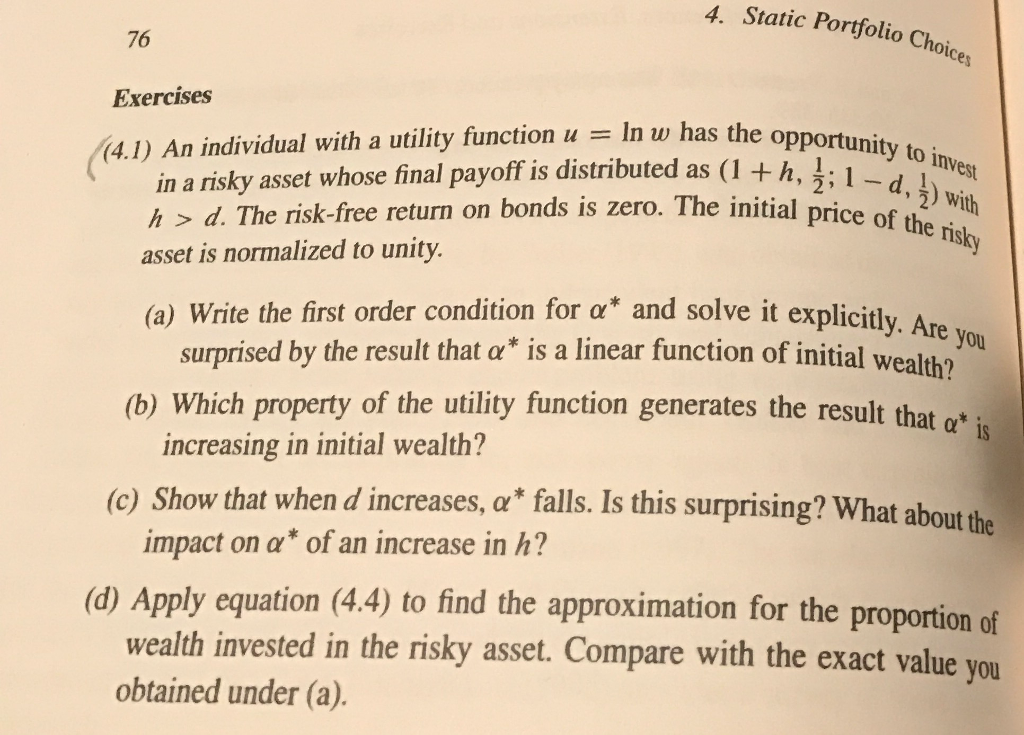
An individual with a utility function u = ln w has the opportunity to in a risky asset whose final payoff is distributed as (1 + h, 1/2; 1 - d, 1/2) invest h > d. The risk-free return on bonds is zero. The initial price of the risky asset is normalized to unity. Write the first order condition for alpha* and solve it explicitly. Are y surprised by the result that alpha* is a linear function of initial wealth? Which property of the utility function generates the result that alpha* increasing in initial wealth? Show that when d increases, alpha* falls. Is this surprising? What about the impact on alpha* of an increase in h? Apply equation (4.4) to find the approximation for the proportion of wealth invested in the risky asset. Compare with the exact value y obtained under (a)
Step by Step Solution
There are 3 Steps involved in it

Get step-by-step solutions from verified subject matter experts
 Study Help