







Question: An inexperienced data scientist models a problem as a directed graph with no self-loops, and later decides it would better be modeled as an undirected

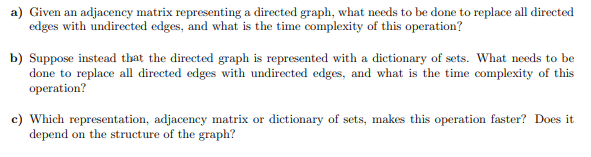
An inexperienced data scientist models a problem as a directed graph with no self-loops, and later decides it would better be modeled as an undirected graph. a) Given an adjacency matrix representing a directed graph, what needs to be done to replace all directed edges with undirected edges, and what is the time complexity of this operation? b) Suppose instead that the directed graph is represented with a dictionary of sets. What needs to be done to replace all directed edges with undirected edges, and what is the time complexity of this operation? c) Which representation, adjacency matrix or dictionary of sets, makes this operation faster? Does it depend on the structure of the graph? An inexperienced data scientist models a problem as a directed graph with no self-loops, and later decides it would better be modeled as an undirected graph. a) Given an adjacency matrix representing a directed graph, what needs to be done to replace all directed edges with undirected edges, and what is the time complexity of this operation? b) Suppose instead that the directed graph is represented with a dictionary of sets. What needs to be done to replace all directed edges with undirected edges, and what is the time complexity of this operation? c) Which representation, adjacency matrix or dictionary of sets, makes this operation faster? Does it depend on the structure of the graph
Step by Step Solution
There are 3 Steps involved in it

Get step-by-step solutions from verified subject matter experts
 Study Help