







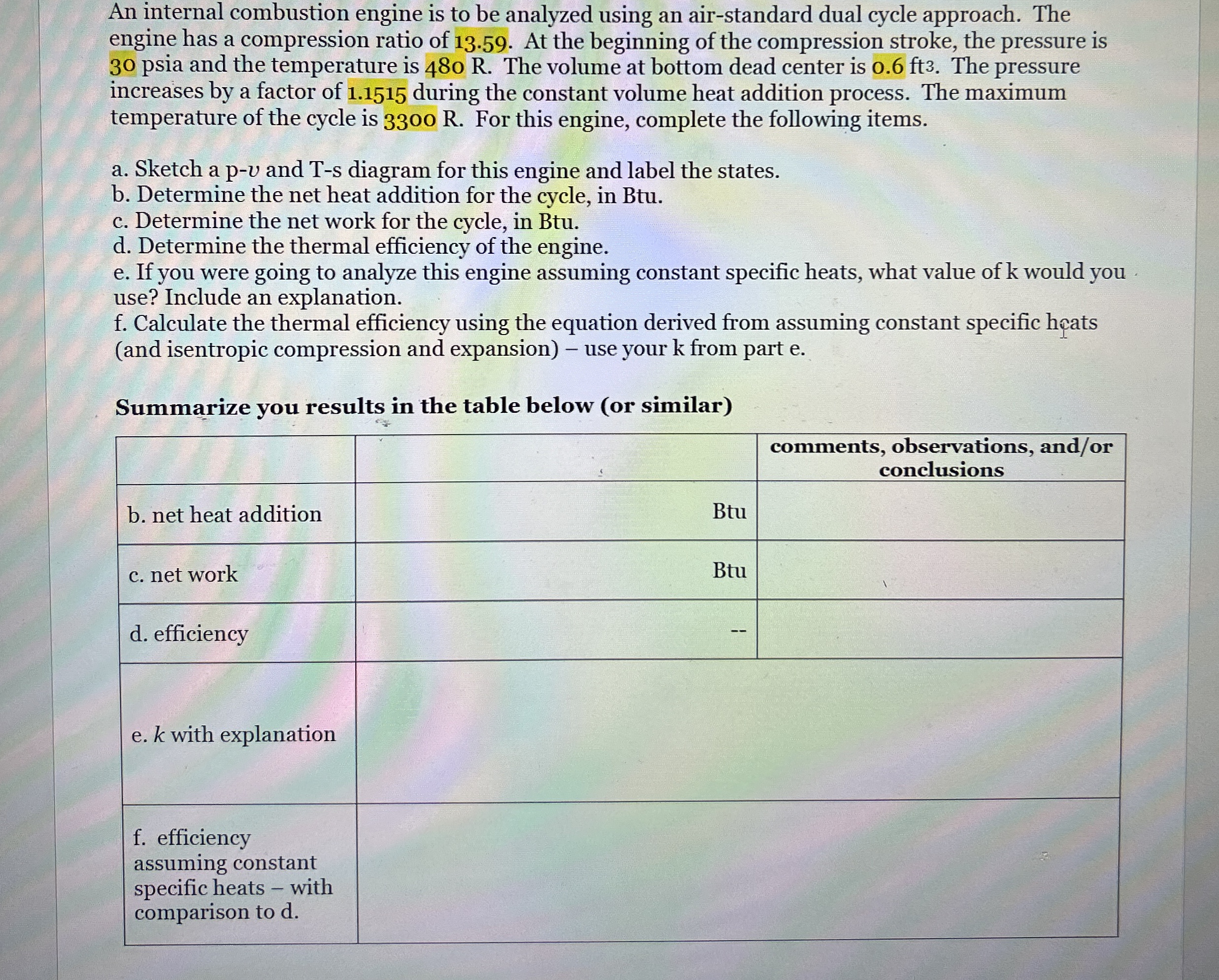
Question: An internal combustion engine is to be analyzed using an air - standard dual cycle approach. The engine has a compression ratio of 1 3
An internal combustion engine is to be analyzed using an airstandard dual cycle approach. The
engine has a compression ratio of At the beginning of the compression stroke, the pressure is
psia and the temperature is o R The volume at bottom dead center is ft The pressure
increases by a factor of during the constant volume heat addition process. The maximum
temperature of the cycle is R For this engine, complete the following items.
a Sketch a and Ts diagram for this engine and label the states.
b Determine the net heat addition for the cycle, in Btu.
c Determine the net work for the cycle, in Btu.
d Determine the thermal efficiency of the engine.
e If you were going to analyze this engine assuming constant specific heats, what value of k would you
use? Include an explanation.
f Calculate the thermal efficiency using the equation derived from assuming constant specific heats
and isentropic compression and expansion use your k from part e
Summarize you results in the table below or similarAn internal combustion engine is to be analyzed using an airstandard dual cycle approach. The
engine has a compression ratio of At the beginning of the compression stroke, the pressure is
psia and the temperature is o R The volume at bottom dead center is ft The pressure
increases by a factor of during the constant volume heat addition process. The maximum
temperature of the cycle is R For this engine, complete the following items.
a Sketch a and Ts diagram for this engine and label the states.
b Determine the net heat addition for the cycle, in Btu.
c Determine the net work for the cycle, in Btu.
d Determine the thermal efficiency of the engine.
e If you were going to analyze this engine assuming constant specific heats, what value of k would you
use? Include an explanation.
f Calculate the thermal efficiency using the equation derived from assuming constant specific heats
and isentropic compression and expansion use your k from part e
Summarize you results in the table below or similar
Step by Step Solution
There are 3 Steps involved in it
1 Expert Approved Answer
Step: 1 Unlock

Question Has Been Solved by an Expert!
Get step-by-step solutions from verified subject matter experts
Step: 2 Unlock
Step: 3 Unlock
 Study Help