







Question: An object is projected upward from ground level with an initial velocity of 4 2 0 feet per second. In this exercise, the goal is
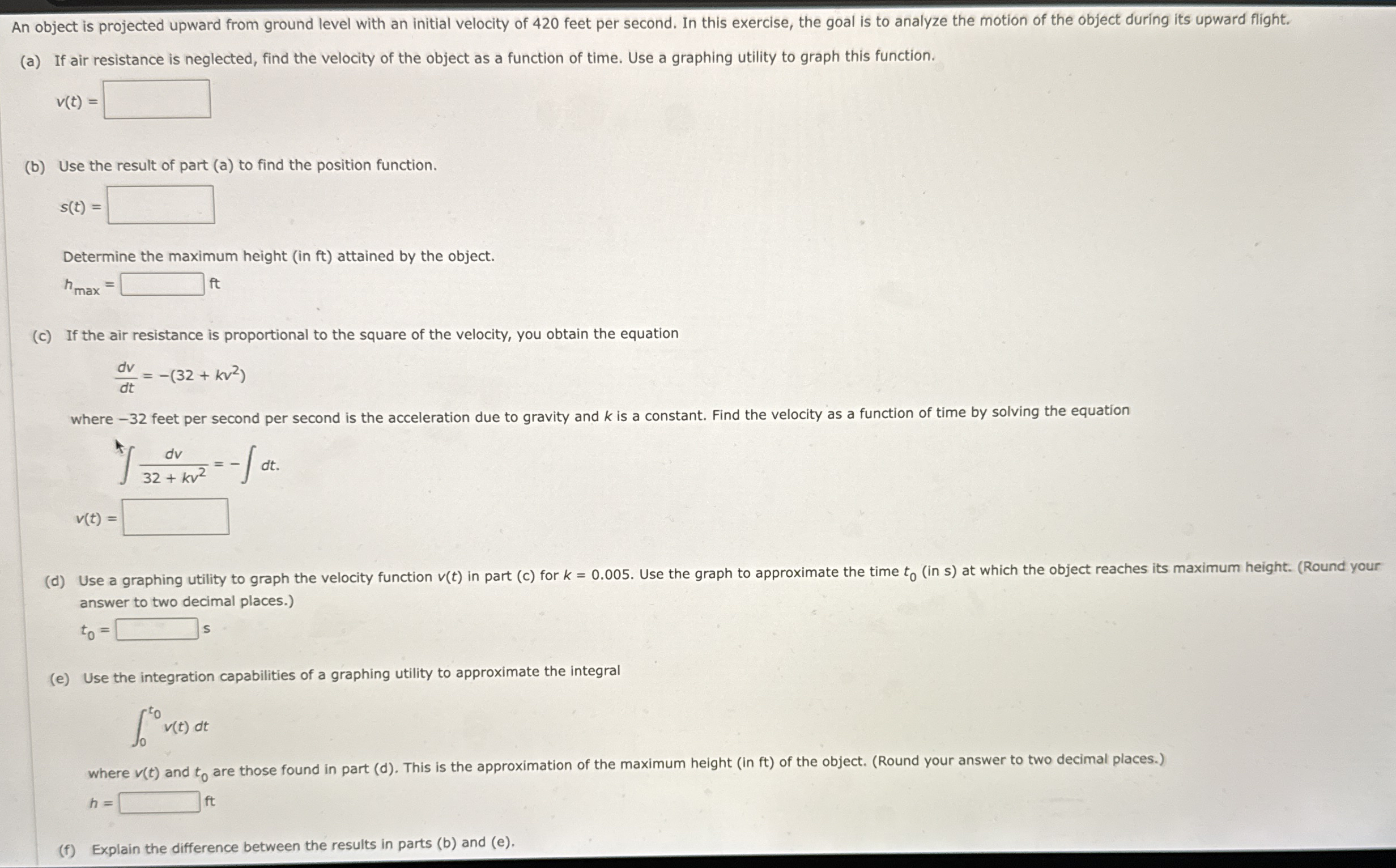
An object is projected upward from ground level with an initial velocity of feet per second. In this exercise, the goal is to analyze the motion of the object during its upward flight.
a If air resistance is neglected, find the velocity of the object as a function of time. Use a graphing utility to graph this function.
b Use the result of part a to find the position function.
Determine the maximum height in ft attained by the object.
ft
c If the air resistance is proportional to the square of the velocity, you obtain the equation
where feet per second per second is the acceleration due to gravity and is a constant. Find the velocity as a function of time by solving the equation
d Use a graphing utility to graph the velocity function in part c for Use the graph to approximate the time in at which the object reaches its maximum height. Round your answer to two decimal places.
e Use the integration capabilities of a graphing utility to approximate the integral
where and are those found in part d This is the approximation of the maximum height in ft of the object. Round your answer to two decimal places.
ft
f Explain the difference between the results in parts b and e
Step by Step Solution
There are 3 Steps involved in it
1 Expert Approved Answer
Step: 1 Unlock

Question Has Been Solved by an Expert!
Get step-by-step solutions from verified subject matter experts
Step: 2 Unlock
Step: 3 Unlock
 Study Help