







Question: an object moves along a track on a lab table, and a position versus time graph is displayed in pic 1 a. select the option
an object moves along a track on a lab table, and a position versus time graph is displayed in pic 1
a. select the option that best describes the motion of the object in pic 2
b. answer question in pic 3 (select a motion graph) from graphs in pic 4
pic 1
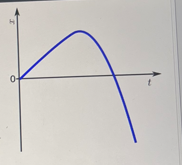
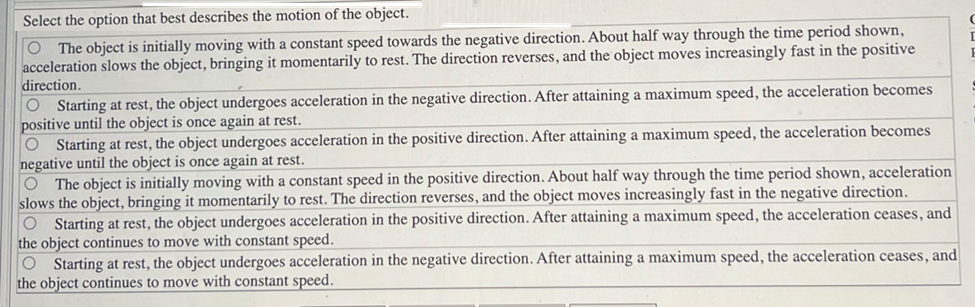
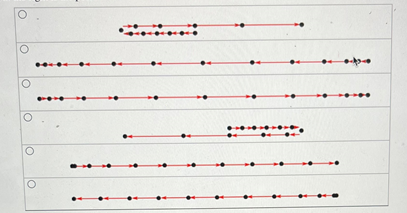

HSelect the option that best describes the motion of the object. O The object is initially moving with a constant speed towards the negative direction. About half way through the time period shown, acceleration slows the object, bringing it momentarily to rest. The direction reverses, and the object moves increasingly fast in the positive direction. Starting at rest, the object undergoes acceleration in the negative direction. After attaining a maximum speed, the acceleration becomes positive until the object is once again at rest. O Starting at rest, the object undergoes acceleration in the positive direction. After attaining a maximum speed, the acceleration becomes negative until the object is once again at rest. The object is initially moving with a constant speed in the positive direction. About half way through the time period shown, acceleration slows the object, bringing it momentarily to rest. The direction reverses, and the object moves increasingly fast in the negative direction. O Starting at rest, the object undergoes acceleration in the positive direction. After attaining a maximum speed, the acceleration ceases, and the object continues to move with constant speed. O Starting at rest, the object undergoes acceleration in the negative direction. After attaining a maximum speed, the acceleration ceases, and the object continues to move with constant speed.O O O O O OTo form a different representation of the motion, the position, at equal time intervals, is represented with black dots, and a displacement vector connects each position to the next in the sequence. Select the motion diagram that corresponds to the position versus time graph in the problem statement. Note that for these motion diagrams, to the right is the positive direction
Step by Step Solution
There are 3 Steps involved in it

Get step-by-step solutions from verified subject matter experts
 Study Help