







Question: An unknown gas ( i . e . , cannot be treated as an ideal gas ) is contained in a well - sealed piston
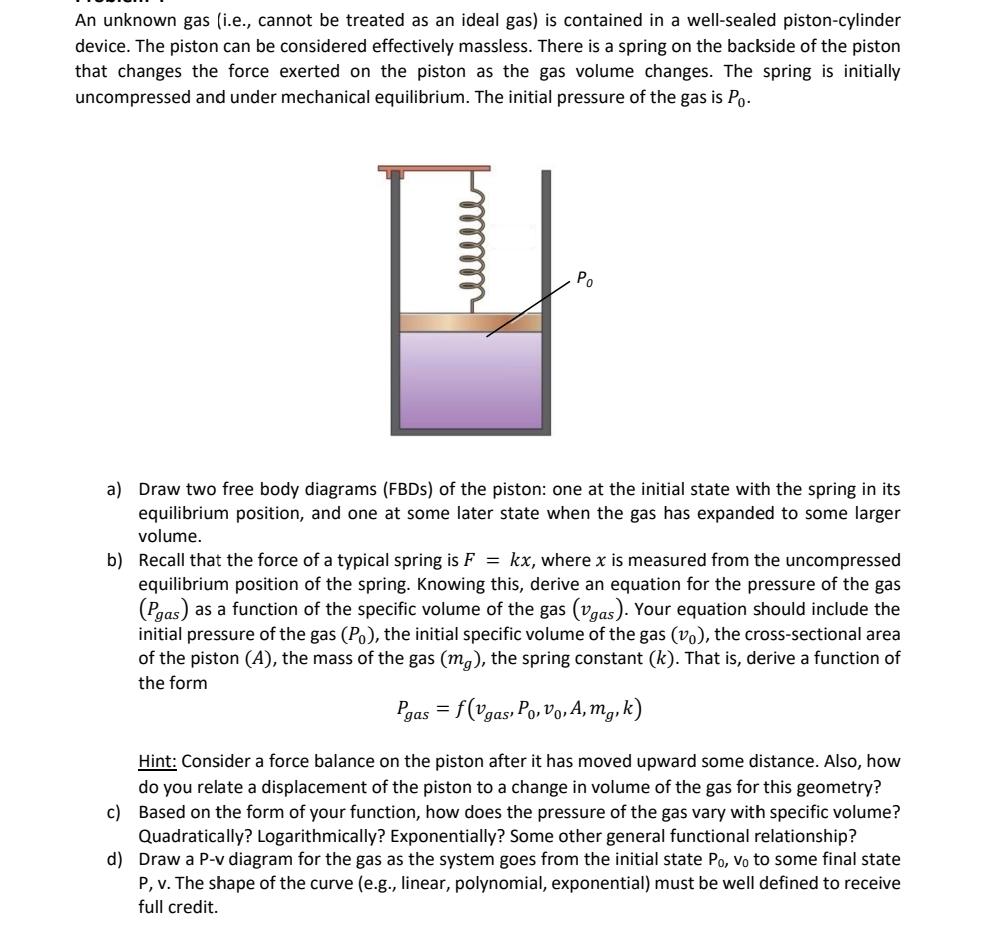
An unknown gas ie cannot be treated as an ideal gas is contained in a wellsealed pistoncylinder device. The piston can be considered effectively massless. There is a spring on the backside of the piston that changes the force exerted on the piston as the gas volume changes. The spring is initially uncompressed and under mechanical equilibrium. The initial pressure of the gas is
a Draw two free body diagrams FBDs of the piston: one at the initial state with the spring in its equilibrium position, and one at some later state when the gas has expanded to some larger volume.
b Recall that the force of a typical spring is where is measured from the uncompressed equilibrium position of the spring. Knowing this, derive an equation for the pressure of the gas as a function of the specific volume of the gas Your equation should include the initial pressure of the gas the initial specific volume of the gas the crosssectional area of the piston the mass of the gas the spring constant That is derive a function of the form
Hint: Consider a force balance on the piston after it has moved upward some distance. Also, how do you relate a displacement of the piston to a change in volume of the gas for this geometry?
c Based on the form of your function, how does the pressure of the gas vary with specific volume? Quadratically? Logarithmically? Exponentially? Some other general functional relationship?
d Draw a Pv diagram for the gas as the system goes from the initial state to some final state The shape of the curve eg linear, polynomial, exponential must be well defined to receive full credit.
Step by Step Solution
There are 3 Steps involved in it
1 Expert Approved Answer
Step: 1 Unlock

Question Has Been Solved by an Expert!
Get step-by-step solutions from verified subject matter experts
Step: 2 Unlock
Step: 3 Unlock
 Study Help