







Question: Analyse the below Redhook Ale Brewery case study using Porters Five Forces Model and PEST Analysis (Political, Economic, Social and Technological) as your guide. le
Analyse the below Redhook Ale Brewery case study using Porters Five Forces Model and PEST Analysis (Political, Economic, Social and Technological) as your guide. 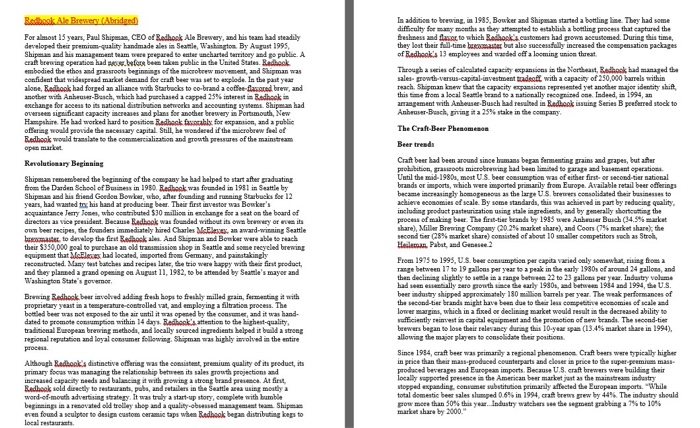
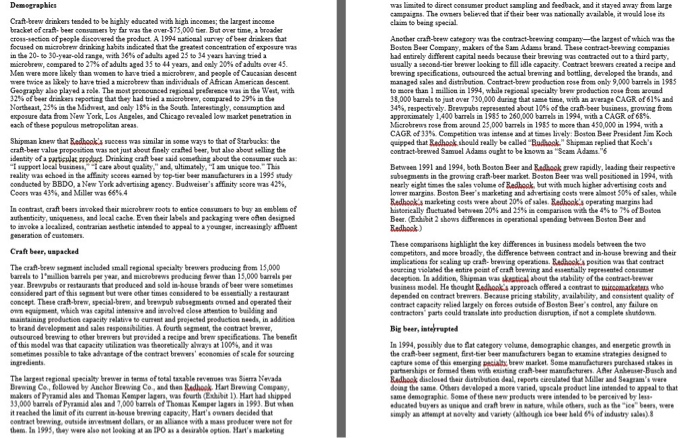
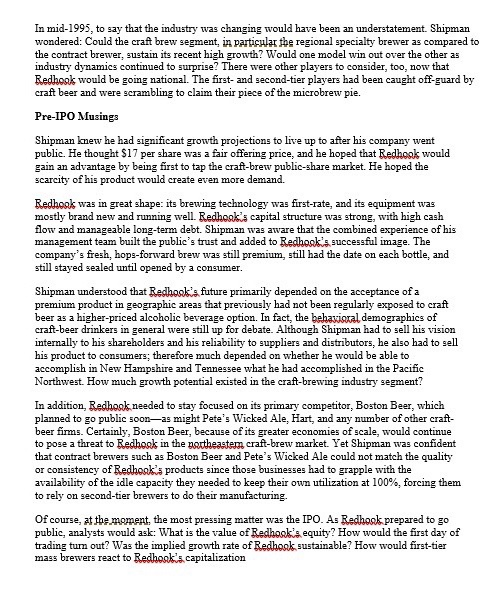
le addition to be 1985, www h a d a boring . They had some f e ed to the that captured tress which compos e d During this time they lost the fut u ta de e spaciages of Radha 13 yes wwfal t at The of calculated capacity the Northeast hackad m ed sales-powth -capital m a de with a capacity of 250,000 barels within Radesk Ale B ridad Fort 15 years CEO of Rack Ala Bwyd d ed deloped the defende Wato By A 1995 Shupenda mwepo wachty do poble. A en begeer had before be take n the United States Badet bodied the the date of microw d Shaw confident that widespread and for a www to Is the past year als, Radhocklad for an alliance with or to cebrada o d brew, and anowi Ash -Buch, which had had a capped 25% in dheeks exchange for access to its national work an g lys Ship had oversees s ticat capacity and plans for another bewery in Portmouth, New Hampshire Hehad worked hard to position Radheek by fore , and a publie offering would provide the scenary capital Sull, he wondered if the microbrew free Redheak would translate to the comma n d growth preures of the mainstream open market this from a local Serband to all reci dos desde 1994 m ement with A Buch in Rat i ng Series Baded stock to Ash -Buch gia 25 wake in the company The Craft Beer Phe Revolutionary Beginning Bertrade Craft beer had been around since been formening rains and grapes, but after prohibition, r oots microbrewing had been to garage basement operations Until the mid-1980s, most US wo mption was of either fint or second tiernational brands er imports, which were imported primarily from Europe. Available retail beer offerings became increasingly homogeneous the large US considered the basieses to achieve economies of sale by some standards, this was ved in part by reducing quality including product pasteurisation using Wale ingredient, and by really shortcutting the process of making beer. The first ter brand by 1935 were Anber Busch (34.5% wakat share), Miller Brewing Company (20.2% market share and Coon (7% market share the second tier (28% market share) consisted of about 10 maller competitors och as Strol, Halaman Pabut, and Genesee 2 Shipas e mbered the beginning of the company and helped to start after graduating from the Darden School of Business in 1980 Badhank was founded in 1981 in Seattle by Shipeta and his friend Goeden Bowker, who, afar founding and maing Starbucks for 12 years, had wanted to his hand at producing beer. Their first investor was Bowker's acquaintance Jerry Jones, who contributed 330 million in exchange for at on the board of directors as vice president. Because Badhook was founded without its own brewery or events own beer recipes, the founders immediately bird Charles M. an award-winning Seattle to develop the first Badhock ales And Shipman and Bonker were able to reach their $350,000 peal to perchase and transmission shop in Seattle and some recycled brewing equipment that Elevhad located mported from Germany, and painstakingly reconstructed. Many test batches and recipes de trio were happy with the first product, and they planned a grand opening on August 11, 1982, to be attended by Seattle's mayor and Washington State's over Brewing Redhock beer volved bruse hope to rely milled grain, fer tig it with proprietary yeast in a temperature-controlled and employing a filtration process. The bodied beer wat exposed to the wil d by the c a nd it was hand- dated to promote s within 14 . Raksts to the highest-quality traditional European bring thed, and locally sw ingredients helped it build a strong reparation and al l ow highly evolved in the entire From 1975 to 1993, U S. be comunica per capita wiadomly somewhat rising from a se between 17 to 19 alles per year to speak in the early 1980s of around 24 pallons, and then decling slightly to end in a range between 22 to 23 gallons per year Industry volume had se a lly prowth ace the early 1980s, and between 1994 and 1994, the US beer industry shipped approximately 180 million barrels per year. The weak performances of the second-torbrands might have been due to the less competitive economies of scale and lowe gins, which is a fired or decl a re would result in the decreased ability to ficiently revestis capital and the sofaw brands. The second- bewers began to lose the relevancy during this 10 years (13.4% market share in 1994). allowing the players to com p osition Since 1954, the wa y areal af beers were typically be produced beverages and importe US. we were building the AMhough edhe distinctive w a y of its product, relationalista salar - and city widow e d As Rebecka sedang medya wondo haw a pe with me bei d old to show Shie stopped and w total domestic beer sales med 0.6% powo 50 ye wyw by 2000 a teroppse 1994, pe by 44% The industry should a bing at 10% locales Demographics Craft brew drinkers tended to be highly educated with high incomes the largest income bracket of crabeer consumers by far was the over-$75,000 tier. But over time, a broader cross-section of people discovered the product. A 1994 national survey ofbeer drikes that focused on microbrew drinking habits indicated that the greatest concentration of exposure mas in the 20- 30-year-old range with 36% of adults aged 25 to 34 years having tranda mierobrew, compared to 27% of adults aged 35 to 44 years, and only 20% of adults over 45. Mes were more likely than women to have tried a microbrew, and people of Caucasian descent wese twice as likely to have tried a microbrew than individuals of African American descent Geography also played a role. The most pronounced regional preference was in the West, with 32% of beer drakes reporting that they had tried a mierobrew, compared to 29% in the Northeast, 25% in the Midwest, and only 18% in the South Interestingly, consumption and exposure data from New York, Los Angeles, and Chicago revealed low market penetration in was limited to direct consumer product sampling and feedback, and it stayed away from large campain. The owners believed that if their beer was nationally available, it would lose its els to being special Another craf-brew category was the contract- wise companythe largest of which was the Boston Beer Company, makers of the Sam Adams brand. The contract-bouwing companies had entirely different capital needs because their brewing was contracted out to a third party. usually a second-tier brewer looking to fill idle capacity. Contract bewers created a recipe and brewing specifications, outsourced the actual brewing and bottling, developed the brands, and managed sales and distribution Contract-brew production rose from only 9,000 barrels in 1993 to more than 1 million in 1994, while regional specialty brew production for free a nd 38,000 barrels to just over 730,000 during that same time, with an average CAGR of 61% and 34%, respectively, Brewpubs represented about 10% of the craft beer business, growing from approximately 1,400 barrels in 1985 to 260,000 barrels in 1994, with a CAGR of 68% Microbreny rose from around 25,000 barrels 1995 to more than 450.000 in 1994, with a CAGR of 33%. Competition was intense and time lively Boston Bee President Jim Koch quipped that Redhock should really be called "Bucheck Ship replied that Koch's contract brewed Samuel Adams ught to be known as "Scam Adams." each other toplogs mesopolitan area Shirl ewat Badsokis success was similar in some ways to that of Starbucks the craf-bees value proposition was not just about finely crafted beer, but also about selling the identity of a partial product Drinking craft beer said something about the consumersuch "I support local business, care about quality, and, ultimately, "I am un tee." Thes reality was echoed is the affity score earned by top-tierber manufactures in a 1995 study conducted by BBDO, a New York advertising agency. Budweiser's affinity score was 42% Coors was 439, and Miller was 66% 4 Between 1991 and 1994, both Buton Beer and Radhook pre rapidly, leading their respective Subsements in the growing craft beer market. Boston Beer as well positioned in 1994, with Dearly eight times the sales volume of Radhook, but with much higher advertising costs and lones marins Boston Bear's marketing and adhertising costs were almost 50% of sales, while Redhoek's marketing costs were about 20% of sales Radhock's operating margins had historically fluctuated between 20% and 25% in comparison with the 4 to 7% of Boston Beer Exhibit 2 shows differences in operational spending between Boston Beer and Redback) In contrast, craft beers invoked their microbrew roots to entice consumers to buy an emblem of authenticity, uniqueness, and local cache. Even the labels and packaging were often designed tovoke a localized, contra esthetic intended to appeal to a you , reasingly af ! peneration of customers Craft beer, unpacked The craft-brew set included small regional specialty brewers producing from 15.000 barrels to 1 million barrels per year, and microbrews producing fewer than 15,000 barrels per wear Brewtabs or restaurants that produced and soldbouse brands of beer were sometimes considered part of this se t but were other times considered to be essentially a restaurant concept. These craft-brew, special brew, and brewpub subsegments onned and operated their own grapment, which was capital intensive and evolved close attention to building and maintaining production capacity relative to current and projected peoduction needs, in addition to brand development and sales responsibilities. A fourth segment, the contract brener tsourced brew to other broers bet provided a recipe and brew specification. The benefit of this model was that capacity utilisation was theoretically always at 100%, and it was sometimes possible to take advantage of the contract brewers' economies of scale for sourcing ingredients These comparison highlight the key differences in business models between the two competitors and moce broadly, the difference between contract and in-hoose bewing and their implications for scaling pa reming operations. Bedek a potom was that contract Boeing solated the entire point of crabrewing and really represented con deception. In addition, Shipman was suptial about the stability of the contract-brewer business model. He thought Redhook's approach offered a contrast to tireomarkers who depended on contract brewers. Because pricing stability, availability, and consistent quality of contract capacity relied largely on forces outside of Boston Bear's control any failure contractors parts could translate into production disruption, if not a complete shutdown Big beer, interrupted The largest regional specialty brewer in terms of total taxable revenge wa Serra Nevada Brewing Co., followed by Anchor Brewing Co., and the Redhook, Hart Brewing Company makers of Pyramidales and Thomas Kemper layers, was fourth chil) Hart had shipped 33,000 barrels of Pyramidal and 7,000 barrels of Thomas Kemper lagers in 1993. But when it reached the limit of its re bouse brewing capacity, Hart's own decided that contract brewing outside ime dollars, or an alliance with a mass producer were not for them. In 1995, they were also not looking at IPO sa deale option Hart's marketing In 1994, possibly due to flat category volume, demographie changes, and energetic growth is the crabeer ment, firstberber manufacturers began to mine strategies designed to captures of this emerging patialty brew marketSom ma ture purchased stakes in partships or formed them with a beer manufacturers Afer Anboter-Busch and Redboek dielowed their distribution deal reports eireulated that Mulder and Seagram's were doing the same. Other developed a more varied, upscale product line intended to appeal to that same demographie. Some of these w products were intended to be perceived by lens educated buyers a unique and craft brew in nature, while others, vuch as the icebers, we simply as atemptat novelty and variety (although iceber bald 6% of industry sales).8 In mid-1995, to say that the industry was changing would have been an understatement. Shipman wondered: Could the craft brew segment, in particular the regional specialty brewer as compared to the contract brewer, sustain its recent high growth? Would one model win out over the other as industry dynamics continued to surprise? There were other players to consider, too, now that Redhook would be going national. The first- and second-tier players had been caught off guard by craft beer and were scrambling to claim their piece of the microbrew pie. Pre-IPO Musings Shipman knew he had significant growth projections to live up to after his company went public. He thought $17 per share was a fair offering price, and he hoped that Bedhoek would gain an advantage by being first to tap the craft-brew public-share market. He hoped the scarcity of his product would create even more demand. Redhonk was in great shape: its brewing technology was first-rate, and its equipment was mostly brand new and running well. Redheak's capital structure was strong, with high cash flow and manageable long-term debt. Shipman was aware that the combined experience of his management team built the public's trust and added to Redheak's successful image. The company's fresh, hops-forward brew was still premium, still had the date on each bottle, and still stayed sealed until opened by a consumer. and added to Redbook's succbined experience of his hops-forward brew w Shipman understood that Redhoek's future primarily depended on the acceptance of a premium product in geographic areas that previously had not been regularly exposed to craft beer as a higher-priced alcoholic beverage option. In fact, the behavioral demographics of craft-beer drinkers in general were still up for debate. Although Shipman had to sell his vision internally to his shareholders and his reliability to suppliers and distributors, he also had to sell his product to consumers, therefore much depended on whether he would be able to accomplish in New Hampshire and Tennessee what he had accomplished in the Pacific Northwest. How much growth potential existed in the craft-brewing industry segment? In addition, Redhock needed to stay focused on its primary competitor, Boston Beer, which planned to go public soon as might Pete's Wicked Ale, Hart, and any number of other craft- beer firms. Certainly, Boston Beer, because of its greater economies of scale, would continue to pose a threat to Redheak in the northeastern craft-brew market. Yet Shipman was confident that contract brewers such as Boston Beer and Pete's Wicked Ale could not match the quality or consistency of Redheaks products since those businesses had to grapple with the availability of the idle capacity they needed to keep their own utilization at 100%, forcing them to rely on second-tier brewers to do their manufacturing Of course, at the moment, the most pressing matter was the IPO. As Redhook prepared to go public, analysts would ask: What is the value of Redhoek's equity? How would the first day of trading turn out? Was the implied growth rate of Redhook sustainable? How would first-tier mass brewers react to Redhook's capitalization le addition to be 1985, www h a d a boring . They had some f e ed to the that captured tress which compos e d During this time they lost the fut u ta de e spaciages of Radha 13 yes wwfal t at The of calculated capacity the Northeast hackad m ed sales-powth -capital m a de with a capacity of 250,000 barels within Radesk Ale B ridad Fort 15 years CEO of Rack Ala Bwyd d ed deloped the defende Wato By A 1995 Shupenda mwepo wachty do poble. A en begeer had before be take n the United States Badet bodied the the date of microw d Shaw confident that widespread and for a www to Is the past year als, Radhocklad for an alliance with or to cebrada o d brew, and anowi Ash -Buch, which had had a capped 25% in dheeks exchange for access to its national work an g lys Ship had oversees s ticat capacity and plans for another bewery in Portmouth, New Hampshire Hehad worked hard to position Radheek by fore , and a publie offering would provide the scenary capital Sull, he wondered if the microbrew free Redheak would translate to the comma n d growth preures of the mainstream open market this from a local Serband to all reci dos desde 1994 m ement with A Buch in Rat i ng Series Baded stock to Ash -Buch gia 25 wake in the company The Craft Beer Phe Revolutionary Beginning Bertrade Craft beer had been around since been formening rains and grapes, but after prohibition, r oots microbrewing had been to garage basement operations Until the mid-1980s, most US wo mption was of either fint or second tiernational brands er imports, which were imported primarily from Europe. Available retail beer offerings became increasingly homogeneous the large US considered the basieses to achieve economies of sale by some standards, this was ved in part by reducing quality including product pasteurisation using Wale ingredient, and by really shortcutting the process of making beer. The first ter brand by 1935 were Anber Busch (34.5% wakat share), Miller Brewing Company (20.2% market share and Coon (7% market share the second tier (28% market share) consisted of about 10 maller competitors och as Strol, Halaman Pabut, and Genesee 2 Shipas e mbered the beginning of the company and helped to start after graduating from the Darden School of Business in 1980 Badhank was founded in 1981 in Seattle by Shipeta and his friend Goeden Bowker, who, afar founding and maing Starbucks for 12 years, had wanted to his hand at producing beer. Their first investor was Bowker's acquaintance Jerry Jones, who contributed 330 million in exchange for at on the board of directors as vice president. Because Badhook was founded without its own brewery or events own beer recipes, the founders immediately bird Charles M. an award-winning Seattle to develop the first Badhock ales And Shipman and Bonker were able to reach their $350,000 peal to perchase and transmission shop in Seattle and some recycled brewing equipment that Elevhad located mported from Germany, and painstakingly reconstructed. Many test batches and recipes de trio were happy with the first product, and they planned a grand opening on August 11, 1982, to be attended by Seattle's mayor and Washington State's over Brewing Redhock beer volved bruse hope to rely milled grain, fer tig it with proprietary yeast in a temperature-controlled and employing a filtration process. The bodied beer wat exposed to the wil d by the c a nd it was hand- dated to promote s within 14 . Raksts to the highest-quality traditional European bring thed, and locally sw ingredients helped it build a strong reparation and al l ow highly evolved in the entire From 1975 to 1993, U S. be comunica per capita wiadomly somewhat rising from a se between 17 to 19 alles per year to speak in the early 1980s of around 24 pallons, and then decling slightly to end in a range between 22 to 23 gallons per year Industry volume had se a lly prowth ace the early 1980s, and between 1994 and 1994, the US beer industry shipped approximately 180 million barrels per year. The weak performances of the second-torbrands might have been due to the less competitive economies of scale and lowe gins, which is a fired or decl a re would result in the decreased ability to ficiently revestis capital and the sofaw brands. The second- bewers began to lose the relevancy during this 10 years (13.4% market share in 1994). allowing the players to com p osition Since 1954, the wa y areal af beers were typically be produced beverages and importe US. we were building the AMhough edhe distinctive w a y of its product, relationalista salar - and city widow e d As Rebecka sedang medya wondo haw a pe with me bei d old to show Shie stopped and w total domestic beer sales med 0.6% powo 50 ye wyw by 2000 a teroppse 1994, pe by 44% The industry should a bing at 10% locales Demographics Craft brew drinkers tended to be highly educated with high incomes the largest income bracket of crabeer consumers by far was the over-$75,000 tier. But over time, a broader cross-section of people discovered the product. A 1994 national survey ofbeer drikes that focused on microbrew drinking habits indicated that the greatest concentration of exposure mas in the 20- 30-year-old range with 36% of adults aged 25 to 34 years having tranda mierobrew, compared to 27% of adults aged 35 to 44 years, and only 20% of adults over 45. Mes were more likely than women to have tried a microbrew, and people of Caucasian descent wese twice as likely to have tried a microbrew than individuals of African American descent Geography also played a role. The most pronounced regional preference was in the West, with 32% of beer drakes reporting that they had tried a mierobrew, compared to 29% in the Northeast, 25% in the Midwest, and only 18% in the South Interestingly, consumption and exposure data from New York, Los Angeles, and Chicago revealed low market penetration in was limited to direct consumer product sampling and feedback, and it stayed away from large campain. The owners believed that if their beer was nationally available, it would lose its els to being special Another craf-brew category was the contract- wise companythe largest of which was the Boston Beer Company, makers of the Sam Adams brand. The contract-bouwing companies had entirely different capital needs because their brewing was contracted out to a third party. usually a second-tier brewer looking to fill idle capacity. Contract bewers created a recipe and brewing specifications, outsourced the actual brewing and bottling, developed the brands, and managed sales and distribution Contract-brew production rose from only 9,000 barrels in 1993 to more than 1 million in 1994, while regional specialty brew production for free a nd 38,000 barrels to just over 730,000 during that same time, with an average CAGR of 61% and 34%, respectively, Brewpubs represented about 10% of the craft beer business, growing from approximately 1,400 barrels in 1985 to 260,000 barrels in 1994, with a CAGR of 68% Microbreny rose from around 25,000 barrels 1995 to more than 450.000 in 1994, with a CAGR of 33%. Competition was intense and time lively Boston Bee President Jim Koch quipped that Redhock should really be called "Bucheck Ship replied that Koch's contract brewed Samuel Adams ught to be known as "Scam Adams." each other toplogs mesopolitan area Shirl ewat Badsokis success was similar in some ways to that of Starbucks the craf-bees value proposition was not just about finely crafted beer, but also about selling the identity of a partial product Drinking craft beer said something about the consumersuch "I support local business, care about quality, and, ultimately, "I am un tee." Thes reality was echoed is the affity score earned by top-tierber manufactures in a 1995 study conducted by BBDO, a New York advertising agency. Budweiser's affinity score was 42% Coors was 439, and Miller was 66% 4 Between 1991 and 1994, both Buton Beer and Radhook pre rapidly, leading their respective Subsements in the growing craft beer market. Boston Beer as well positioned in 1994, with Dearly eight times the sales volume of Radhook, but with much higher advertising costs and lones marins Boston Bear's marketing and adhertising costs were almost 50% of sales, while Redhoek's marketing costs were about 20% of sales Radhock's operating margins had historically fluctuated between 20% and 25% in comparison with the 4 to 7% of Boston Beer Exhibit 2 shows differences in operational spending between Boston Beer and Redback) In contrast, craft beers invoked their microbrew roots to entice consumers to buy an emblem of authenticity, uniqueness, and local cache. Even the labels and packaging were often designed tovoke a localized, contra esthetic intended to appeal to a you , reasingly af ! peneration of customers Craft beer, unpacked The craft-brew set included small regional specialty brewers producing from 15.000 barrels to 1 million barrels per year, and microbrews producing fewer than 15,000 barrels per wear Brewtabs or restaurants that produced and soldbouse brands of beer were sometimes considered part of this se t but were other times considered to be essentially a restaurant concept. These craft-brew, special brew, and brewpub subsegments onned and operated their own grapment, which was capital intensive and evolved close attention to building and maintaining production capacity relative to current and projected peoduction needs, in addition to brand development and sales responsibilities. A fourth segment, the contract brener tsourced brew to other broers bet provided a recipe and brew specification. The benefit of this model was that capacity utilisation was theoretically always at 100%, and it was sometimes possible to take advantage of the contract brewers' economies of scale for sourcing ingredients These comparison highlight the key differences in business models between the two competitors and moce broadly, the difference between contract and in-hoose bewing and their implications for scaling pa reming operations. Bedek a potom was that contract Boeing solated the entire point of crabrewing and really represented con deception. In addition, Shipman was suptial about the stability of the contract-brewer business model. He thought Redhook's approach offered a contrast to tireomarkers who depended on contract brewers. Because pricing stability, availability, and consistent quality of contract capacity relied largely on forces outside of Boston Bear's control any failure contractors parts could translate into production disruption, if not a complete shutdown Big beer, interrupted The largest regional specialty brewer in terms of total taxable revenge wa Serra Nevada Brewing Co., followed by Anchor Brewing Co., and the Redhook, Hart Brewing Company makers of Pyramidales and Thomas Kemper layers, was fourth chil) Hart had shipped 33,000 barrels of Pyramidal and 7,000 barrels of Thomas Kemper lagers in 1993. But when it reached the limit of its re bouse brewing capacity, Hart's own decided that contract brewing outside ime dollars, or an alliance with a mass producer were not for them. In 1995, they were also not looking at IPO sa deale option Hart's marketing In 1994, possibly due to flat category volume, demographie changes, and energetic growth is the crabeer ment, firstberber manufacturers began to mine strategies designed to captures of this emerging patialty brew marketSom ma ture purchased stakes in partships or formed them with a beer manufacturers Afer Anboter-Busch and Redboek dielowed their distribution deal reports eireulated that Mulder and Seagram's were doing the same. Other developed a more varied, upscale product line intended to appeal to that same demographie. Some of these w products were intended to be perceived by lens educated buyers a unique and craft brew in nature, while others, vuch as the icebers, we simply as atemptat novelty and variety (although iceber bald 6% of industry sales).8 In mid-1995, to say that the industry was changing would have been an understatement. Shipman wondered: Could the craft brew segment, in particular the regional specialty brewer as compared to the contract brewer, sustain its recent high growth? Would one model win out over the other as industry dynamics continued to surprise? There were other players to consider, too, now that Redhook would be going national. The first- and second-tier players had been caught off guard by craft beer and were scrambling to claim their piece of the microbrew pie. Pre-IPO Musings Shipman knew he had significant growth projections to live up to after his company went public. He thought $17 per share was a fair offering price, and he hoped that Bedhoek would gain an advantage by being first to tap the craft-brew public-share market. He hoped the scarcity of his product would create even more demand. Redhonk was in great shape: its brewing technology was first-rate, and its equipment was mostly brand new and running well. Redheak's capital structure was strong, with high cash flow and manageable long-term debt. Shipman was aware that the combined experience of his management team built the public's trust and added to Redheak's successful image. The company's fresh, hops-forward brew was still premium, still had the date on each bottle, and still stayed sealed until opened by a consumer. and added to Redbook's succbined experience of his hops-forward brew w Shipman understood that Redhoek's future primarily depended on the acceptance of a premium product in geographic areas that previously had not been regularly exposed to craft beer as a higher-priced alcoholic beverage option. In fact, the behavioral demographics of craft-beer drinkers in general were still up for debate. Although Shipman had to sell his vision internally to his shareholders and his reliability to suppliers and distributors, he also had to sell his product to consumers, therefore much depended on whether he would be able to accomplish in New Hampshire and Tennessee what he had accomplished in the Pacific Northwest. How much growth potential existed in the craft-brewing industry segment? In addition, Redhock needed to stay focused on its primary competitor, Boston Beer, which planned to go public soon as might Pete's Wicked Ale, Hart, and any number of other craft- beer firms. Certainly, Boston Beer, because of its greater economies of scale, would continue to pose a threat to Redheak in the northeastern craft-brew market. Yet Shipman was confident that contract brewers such as Boston Beer and Pete's Wicked Ale could not match the quality or consistency of Redheaks products since those businesses had to grapple with the availability of the idle capacity they needed to keep their own utilization at 100%, forcing them to rely on second-tier brewers to do their manufacturing Of course, at the moment, the most pressing matter was the IPO. As Redhook prepared to go public, analysts would ask: What is the value of Redhoek's equity? How would the first day of trading turn out? Was the implied growth rate of Redhook sustainable? How would first-tier mass brewers react to Redhook's capitalization Step by Step Solution
There are 3 Steps involved in it
1 Expert Approved Answer
Step: 1 Unlock

Question Has Been Solved by an Expert!
Get step-by-step solutions from verified subject matter experts
Step: 2 Unlock
Step: 3 Unlock
 Study Help