



Question: Analysis of Dell: Resource Based Views (RBV) Under RBV, focus is put on whether Dell can identify and configure its unique cluster of internal strategic
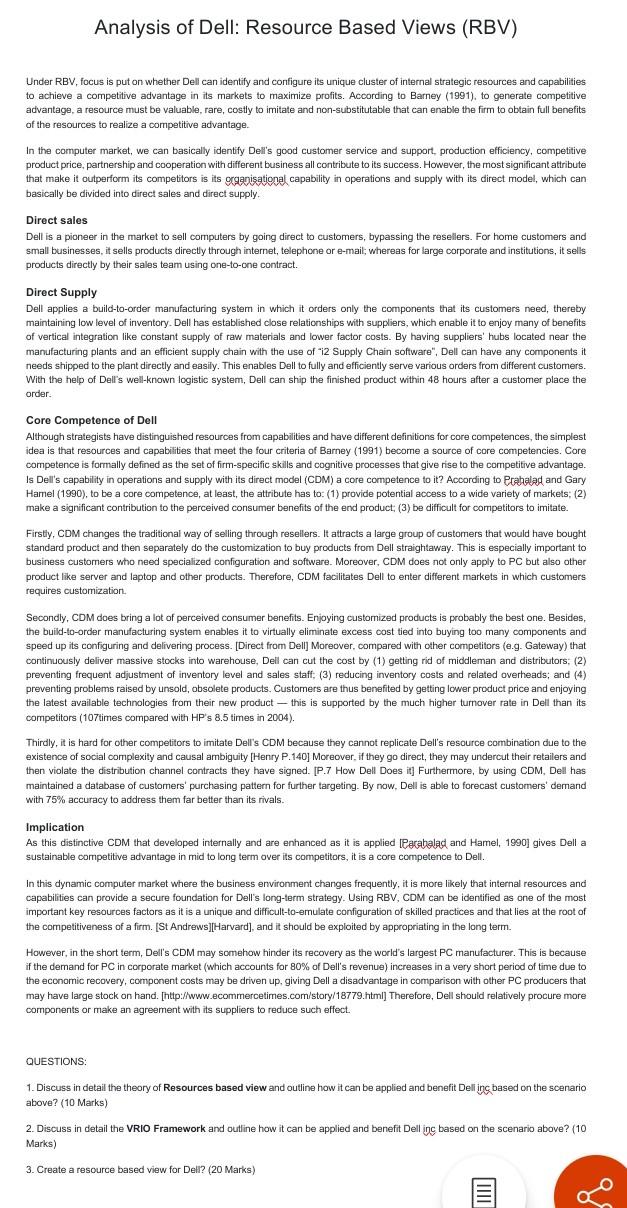
Analysis of Dell: Resource Based Views (RBV) Under RBV, focus is put on whether Dell can identify and configure its unique cluster of internal strategic resources and capabilities to achieve competitive advantage in its markets to maximize profits. According to Barney (1991). to generate competitive advantage. a resource must be valuable, rare, costly to imitate and non-substitutable that can enable the firm to obtain full benefits of the resources to realize a competitive advantage. In the computer market, we can basically identify Dell's good customer service and support, production efficiency, competitive product price, partnership and cooperation with different business all contribute to its success. However, the most significant attribute that make it outperform its competitors is its organisational capability in operations and supply with its direct model, which can basically be divided into direct sales and direct supply Direct sales Dell is a pioneer in the market to sell computers by going direct to customers, bypassing the resellers. For home customers and small businesses, it sells products directly through internet, telephone or e-mail, whereas for large corporate and institutions, it sells products directly by their sales team using one-to-one contract. Direct Supply Dell applies a build-to-order manufacturing system in which it orders only the components that its customers need, thereby maintaining low level of inventory. Dell has established close relationships with suppliers, which enable it to enjoy many of benefits of vertical integration like constant supply of raw materials and lower factor costs. By having suppliers' hubs located near the manufacturing plants and an efficient supply chain with the use of "12 Supply Chain software", Dell can have any components it needs shipped to the plant directly and easily. This enables Dell to fully and efficiently serve various orders from different customers. With the help of Dell's well-known logistic system, Dell can ship the finished product within 48 hours after a customer place the order Core Competence Dell Although strategists have distinguished resources from capabilities and have different definitions for core competences, the simplest idea is that resources and capabilities that meet the four criteria of Barney (1991) become a source of core competencies. Core competence is formally defined as the set of firm-specific skills and cognitive processes that give rise to the competitive advantage. Is Dell's capability in operations and supply with its direct model (CDM) a core competence to it? According to Prahalad and Gary Harel (1990), to be a core competence, at least, the attribute has to: (1) provide potential access to a wide variety of markets; (2) make a significant contribution to the perceived consumer benefits of the end product; (3) be difficult for competitors to imitate. Firstly, CDM changes the traditional way of selling through resellers. It attracts a large group of customers that would have bought standard product and then separately do the customization to buy products from Dell straightaway. This is especially important to business customers who need specialized configuration and software. Moreover, CDM does not only apply to PC but also other product like server and laptop and other products. Therefore, CDM facilitates Dell to enter different markets in which customers requires customization Secondly, CDM does bring a lot of perceived consumer benefits. Enjoying customized products is probably the best one. Besides, the build-to-order manufacturing system enables it to virtually eliminate excess cost tied into buying too many components and speed up its configuring and delivering process. [Direct from Dell] Moreover, compared with other competitors (e.g. Gateway) that continuously deliver massive stocks into warehouse, Dell can cut the cost by (1) getting rid of middleman and distributors (2) preventing frequent adjustment of inventory level and sales staff; (3) reducing inventory costs and related overheads; and (4) preventing problems raised by unsold, obsolete products. Customers are thus benefited by getting lower product price and enjoying the latest available technologies from their new product - this is supported by the much higher turnover rate Dell than its competitors (107times compared with HP's 8.5 times in 2004). Thirdly, it is hard for other competitors to imitate Dell's CDM because they cannot replicate Dell's resource combination due to the existence of social complexity and causal ambiguity (Henry P.140] Moreover, if they go direct, they may undercut their retailers and then violate the distribution channel contracts they have signed. [P.7 How Dell Does it] Furthermore, by using CDM, Dell has maintained a database of customers' purchasing pattern for further targeting. By now. Dell is able to forecast customers' demand with 75% accuracy to address them far better than its rivals. Implication As this distinctive CDM that developed internally and are enhanced as it is applied Pacabalad and Hamel, 1990) gives Dell a sustainable competitive advantage in mid to long term over its competitors, it is a core competence to Dell. In this dynamic computer market where the business environment changes frequently, it is more likely that internal resources and capabilities can provide a secure foundation for Dell's long-term strategy. Using RBV, CDM can be identified as one of the most important key resources factors as it is a unique and difficult-to-emulate configuration of skilled practices and that lies at the root of the competitiveness of a firm. (St Andrews][Harvard), and it should be exploited by appropriating in the long term. However, in the short term, Dell's CDM may somehow hinder its recovery as the world's largest PC manufacturer. This is because if the demand for PC in corporate market (which accounts for 80% of Dell's revenue) increases in a short period of time due to the economic recovery, component costs may be driven up, giving Dell a disadvantage in comparison with other PC producers that may have large stock on hand. [http://www.ecommercetimes.com/story/18779.html] Therefore, Dell should relatively procure more components or make an agreement with its suppliers to reduce such effect. QUESTIONS: 1. Discuss in detail the theory of Resources based view and outline how it can be applied and benefit Dell ins based on the scenario above? (10 Marks) 2. Discuss in detail the VRIO Framework and outline how it can be applied and benefit Dell ing based on the scenario above? (10 Marks) 3. Create a resource based view for Dell? (20 Marks)
Step by Step Solution
There are 3 Steps involved in it
1 Expert Approved Answer
Step: 1 Unlock

Question Has Been Solved by an Expert!
Get step-by-step solutions from verified subject matter experts
Step: 2 Unlock
Step: 3 Unlock