







Question: analytic solutions we do in class. So, we will take an over-simplified reaction set (that can be solved both analytically and numerically) and compare the
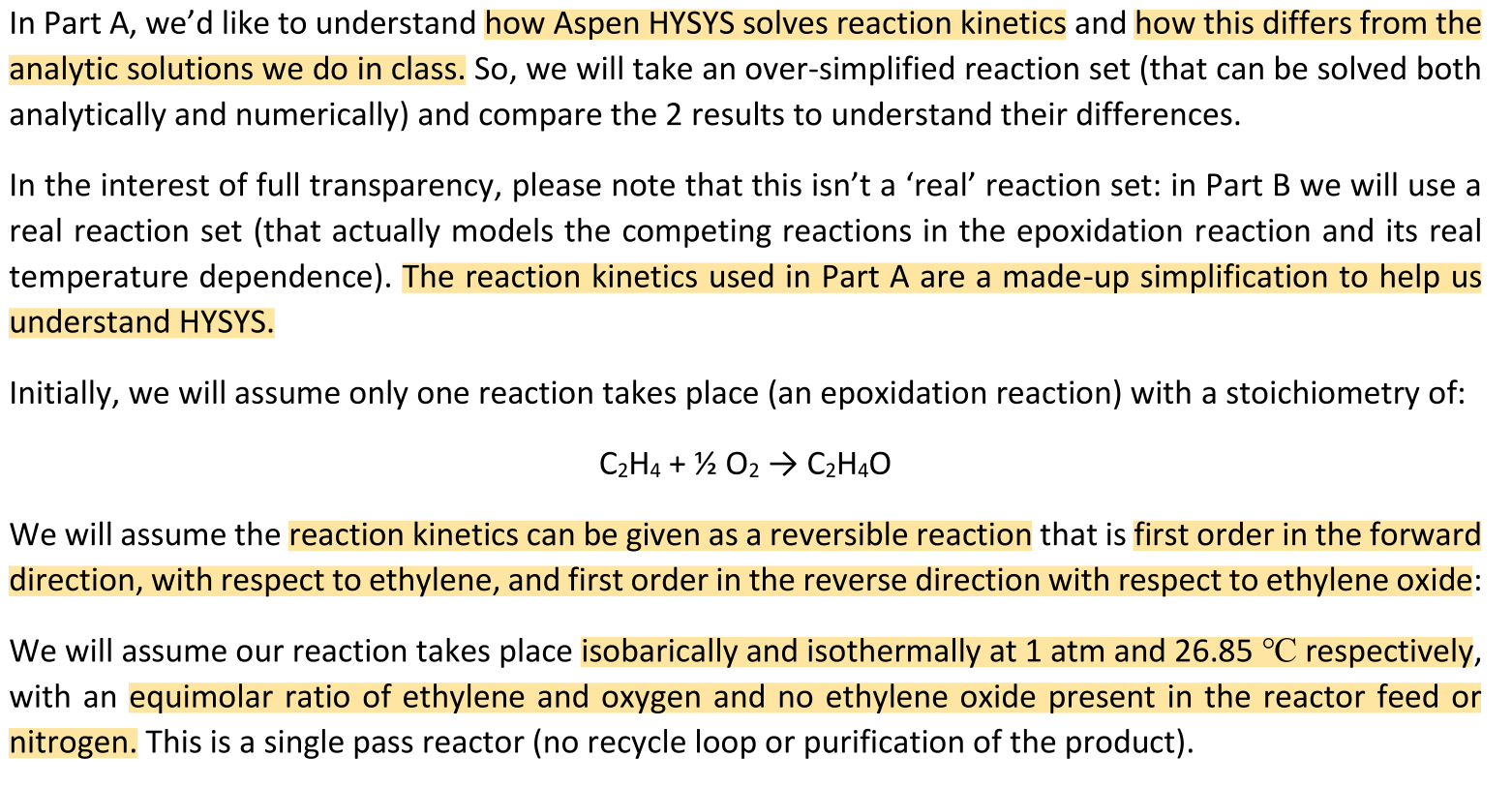
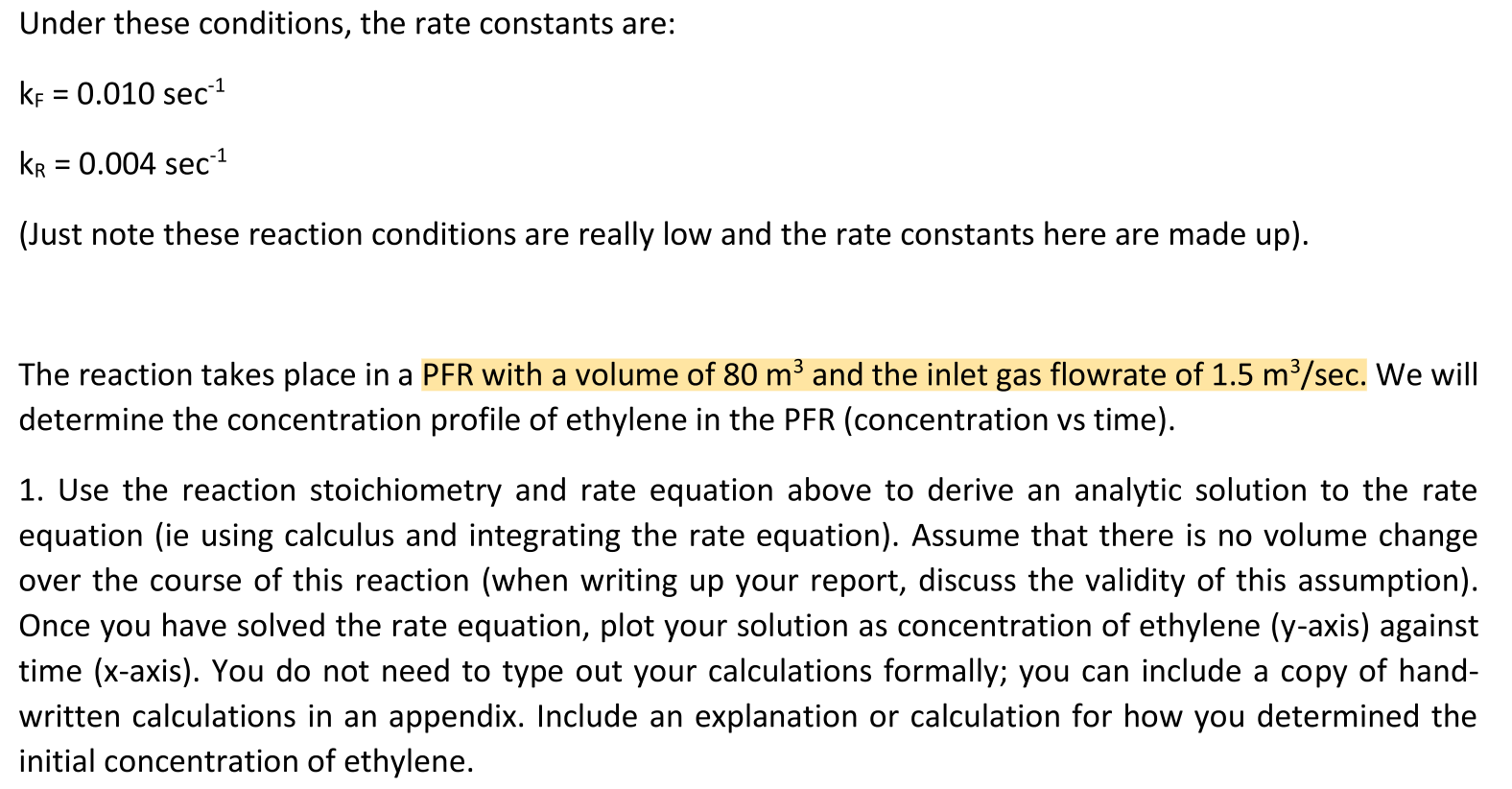
analytic solutions we do in class. So, we will take an over-simplified reaction set (that can be solved both analytically and numerically) and compare the 2 results to understand their differences. In the interest of full transparency, please note that this isn't a 'real' reaction set: in Part B we will use a real reaction set (that actually models the competing reactions in the epoxidation reaction and its real temperature dependence). The reaction kinetics used in Part A are a made-up simplification to help us understand HYSYS. Initially, we will assume only one reaction takes place (an epoxidation reaction) with a stoichiometry of: C2H4+1/2O2C2H4O We will assume the reaction kinetics can be given as a reversible reaction that is first order in the forward direction, with respect to ethylene, and first order in the reverse direction with respect to ethylene oxide: We will assume our reaction takes place isobarically and isothermally at 1 atm and 26.85C respectively, with an equimolar ratio of ethylene and oxygen and no ethylene oxide present in the reactor feed or nitrogen. This is a single pass reactor (no recycle loop or purification of the product). Under these conditions, the rate constants are: kF=0.010sec1kR=0.004sec1 (Just note these reaction conditions are really low and the rate constants here are made up). The reaction takes place in a PFR with a volume of 80m3 and the inlet gas flowrate of 1.5m3/sec. We will determine the concentration profile of ethylene in the PFR (concentration vs time). 1. Use the reaction stoichiometry and rate equation above to derive an analytic solution to the rate equation (ie using calculus and integrating the rate equation). Assume that there is no volume change over the course of this reaction (when writing up your report, discuss the validity of this assumption). Once you have solved the rate equation, plot your solution as concentration of ethylene ( y-axis) against time ( x-axis). You do not need to type out your calculations formally; you can include a copy of handwritten calculations in an appendix. Include an explanation or calculation for how you determined the initial concentration of ethylene
Step by Step Solution
There are 3 Steps involved in it

Get step-by-step solutions from verified subject matter experts
 Study Help