







Question: Analytical Problems 1. Alvin's demand for bottled water is given by the equation QA = 8 - .5P. Betty's demand function is OB = 6
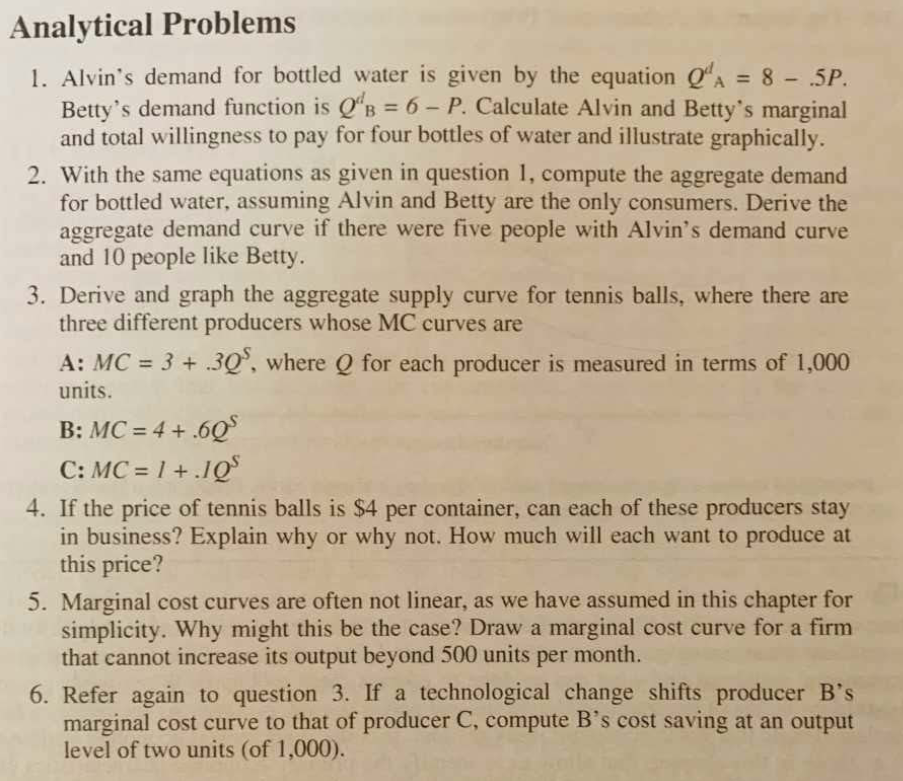
Analytical Problems 1. Alvin's demand for bottled water is given by the equation QA = 8 - .5P. Betty's demand function is O"B = 6 - P. Calculate Alvin and Betty's marginal and total willingness to pay for four bottles of water and illustrate graphically. 2. With the same equations as given in question 1, compute the aggregate demand for bottled water, assuming Alvin and Betty are the only consumers. Derive the aggregate demand curve if there were five people with Alvin's demand curve and 10 people like Betty. 3. Derive and graph the aggregate supply curve for tennis balls, where there are three different producers whose MC curves are A: MC = 3 + .30', where @ for each producer is measured in terms of 1,000 units. B: MC =4+.605 C: MC = 1+.105 4. If the price of tennis balls is $4 per container, can each of these producers stay in business? Explain why or why not. How much will each want to produce at this price? 5. Marginal cost curves are often not linear, as we have assumed in this chapter for simplicity. Why might this be the case? Draw a marginal cost curve for a firm that cannot increase its output beyond 500 units per month. 6. Refer again to question 3. If a technological change shifts producer B's marginal cost curve to that of producer C, compute B's cost saving at an output level of two units (of 1,000)
Step by Step Solution
There are 3 Steps involved in it

Get step-by-step solutions from verified subject matter experts
 Study Help