







Question: Analytlcs Exerclse ( mathbf { 1 5 - 1 } ) ( Algo ) Grainger: Reengineering the China / U . S
Analytlcs Exerclse mathbfAlgo
Grainger: Reengineering the ChinaUS Supply Chain
W W Grainger, Incorporated, is a leading supplier of maintenance, repalr, and operating MRO products to businesses and Institutions In the United States, Canada, and Mexico, with an expanding presence In Europe, Japan, Indla. China, and Panama. The company works with more than suppliers and runs an extensive website www gralngercom where Grainger offers nearly million products. The products range from Industrial adhesives used in manufacturing, to hand tools, Janitorial supplies, lighting equipment, and power tools. When something is needed by one of its customers, it is often needed quickly, so quick service and product avallability are key drivers to Gralnger's success.
Your assignment" Involves studying US distribution In Grainger's supply chain. Grainger works with over suppliers in the China and Talwan reglon. These suppliers produce products to Grainger's specifications and ship to the United States using ocean frelght carrlers from four major ports In China and Talwan. From these ports, product is shipped to US entry ports in elther Seattle, Washington, or Los Angeles, Callfornla. After passing through customs, the and foot containers are shipped by rall to Grainger's central distribution center in Kansas City, Kansas. The containers are unloaded and quality is checked In Kansas City. From there. individual Items are sent to regional warehouses in nine US locations, a Canadian site, and Mexico.
Grainger: US Distribution
In the United States, approximately percent of the containers enter in Seattle. Washington, and percent at the Los Angeles, Calfornla, port. Contalners on arrival at the port citles are inspected by federal agents and then loaded onto rall cars for movement to the Kansas City distributlon center. Varlable costs for processing at the port are $ per cubic meter CBM In both Los Angeles and Seattle. The rate for shipping the contalners to Kansas City is $ per CBM per mile.
In Kansas City, the containers are unloaded and processed through a quality assurance check. This costs $ per CBM processed. A very small percentage of the material is actually sent back to the supplier, but errors in quantity and package slize are often found that require accounting adjustments.
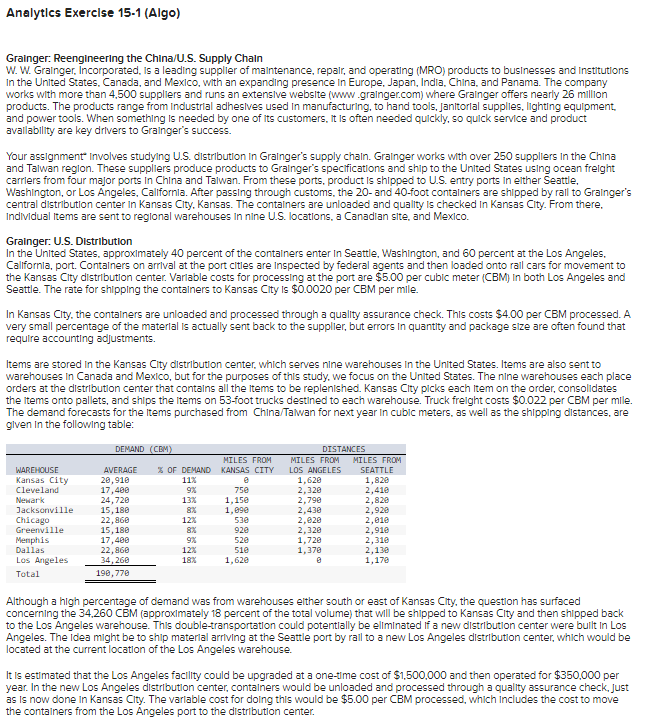
Items are stored in the Kansas City distribution center, which serves nine warehouses in the United States. Items are also sent to warehouses in Canada and Mexico, but for the purposes of this study, we focus on the United States. The nine warehouses each place orders at the distribution center that contalns all the items to be replenished. Kansas City picks each Item on the order, consolidates the items onto pallets, and ships the Items on foot trucks destined to each warehouse. Truck freight costs $ per CBM per mile. The demand forecasts for the Items purchased from ChinaTalwan for next year In cubic meters, as well as the shipping distances, are glven In the following table:
Although a high percentage of demand was from warehouses elther south or east of Kansas City, the question has surfaced concerning the CBM approximately percent of the total volume that will be shipped to Kansas City and then shipped back to the Los Angeles warehouse. This doubletransportation could potentially be eliminated If a new distribution center were built in Los Angeles. The idea might be to ship material arriving at the Seattle port by rall to a new Los Angeles distribution center, which would be located at the current location of the Los Angeles warehouse.
It is estimated that the Los Angeles facility could be upgraded at a onetime cost of $ and then operated for $ per year. In the new Los Angeles distribution center, contalners would be unloaded and processed through a quality assurance check, Just as is now done in Kansas City. The varlable cost for doing this would be $ per CBM processed, which includes the cost to move the containers from the Los Angeles port to the distribution center. After the materlal is processed in Los Angeles, the amount needed to replenish the Los Angeles warehouse CBM per year on average would be kept and the rest sent by rall to Kansas City. It would then be directly stocked in the Kansas City distribution center and used to replenish the warehouses. Grainger expects that very little would need to be shipped back to the Los Angeles warehouse after the new system was operating for about slx months.
Grainger management feels that it may be possible to make this change, but they are not sure if it would actually save any money and whether it would be a good strategic change.
The data in this case have been developed for teaching purposes and do not represent the actual situation at Grainger. The data, though, are representatlve of an actual pr
Step by Step Solution
There are 3 Steps involved in it
1 Expert Approved Answer
Step: 1 Unlock

Question Has Been Solved by an Expert!
Get step-by-step solutions from verified subject matter experts
Step: 2 Unlock
Step: 3 Unlock
 Study Help