







Question: Analyze the case - The Tablet PC for Nurses: A Mobile Clinical Assistant using the methodology - The Tablet PC for Nurses: A Mobile Clinical
Analyze the case - "The Tablet PC for Nurses: A Mobile Clinical Assistant" using the methodology
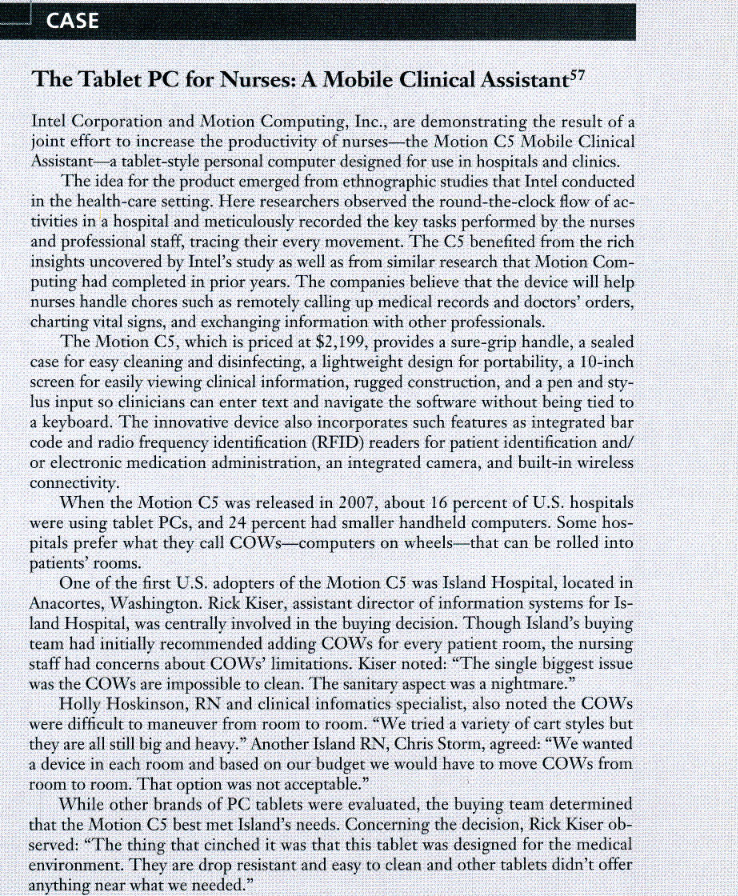
- The Tablet PC for Nurses: A Mobile Clinical Assistant\" Intel Corporation and Motion Computing, Inc, are demonstrating the result of a joint effort to increase the productivity of nursesthe Motion C5 Mobile Clinical Assistant-a tablet~style personal computer designed for use in hospitals and clinics. The idea for the product emerged from ethnographic studies that Intel conducted in the health+care setting. Herc researchers observed the round-dte-clock flow of ac- tivities in a hospital and meticulously recorded the key tasks performed by the nurses and professional staff, tracing their every movement. The C5 beneted from the rich insights uncovered by Intel's study as well as from similar research that Motion Com- puting had completed in prior years. The companies believe that the device will help nurses handle chores such as remoter calling up medical records and doctors' orders, charting vital signs, and cathanging information with other professionals. The Motion (35, which is priced at $2,199, provides a sure-grip handle, a sealed case for easy cleaning and disinfecting, a lightweight design for portability, a [Ii-inch screen for easily viewing clinical information, rugged construction, and a pen and sty- lus input so clinicians can enter teat and navigate the software without being tied to a keyboard. The innovative device also incorporates such features as integrated bar code and radio frequency identication {REID} readers for patient identication and:If or electronic medication administration, an integrated camera, and built-in wireless oonnccqur. 1|When the Motion CS was released in zoos, about 15 percent of U.S. hospitals were using tablet PCs, and Pi- pcrcent had smaller handheld computers. Some hos- - pitals prefer what they call COWscompnters on wheelsthat can be rolled into patients' rooms. One of the first U.S. adopters of the Motion C5 was Island Hospital, located in Anacortcs, Washington. Rick Kiser, assistant director of information systems for Is- land Hospital, was centrally involved in tile boyiug'dccision. Though Island's buying team had initially recommended adding CDWs for every patient room, the nursing stall had concerns about COWs' limitations. Kiser noted: \"The single biggest issue was the CGWs are impossible to clean. The sanitary aspect was a nightmare.\" Holly Hoslrlnson, RN and clinical infomatitn specialist, also noted the CDWs were difcult to maneuver from room to room. \"We tried a variety of cart styles but they are all- still big and heavy. 1Hitnother Island RN, Chris Storm, agreed: \"We wanted a device in each room and based on our budget we would have to move COWs from room to room. That opuou was not acceptable. ' While other brands of PC tablets were evaluated, the buying team determined that the Motion C5 best that Island's needs. Concerning the decision, Rick Kiser ob- served: \"The thing that cinched it was that this tablet was designed for the medical environment. They are drop resistant and easy to clean and other tablets didn t offer . anything .near what we needed.\
Step by Step Solution
There are 3 Steps involved in it

Get step-by-step solutions from verified subject matter experts
 Study Help