







Question: Analyze the following case. The answer should point out components, process, models, interventions of Organiational Development. 6. Analyze the following case. The answer should point
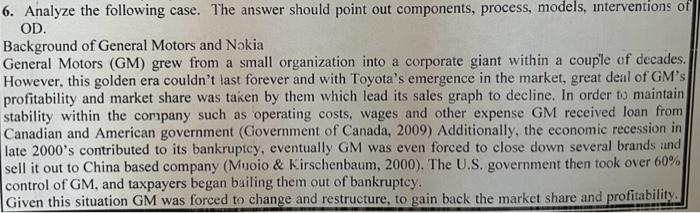
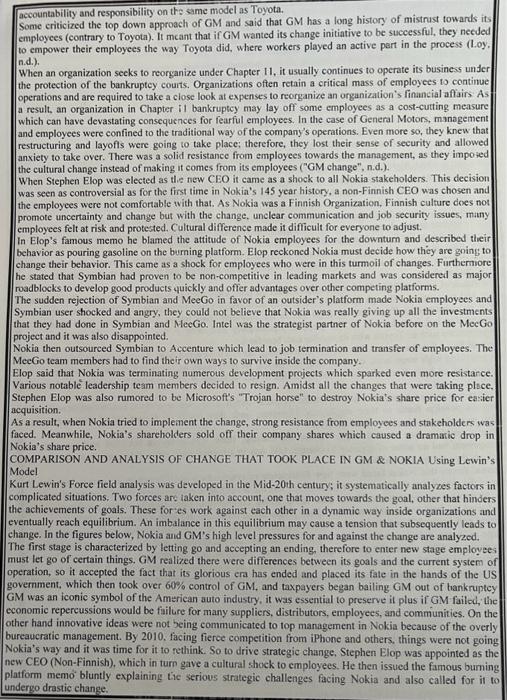
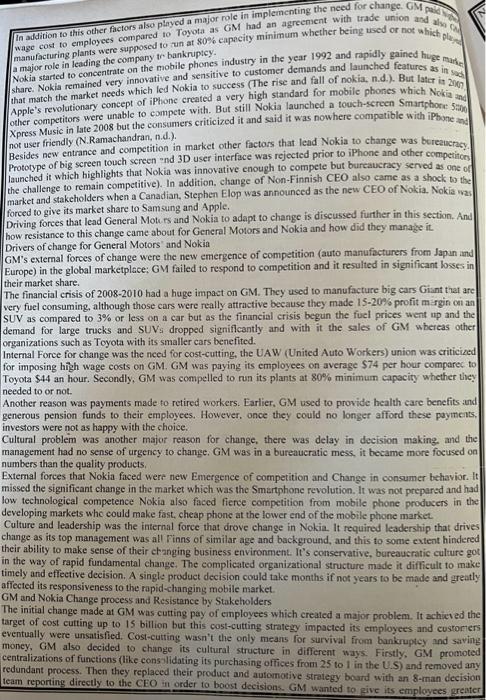
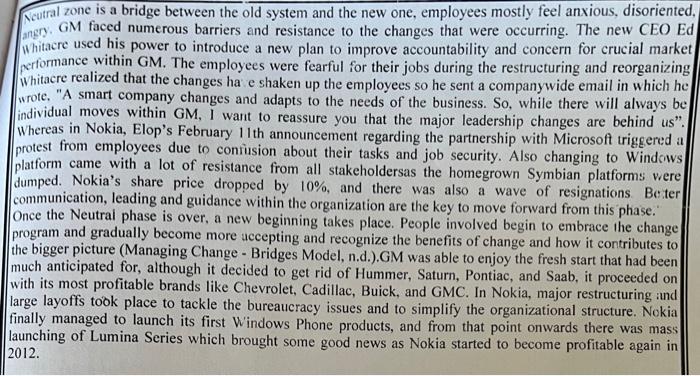
6. Analyze the following case. The answer should point out components, process, models, interventions of OD. Background of General Motors and Nokia General Motors (GM) grew from a small organization into a corporate giant within a couple of decades. However, this golden era couldn't last forever and with Toyota's emergence in the market, great deal of GM's profitability and market share was taken by them which lead its sales graph to decline. In order to maintain stability within the company such as operating costs, wages and other expense GM received loan from Canadian and American government (Government of Canada, 2009) Additionally, the economic recession in late 2000's contributed to its bankruptcy, eventually GM was even forced to close down several brands and sell it out to China based company (Muoio \& Kirschenbaum, 2000). The U.S. government then took over 60% control of GM, and taxpayers began bsiling them out of bankruptcy. Given this situation GM was forced to change and restructure, to gain back the market share and profitability. accountability and responsibility on the same model as Toyota. Some criticized the top down approach of GM and said that GM has a long history of mistrust towards its employees (contrary to Toyota). It mcant that if GM wanted its change initiative to be successful, they neculed to empower their employees the way Toyota did, where workers played an active part in the process (L.oy. n.d.). When an organization secks to reorganize under Chapter 11, it usually continues to operate its business under the protection of the bankruptey cours. Organizations often retain a critical mass of employees to continue operations and are required to take a close look at expenses to reorganize an organization's financial affairs As a result, an organization in Chapter it bankruptcy may lay off some cmployees as a cost-cutting measure which can have devastating consequences for fearful employees. In the case of General Motors, management and employees were confined to the traditional way of the company's openations. Even more so, they knew that restructuring and layofls were going to take place; therefore, they lost their sense of security and allowed anxiety to take over. There was a solid resistance from employees towards the management, as they imposed the cultural change instead of making it comes from its employees ("GM change", n.d.). When Stephen Elop was elected as the new CEO it came as a shock to all Nokia stakeholders. This decision was seen as controversial as for the first time in Nokia's 145 year history, a non-Finnish CEO was chosen and the employees were not comfortable with that. As Nokia was a Finnish Organization. Finnish culture does not promote uncertainty and change but with the change, unclear communication and job security issues, many cmployees felt at risk and protested. Cultural difference made it difficult for everyone to adjust. In Elop's famous memo he blamed the attitude of Nokia employees for the downtum and described their behavior as pouring gasoline on the burning platform. Elop reckoned Nokia must decide how they are going to change their behavior. This came as a shock for employees who were in this turmoil of changes. Furtherniore he stated that Symbian had proven to be noni-competitive in leading markets and was considered as major roadblocks to develop good products quickly and offer advantages over other competing platforms. The sudden rejection of Symbian and MeeGo in favor of an outsider's platform made Nokia employees and Symbian user shocked and angry, they could not believe that Nokia was really giving up all the investments that they had done in Symbian and MeeGo. Intel was the strategist partner of Nokia before on the MecGo project and it was also disappointed. Nokia then outsourced Symbian to Accenture which lead to job termination and transfer of employees. The MeeGo team members had to find their own ways to survive inside the company. Elop said that Nokia was terminating numerous development projects which sparked even more resistarce. Various notable leadership team members decided to resign. Amidst all the changes that were taking plsce, Stephen Elop was also rumored to be Microsoft's "Trojan horse" to destroy Nokia's share price for easier acquisition. As a result, when Nokia tried to implement the change, strong resistance from employees and stakeholders was faced. Meanwhile, Nokia's shareholders sold off their company shares which caused a dramaric drop in Nokia's share price. COMPARISON AND ANALYSIS OF CHANGE THAT TOOK PLACE IN GM \& NOKIA Using Lewin's Model Kurt Lewin's Force field analysis was developed in the Mid-20th century; it systematically analyzes factors in complicated situations. Two forces are iaken into account, one that moves towards the goal, other that hinders the achievements of goals. These for 'es work against cach other in a dynamic way inside organizations and eventually reach equilibrium. An imbalance in this equilibrium may cause a tension that subsequently leads to change. In the figures below, Nokia and GM's high level pressures for and against the change are analyzed. The first stage is characterized by letting go and accepting an ending, therefore to cnter new stage employee: must let go of certain things. GM realized there were differences between its goals and the current system of operation, so it accepted the fact that its glorious cra has ended and placed its fate in the hands of the US government, which then took over 60% control of GM, and taxpayers began bailing GM out of tankruptcy GM was an iconic symbol of the American auto industry. it was essential to preserve it plus if GM failed, the economic repercussions would be failure for many suppliers, distributors, employees, and communities. On the other hand innovative ideas were not being communicated to top management in Nokia because of the overly bureaucratic management. By 2010. facing fierce competition from iPhone and others, things were not going Nokia's way and it was time for it to rethink. So to drive strategic change, Stephen Elop was appointed as the new CEO (Non-Finnish), which in turn gave a cultural shock to cmployees. He then issued the famous buming platform memo bluntly explaining the serious strategic challenges facing Nokia and also called for it to undergo drastic change. In addition to this other factors also played a major role in implementing the need for change. GM paic that match the market needs which ied Nokia to success (The rise and fall of nokia, n.d.). But later in anos. other competitors were unable the consumers criticized it and said it was nowhere compatible with iPhone and Xpress Music in late 2008 but the consumer and. n.d.). not user friendly (N.Ramachandran, Besides new entrance and competition in market other factors that lead Nokia to change was beresiactace. launched it which highlights that Nokia was innovative enough to compete but bureaucracy served as one of the challenge to remain competitive). In addition. change of Non-Finnish CEO also came as a shock to the market and stakeholders when a Canadian, Stephen Elop was announced as the new CEO of Nokia. Nokia was forced to give its market share to Samsung and Apple. Driving forees that lead General Moters and Nokia to adapt to change is discussed further in this section. And how resistance to this change came about for General Motors and Nokia and how did they manabe it. Drivers of change for General Motors' and Nokia GM's extemal forces of change were the new emergence of competition (auto manufecturers from Japan and Europe) in the global marketplece; GV failed to respond to competition and it resulted in significant losses in their market share. The financial crisis of 2008-2010 had a huge impact on GM. They used to manufacture big cars Giant that are very fuel consuming, although those cars were really attractive because they made 1520% profit migin cei an SUV as compared to 3% or less on a car but as the financial crisis begun the fuel prices went up and the demand for large trucks and SUVs dropped signifleantly and with it the sales of GM whereas other organizations such as Toyota with its smaller cars benefited. Intemal Force for change was the nced for cost-cutting, the UAW (United Auto Workers) union was criticieed for imposing hilh wage costs on GM. GM was paying its employees on average $74 per hour comparec to Toyota $44 an hour. Secondly, GM was compelled to run its plants at 80% minimum capacity whether they needed to or not. Another reason was payments made to retired workers. Earlier, GM used to provide health care benefits and generous pension funds to their employees. However. once they could no longer afford these payments, investors were not as happy with the choice. Cultural problem was another major reason for change, there was delay in decision making. and the management had no sense of urgency to change. GM was in a bureaucratic mess, it became more focused on numbers than the quality products. Extemal forces that Nokia faced were new Emergence of competition and Change in consumer behavior. It missed the significant change in the market which was the Smertphone revolution. It was not prepared and had low technological competence Nokia also faced fierce competition from mobile phone producers in the developing markets whe could make fast, cheap phone at the lower end of the mobile phone market. Culture and leadership was the internal force that drove change in Nokia. It required leadership that drives change as its top management was all Finns of similar age and background, and this to some extent hindered their ability to make sense of their clanging business environment. It's conservative, bureaucratic culture got in the way of rapid fundamental change. The complicated organizational structure made it difficult to make timely and effective decision. A single product decision could take months if not years to be made and greatly affected its responsiveness to the rapid-changing mobile market. GM and Nokia Change process and Resistance by Stakeholders The initial change made at GM was cutting pay of employees which created a major problem. It achieved the target of cost cutting up to 15 billion but this cost-cutting strategy impacted its employees and custorters eventually were unsatisfied. Cost-cutting wasn't the only means for survival from bunicruptcy and saving money, GM also decided to change its cultural structure in different ways. Firstly, GM promoted centralizations of functions (like consilidating its purchasing offices from 25 to 1 in the U.S) and removed any redundant process. Then they replaced their product and automotive strategy board with an 8 -rnan decision team reporting directly to the CEO in order to boost decisions. GM wanted to give its employees greater Ncutral zone is a bridge between the old system and the new one, employees mostly feel anxious, disoriented angry. GM faced numerous barriers and resistance to the changes that were occurring. The new whitacre used his power to introduce a new plan to improve accountability and concern for crucial market performance within GM. The employees were fearful for their jobs during the restructuring and reorganizing Whitacre realized that the changes ha e shaken up the employees so he sent a companywide email in which he wrote. "A smart company changes and adapts to the needs of the business. So, while there will always be individual moves within GM, I want to reassure you that the major leadership changes are behind us". Whereas in Nokia, Elop's February 11 th announcement regarding the partnership with Microsoft triggered a protest from employees due to conrision about their tasks and job security. Also changing to Windows platform came with a lot of resistance from all stakeholdersas the homegrown Symbian platforms were dumped. Nokia's share price dropped by 10%, and there was also a wave of resignations Beter communication, leading and guidance within the organization are the key to move forward from this phase.' Once the Neutral phase is over, a new beginning takes place. People involved begin to embrace the change program and gradually become more accepting and recognize the benefits of change and how it contributes to the bigger picture (Managing Change - Bridges Model, n.d.).GM was able to enjoy the fresh start that had been much anticipated for, although it decided to get rid of Hummer, Saturn, Pontiac, and Saab, it proceeded on with its most profitable brands like Chevrolet, Cadillac, Buick, and GMC. In Nokia, major restructuring ind large layoffs to k place to tackle the bureaucracy issues and to simplify the organizational structure. Nokia finally managed to launch its first Windows Phone products, and from that point onwards there was mass launching of Lumina Series which brought some good news as Nokia started to become profitable again in 2012
Step by Step Solution
There are 3 Steps involved in it

Get step-by-step solutions from verified subject matter experts
 Study Help