







Question: Analyze the nurses decision (Case 7.2) using the ethics triad: o Results-Based Analysis o Rule-Based Analysis o Virtue-Based Analysis For the past four years, I
Analyze the nurses decision (Case 7.2) using the ethics triad: o Results-Based Analysis o Rule-Based Analysis o Virtue-Based Analysis
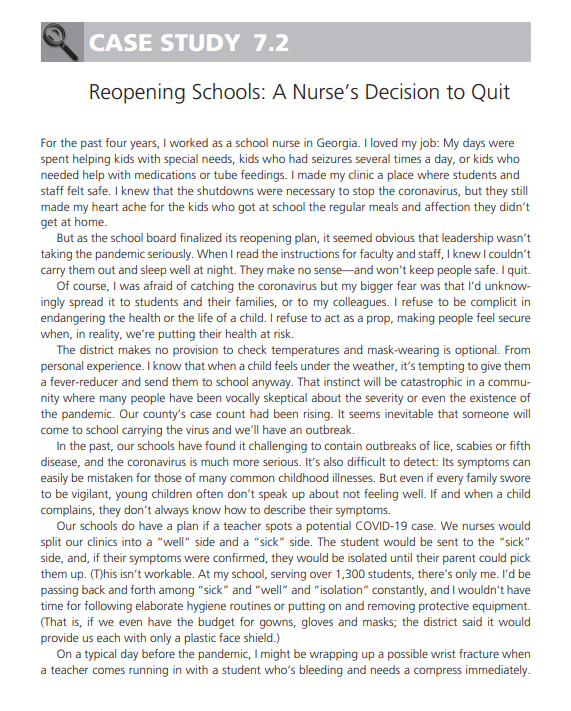
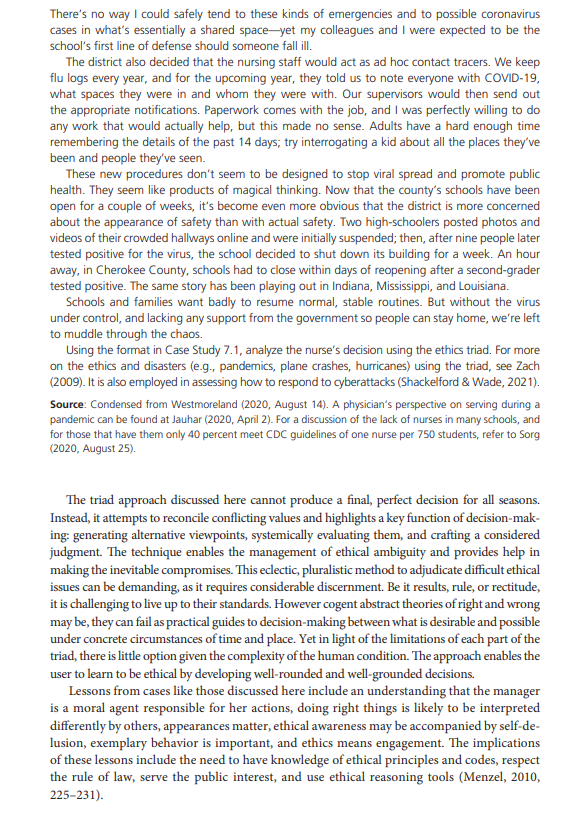
For the past four years, I worked as a school nurse in Georgia. I loved my job: My days were spent helping kids with special needs, kids who had seizures several times a day, or kids who needed help with medications or tube feedings. I made my clinic a place where students and staff felt safe. I knew that the shutdowns were necessary to stop the coronavirus, but they still made my heart ache for the kids who got at school the regular meals and affection they didn't get at home. But as the school board finalized its reopening plan, it seemed obvious that leadership wasn't taking the pandemic seriously. When I read the instructions for faculty and staff, I knew I couldn't carry them out and sleep well at night. They make no sense-and won't keep people safe. I quit. Of course, I was afraid of catching the coronavirus but my bigger fear was that I'd unknowingly spread it to students and their families, or to my colleagues. I refuse to be complicit in endangering the health or the life of a child. I refuse to act as a prop, making people feel secure when, in reality, we're putting their health at risk. The district makes no provision to check temperatures and mask-wearing is optional. From personal experience. I know that when a child feels under the weather, it's tempting to give them a fever-reducer and send them to school anyway. That instinct will be catastrophic in a community where many people have been vocally skeptical about the severity or even the existence of the pandemic. Our county's case count had been rising. It seems inevitable that someone will come to school carrying the virus and we'll have an outbreak. In the past, our schools have found it challenging to contain outbreaks of lice, scabies or fifth disease, and the coronavirus is much more serious. It's also difficult to detect: Its symptoms can easily be mistaken for those of many common childhood illnesses. But even if every family swore to be vigilant, young children often don't speak up about not feeling well. If and when a child complains, they don't always know how to describe their symptoms. Our schools do have a plan if a teacher spots a potential COVID-19 case. We nurses would split our clinics into a "well" side and a "sick" side. The student would be sent to the "sick" side, and, if their symptoms were confirmed, they would be isolated until their parent could pick them up. (T)his isn't workable. At my school, serving over 1,300 students, there's only me. I'd be passing back and forth among "sick" and "well" and "isolation" constantly, and I wouldn't have time for following elaborate hygiene routines or putting on and removing protective equipment. (That is, if we even have the budget for gowns, gloves and masks; the district said it would provide us each with only a plastic face shield.) On a typical day before the pandemic, I might be wrapping up a possible wrist fracture when a teacher comes running in with a student who's bleeding and needs a compress immediately. There's no way I could safely tend to these kinds of emergencies and to possible coronavirus cases in what's essentially a shared space-yet my colleagues and I were expected to be the school's first line of defense should someone fall ill. The district also decided that the nursing staff would act as ad hoc contact tracers. We keep flu logs every year, and for the upcoming year, they told us to note everyone with COVID-19, what spaces they were in and whom they were with. Our supervisors would then send out the appropriate notifications. Paperwork comes with the job, and I was perfectly willing to do any work that would actually help, but this made no sense. Adults have a hard enough time remembering the details of the past 14 days; try interrogating a kid about all the places they've been and people they've seen. These new procedures don't seem to be designed to stop viral spread and promote public health. They seem like products of magical thinking. Now that the county's schools have been open for a couple of weeks, it's become even more obvious that the district is more concerned about the appearance of safety than with actual safety. Two high-schoolers posted photos and videos of their crowded hallways online and were initially suspended; then, after nine people later tested positive for the virus, the school decided to shut down its building for a week. An hour away, in Cherokee County, schools had to close within days of reopening after a second-grader tested positive. The same story has been playing out in Indiana, Mississippi, and Louisiana. Schools and families want badly to resume normal, stable routines. But without the virus under control, and lacking any support from the government so people can stay home, we're left to muddle through the chaos. Using the format in Case Study 7.1, analyze the nurse's decision using the ethics triad. For more on the ethics and disasters (e.g., pandemics, plane crashes, hurricanes) using the triad, see Zach (2009). It is also employed in assessing how to respond to cyberattacks (Shackelford \& Wade, 2021). Source: Condensed from Westmoreland (2020, August 14). A physician's perspective on serving during a pandemic can be found at Jauhar (2020, April 2). For a discussion of the lack of nurses in many schools, and for those that have them only 40 percent meet CDC guidelines of one nurse per 750 students, refer to Sorg (2020, August 25). The triad approach discussed here cannot produce a final, perfect decision for all seasons. Instead, it attempts to reconcile conflicting values and highlights a key function of decision-making: generating alternative viewpoints, systemically evaluating them, and crafting a considered judgment. The technique enables the management of ethical ambiguity and provides help in making the inevitable compromises. This eclectic, pluralistic method to adjudicate difficult ethical issues can be demanding, as it requires considerable discernment. Be it results, rule, or rectitude, it is challenging to live up to their standards. However cogent abstract theories of right and wrong may be, they can fail as practical guides to decision-making between what is desirable and possible under concrete circumstances of time and place. Yet in light of the limitations of each part of the triad, there is little option given the complexity of the human condition. The approach enables the user to learn to be ethical by developing well-rounded and well-grounded decisions. Lessons from cases like those discussed here include an understanding that the manager is a moral agent responsible for her actions, doing right things is likely to be interpreted differently by others, appearances matter, ethical awareness may be accompanied by self-delusion, exemplary behavior is important, and ethics means engagement. The implications of these lessons include the need to have knowledge of ethical principles and codes, respect the rule of law, serve the public interest, and use ethical reasoning tools (Menzel, 2010, 225-231)Step by Step Solution
There are 3 Steps involved in it
1 Expert Approved Answer
Step: 1 Unlock

Question Has Been Solved by an Expert!
Get step-by-step solutions from verified subject matter experts
Step: 2 Unlock
Step: 3 Unlock
 Study Help