Question: Analyzing a Change Process through the Change Path Model Part I Interview a manager at any level who has been involved in change with his

Analyzing a Change Process through the Change Path Model

Part I

Interview a manager at any level who has been involved in change with his or her organization. Ask the person to describe the change, what he or she was trying to accomplish, and what happened. Use the following questions as guides for the interview.

  • How was the desired change identified? What were the reasons for the change?
  • Describe the gap between the organization's current performance and the desired future state.
  • What was the vision for the change? How was that vision communicated throughout the organization?
  • How were the formal structures, systems, and processes involved in the change?
  • How were the recipients of change and other key stakeholders engaged in order to get them on board with the change?
  • What tools and trainings were used as the change was implemented, and how did the leadership make the change stick?
  • What challenges surfaced that weren't accounted for in the original change plan?
  • What were the results of the change process? Did the results reflect the original vision? How was measurement used to facilitate change at different stages of the process?

Part II

After the interview, describe the process of the change by answering the following questions that are related to how they managed the process:

  • How did the manager work to make things happen?
  • Who was involved?
  • How did they persuade others?
  • What resources did they use?
  • Also describe what was being changed? Why were these things important? How did these changes help the organization?
  • As you reflect back on the interview, which do you feel was more important to the impact of the change: how things were changed, that is, process, or what was changed?

Analyzing a Change Process through the ChangeAnalyzing a Change Process through the ChangeAnalyzing a Change Process through the Change
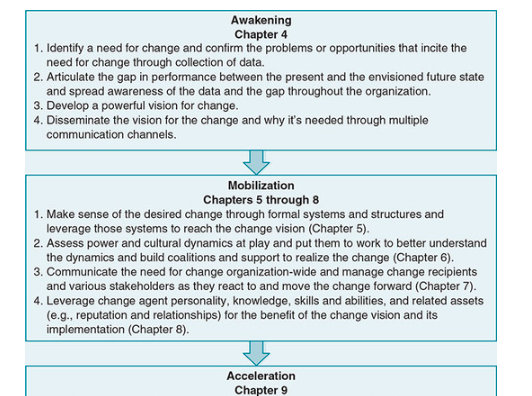
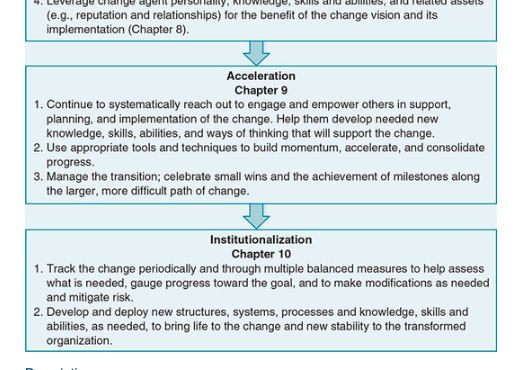
Figure 2.2 The Change Path ModelAwakening Chapter 4 1. Identify a need for change and confirm the problems or opportunities that incite the need for change through collection of data. 2. Articulate the gap in performance between the present and the envisioned future state and spread awareness of the data and the gap throughout the organization. 3. Develop a powerful vision for change. 4. Disseminate the vision for the change and why it's needed through multiple communication channels. Mobilization Chapters 5 through 8 1. Make sense of the desired change through formal systems and structures and leverage those systems to reach the change vision (Chapter 5). 2. Assess power and cultural dynamics at play and put them to work to better understand the dynamics and build coalitions and support to realize the change (Chapter 6). 3. Communicate the need for change organization-wide and manage change recipients and various stakeholders as they react to and move the change forward (Chapter 7). 4. Leverage change agent personality, knowledge, skills and abilities, and related assets (e.g., reputation and relationships) for the benefit of the change vision and its implementation (Chapter 8). Acceleration Chapter 9Leverage change agent personality, Nowledge, skills and abilities, and Telaled a35tika (e.g., reputation and relationships) for the benefit of the change vision and its implementation (Chapter 8). Acceleration Chapter 9 1. Continue to systematically reach out to engage and empower others in support, planning, and implementation of the change. Help them develop needed new knowledge, skills, abilities, and ways of thinking that will support the change. 2. Use appropriate tools and techniques to build momentum, accelerate, and consolidate progress. 3. Manage the transition; celebrate small wins and the achievement of milestones along the larger, more difficult path of change. Institutionalization Chapter 10 1. Track the change periodically and through multiple balanced measures to help assess what is needed, gauge progress toward the goal, and to make modifications as needed and mitigate risk. 2. Develop and deploy new structures, systems, processes and knowledge, skills and abilities, as needed, to bring life to the change and new stability to the transformed organization

Step by Step Solution

There are 3 Steps involved in it

1 Expert Approved Answer
Step: 1 Unlock blur-text-image

Question Has Been Solved by an Expert!

Get step-by-step solutions from verified subject matter experts

Step: 2 Unlock
Step: 3 Unlock

Students Have Also Explored These Related General Management Questions!