







Question: Ancient explorers did not have the electronic navigation systems we have now. Instead, they used course, speed, time, and distance to determine their position in
Ancient explorers did not have the electronic navigation systems we have now. Instead, they used course, speed, time, and distance to determine their position in the ocean. When traveling in the ocean the course is the direction that you intend to steer the vessel. However, with the wind, current and other factors, the direction of the vessel changes. This true path is called "Course made good".
In this four-part activity, you will plot a path based on various criteria. The course is always due East (90 when measuring from 0 north clockwise). This is the only instruction given before the different parts of the the description.
Part 1
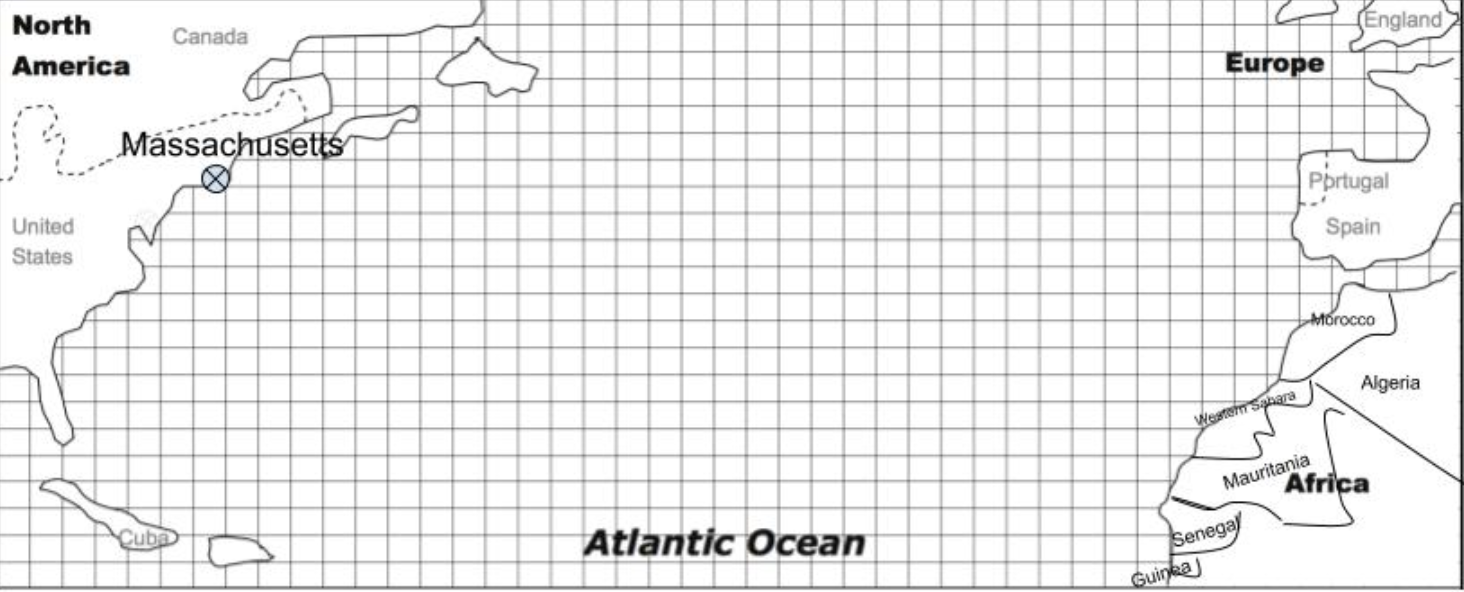
Using the map below, chart out a course of 5 squares a month starting from Massachusetts, heading due East.
Map each of these vectors using a blue pencil.
It will take ___ months and the vessel will land in ______________ Part 2
Unfortunately, the wind also plays a role in the destination. Now calculate the path with the following wind vectors. Draw the course vector in blue, then add the wind vector in orange to the tail of the blue vector. Using vector addition, draw the resultant vector in green.
| Month 1 | Month 2 | Month 3 | Month 4 | Month 5 | Month 6 |
| 2 Squares South | 3 Diagonal Squares Southwest | No Wind | 4 Diagonal Squares Northeast | 3 Squares South | 3 Diagonal Squares Southeast |
It will take ___ months and the vessel will land in ______________
Part 3
The wind is not the only factor. There are also ocean currents. Now calculate the path with the course vector in blue (part 1), the wind vectors in orange (part 2), and the ocean currents below in red. Using vector addition calculate the resultant vectors in green.
| Month 1 | Month 2 | Month 3 | Month 4 | Month 5 | Month 6 |
| 1 square diagonally southwest. | 1 square diagonally southwest. | 1 square west. | 2 squares diagonally southwest. | 1 squares diagonally southwest. | 1 squares diagonally southeast. |
It would take approximately ___________ months to reach _______________________ .
Part 4
Map your own journey
Looking up actual ocean currents directions, estimate what favorable winds and ocean currents you would need to have to arrive in Senegal. How long would it take?
| Month 1 | Month 2 | Month 3 | Month 4 | Month 5 | Month 6 | |
| Wind | ||||||
| Ocean |
Ocean current website https://cimss.ssec.wisc.edu/sage/oceanography/lesson3/concepts.html
Pictured Below is the map used for Parts 1-4
Step by Step Solution
There are 3 Steps involved in it

Get step-by-step solutions from verified subject matter experts
 Study Help