



Question: Andrew took a $ 1 2 , 0 0 0 car loan. He wants to pay off this debt quick, so he chooses to pay
Andrew took a $ car loan. He wants to pay off this debt quick, so he chooses to pay it in
just two years. The loan has a nominal interest rate, compounded quarterly.
a He will make quarterly payments. Draw the cash flow diagram.
b What is his quarterly payment?
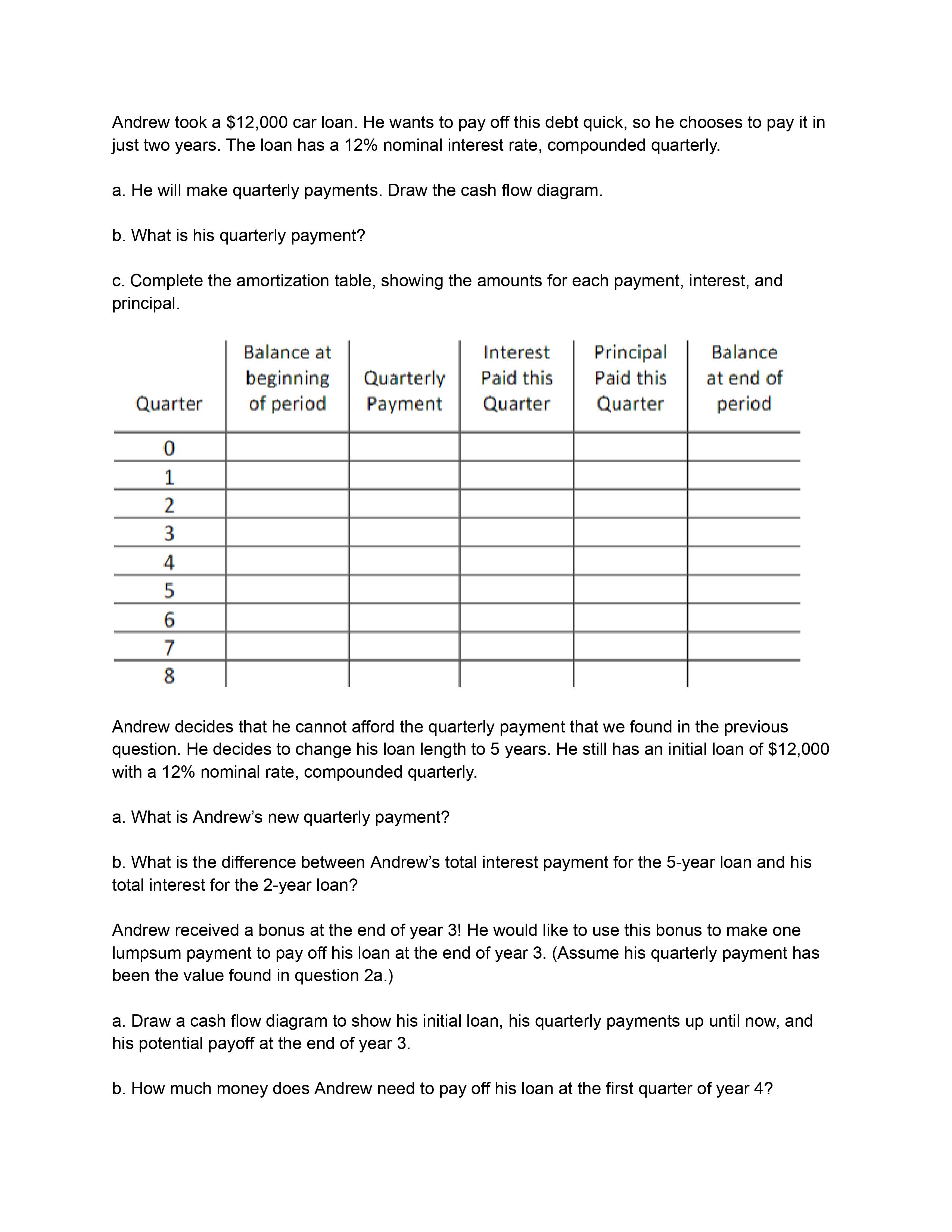
c Complete the amortization table, showing the amounts for each payment, interest, and
principal.
Andrew decides that he cannot afford the quarterly payment that we found in the previous
question. He decides to change his loan length to years. He still has an initial loan of $
with a nominal rate, compounded quarterly.
a What is Andrew's new quarterly payment?
b What is the difference between Andrew's total interest payment for the year loan and his
total interest for the year loan?
Andrew received a bonus at the end of year He would like to use this bonus to make one
lumpsum payment to pay off his loan at the end of year Assume his quarterly payment has
been the value found in question a
a Draw a cash flow diagram to show his initial loan, his quarterly payments up until now, and
his potential payoff at the end of year
b How much money does Andrew need to pay off his loan at the first quarter of year
Step by Step Solution
There are 3 Steps involved in it
1 Expert Approved Answer
Step: 1 Unlock

Question Has Been Solved by an Expert!
Get step-by-step solutions from verified subject matter experts
Step: 2 Unlock
Step: 3 Unlock