







Question: Animal Classification Using Frame - Based Systems and Prolog Objective: In this assignment, you will implement a simple frame - based system in Prolog to
Animal Classification Using FrameBased Systems and Prolog
Objective:
In this assignment, you will implement a simple framebased system in Prolog to classify animals based on their characteristics. You will define frames for general animal categories such as mammals, birds, reptiles and specific animals such as dolphins, eagles, and turtles The frames will use inheritance to allow specific animals to inherit properties from their parent categories. Additionally, you will write Prolog rules to classify animals and query their attributes.
Problem Statement:
You are tasked with designing a framebased knowledge system in Prolog to classify animals. Each frame represents either a category of animals or a specific animal, and each frame contains attributes slots with corresponding values. The system should use inheritance to allow specific animal frames to inherit attributes from more general categories.
Using the provided Prolog frame structure, you will:
Define frames for general animal categories such as mammal, bird, and reptile.
Define frames for specific animals like dolphin, eagle, and turtle.
Implement inheritance so that specific animals inherit attributes from their respective categories.
Write classification rules in Prolog to identify whether an animal belongs to a certain category based on its attributes.
Requirements:
Frame Definitions:
Define frames for general animal categories such as animal, mammal, bird, and reptile.
Define frames for specific animals, including dolphin, eagle, and turtle. Each specific animal frame should inherit from a parent frame eg dolphin inherits from mammal
Each frame should have attributes slots such as legs, habitat, movement, and reproduction.
You can use the following attributes slots and values to define your frames:
legs: Number of legs eg
habitat: Where the animal lives eg land, water
movement: How the animal moves eg swims, flies, crawls
reproduction: How the animal reproduces eg lays eggs, live birth
warmblooded: yes or nohair: yes or no
wings: yes or no
flies: yes or no
Example of frames:
framemammalwarmbloodedyes, hairyes, livebirthyes
framebirdwingsyes, fliesunknown, layseggsyes
Inheritance:
Implement inheritance in Prolog using a rule that checks a frame's parent if an attribute is not directly specified in the specific animal frame.
Example of inheritance:
inheritsfromdolphin mammal
Base case: if a frame explicitly has a value for a slot, return it
inheritFrame Slot, Value : frameFrame Slots memberSlotValue, Slots
Recursive case: if a slot isn't found in the current frame, check the parent frame
inheritFrame Slot, Value : inheritsfromFrame Parent inheritParent Slot, Value
Classification Rules:
Write Prolog rules to classify animals. For example, an animal is classified as a mammal if it has hair and is warmblooded.
Write rules for classifying mammals, birds, and reptiles.
Example of classification rule:
Classify an animal as a mammal if it is warmblooded and has hair
mammalAnimal : inheritAnimal warmblooded, yes inheritAnimal hair, yes
Classify an animal as a bird if it has wings and lays eggs
birdAnimal : inheritAnimal wings, yes inheritAnimal layseggs, yes
Queries:
You must provide Prolog queries to test your program. The queries should:
Classify a given animal as mammal, bird, or reptile.
Retrieve specific attributes of animals, such as their habitat or whether they can fly.
Deliverables:Prolog Program:
Implement the framebased system, including the frames, inheritance logic, and classification rules.
Test Queries:
Write and test queries in Prolog to classify the animals and retrieve their attributes.
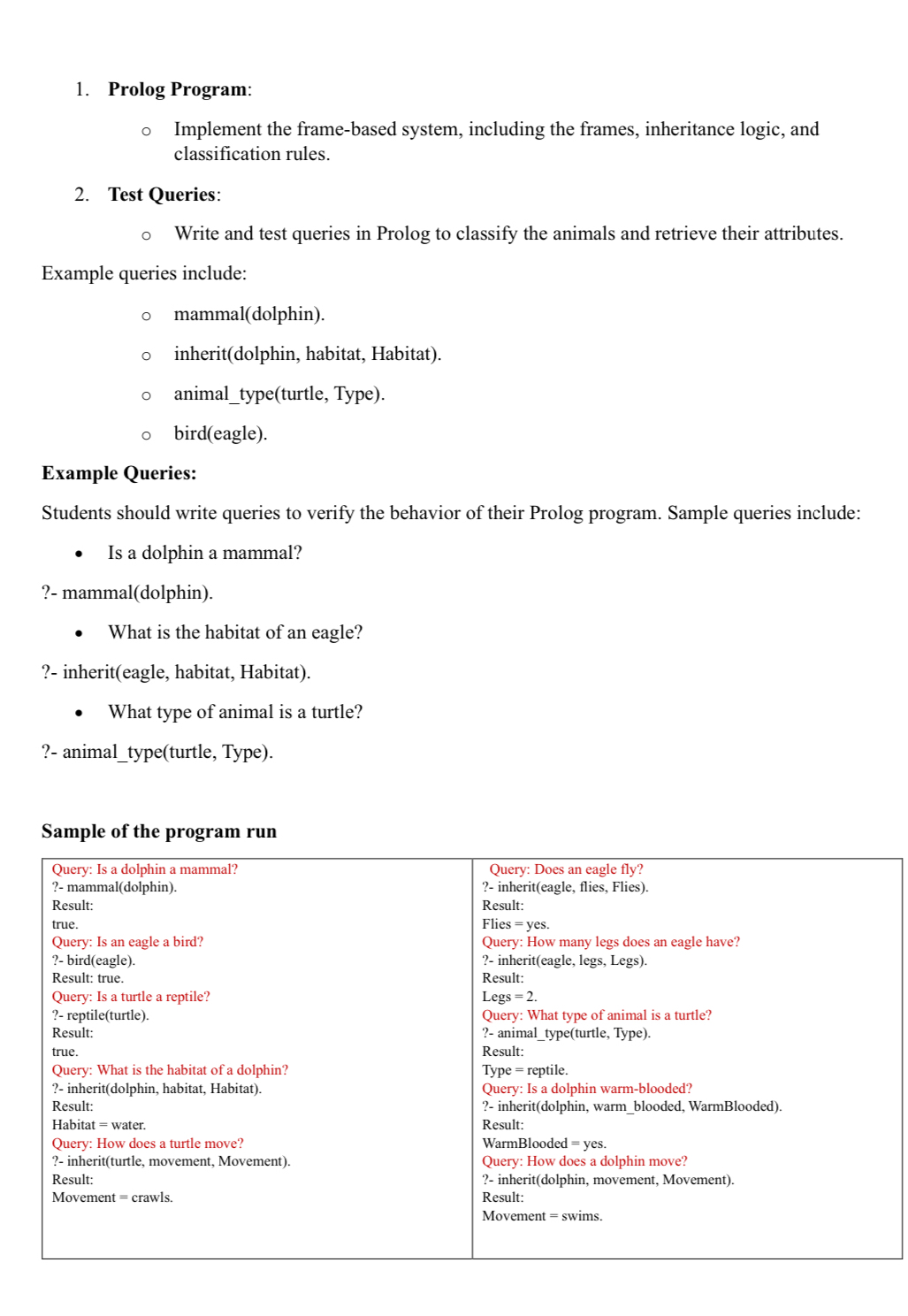
Example queries include:
mammaldolphin
inheritdolphin habitat, Habitat
animaltypeturtle Type
birdeagle
Example Queries:
Students should write queries to verify the behavior of their Prolog program. Sample queries include:
Is a dolphin a mammal?
mammaldolphin
What is the habitat of an eagle?
inheriteagle habitat, Habitat
What type of animal is a turtle?
animaltypeturtle Type
Sample of the program run
tableQuery: Is a dolphin a mammal?,Query: Does an eagle fly? mammaldolphin inheriteagle flies, FliesResult:Result:trueFlies yes.Query: Is an eagle a bird?,Query: How many legs does an eagle have? birdeagle inheriteagle legs, LegsResult: true.,Result:Query: Is a turtle a reptile?,Legs reptileturtleQuery: What type of animal is a turtle?Result: animaltypeturtle TypetrueResult:Query: What is the habitat of a dolphin?,Type reptile. inheritdolphin habitat, HabitatQuery: Is a dolphin warmblooded?Result: inheritdolphin warmblooded, WarmBloodedHabitat water.,Result:Query: How does a turtle move?,WarmBlooded yes. inheritturtle movement, MovementQuery: How does a d
Step by Step Solution
There are 3 Steps involved in it
1 Expert Approved Answer
Step: 1 Unlock

Question Has Been Solved by an Expert!
Get step-by-step solutions from verified subject matter experts
Step: 2 Unlock
Step: 3 Unlock
 Study Help