





Question: annotated bibliography At beginning of the assignment, a quick statement outlining the planned topic. my topic is Artificial Intelligence in the Health Care Space (1)

annotated bibliography

At beginning of the assignment,

a quick statement outlining the planned topic.

  • my topic is Artificial Intelligence in the Health Care Space (1) A summary of the main subject or problem discussed in the paper. As with reading questions, it's important to offer relevant background information. In this scenario, provide both essential background information and the specific question asked. (2) The author's thesis. After identifying the topic or problem, it's important to understand the solution. (3) Finally, a quick description of how this work relates to your selected topic. Is the author attempting to generate useful concepts to better grasp the topic? Are they arguing for a certain viewpoint on the topic? Is the paper's purpose to influence the larger conversation? Is their argument in support of or opposed to what you plan to discuss? At least 10 references must be included, arranged alphabetically by the author's last name. Citations should follow APA (7th ed.) format should be expressed as paragraphs with entire sentences, rather than bullet points. You may not utilize AI techniques to write this bibliography.
annotated bibliography At beginning of the
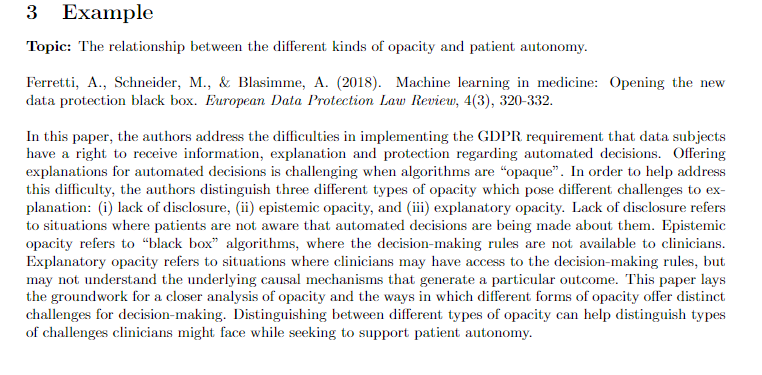
3 Example Topic: The relationship between the different kinds of opacity and patient autonomy. Ferretti, A., Schneider, M., & Blasimme, A. (2018). Machine learning in medicine: Opening the new data protection black box. European Data Protection Law Review, 4(3), 320-332. In this paper, the authors address the difficulties in implementing the GDPR requirement that data subjects have a right to receive information, explanation and protection regarding automated decisions. Offering explanations for automated decisions is challenging when algorithms are "opaque". In order to help address this difficulty, the authors distinguish three different types of opacity which pose different challenges to ex- planation: (i) lack of disclosure, (ii) epistemic opacity, and (iii) explanatory opacity. Lack of disclosure refers to situations where patients are not aware that automated decisions are being made about them. Epistemic opacity refers to "black box" algorithms, where the decision-making rules are not available to clinicians. Explanatory opacity refers to situations where clinicians may have access to the decision-making rules, but may not understand the underlying causal mechanisms that generate a particular outcome. This paper lays the groundwork for a closer analysis of opacity and the ways in which different forms of opacity offer distinct challenges for decision-making. Distinguishing between different types of opacity can help distinguish types of challenges clinicians might face while seeking to support patient autonomy

Step by Step Solution

There are 3 Steps involved in it

1 Expert Approved Answer
Step: 1 Unlock blur-text-image

Question Has Been Solved by an Expert!

Get step-by-step solutions from verified subject matter experts

Step: 2 Unlock
Step: 3 Unlock

Students Have Also Explored These Related Business Writing Questions!