







Question: Another Spread of Behavior Consider the network shown below. Everyone starts with a behavior B . Suppose we are interested in changing the behavior of
Another Spread of Behavior
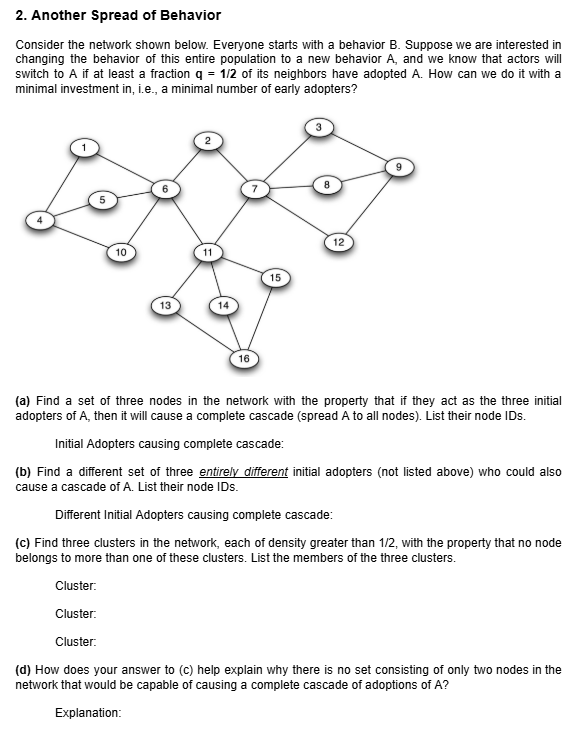
Consider the network shown below. Everyone starts with a behavior B Suppose we are interested in
changing the behavior of this entire population to a new behavior A and we know that actors will
switch to A if at least a fraction q of its neighbors have adopted A How can we do it with a
minimal investment in ie a minimal number of early adopters?
a Find a set of three nodes in the network with the property that if they act as the three initial
adopters of A then it will cause a complete cascade spread A to all nodes List their node IDs.
Initial Adopters causing complete cascade:
b Find a different set of three entirely different initial adopters not listed above who could also
cause a cascade of A List their node IDs.
Different Initial Adopters causing complete cascade:
c Find three clusters in the network, each of density greater than with the property that no node
belongs to more than one of these clusters. List the members of the three clusters.
Cluster:
Cluster:
Cluster:
d How does your answer to c help explain why there is no set consisting of only two nodes in the
network that would be capable of causing a complete cascade of adoptions of A
Explanation:
Step by Step Solution
There are 3 Steps involved in it
1 Expert Approved Answer
Step: 1 Unlock

Question Has Been Solved by an Expert!
Get step-by-step solutions from verified subject matter experts
Step: 2 Unlock
Step: 3 Unlock
 Study Help