Question: ANOVA I attached a sample ANOVA to the question and the results: ANOVA Results example A 2 (emotionality) x 2 (gender) Between subjects' analysis of
ANOVA
I attached a sample ANOVA to the question and the results:
ANOVA Results example
A 2 (emotionality) x 2 (gender) Between subjects' analysis of variance was conducted with the number of words recalled as the dependent variable. Assumptions concerning homogeneity of variance, independent samples, and normal populations were me.
A 2 (emotionality) x 2 (race) Between subjects' analysis of variance was conducted with the number of words recalled as the dependent variable. Assumptions concerning homogeneity of variance, independent samples, and normal populations were me.
Interaction: individuals given a free recall task recalled the same number of words regardless of whether the words were related (m=55) or unrelated (M=55) or unrelated (M=55). On the other hand, individuals given a paired associate task recalled more related words (M=45) versus unrelated words (M=30)
Main effects:
There was a main effect of A such that individuals recalled more words when given a free recall task (M=55) than when given a paired associate task (M=42.5) F (1,230) =4.52, p<.05.>
There was also a main effect of B such that individuals recalled more words when those words were related (M=50) than unrelated (M=42.5)
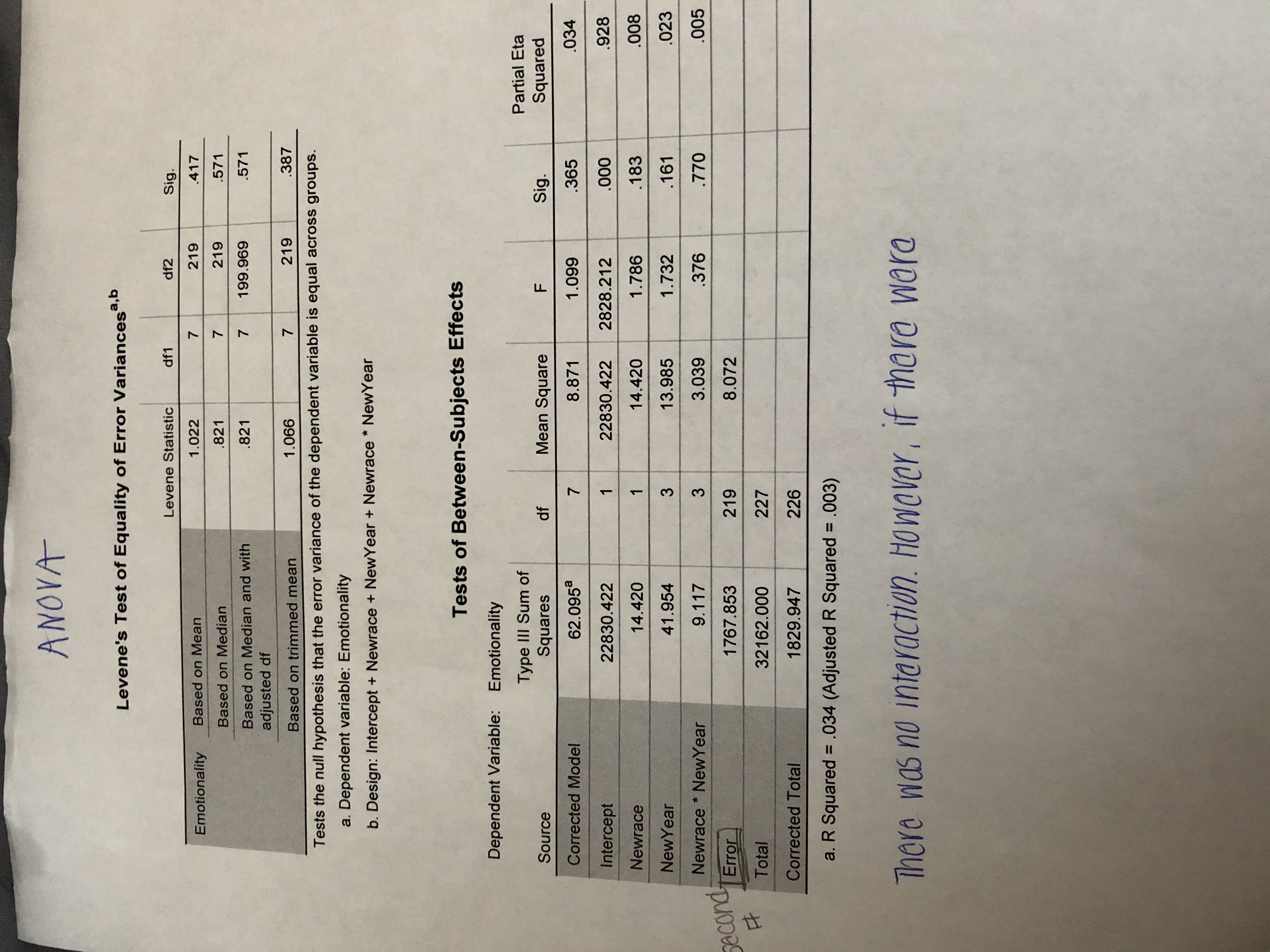
Degrees of freedom for the variable and degrees of error for the second number (1,227)
Separating females in one line vs males
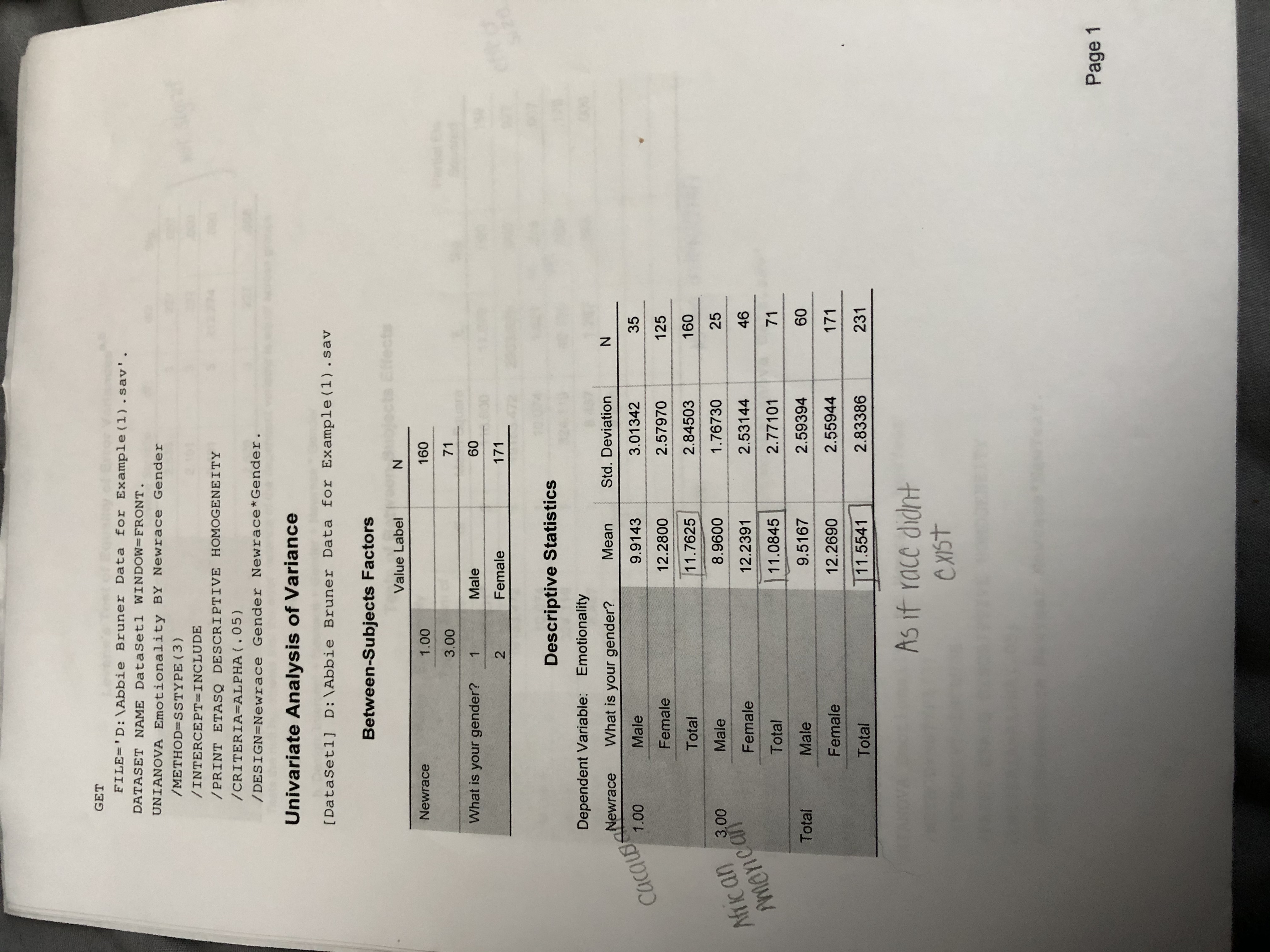
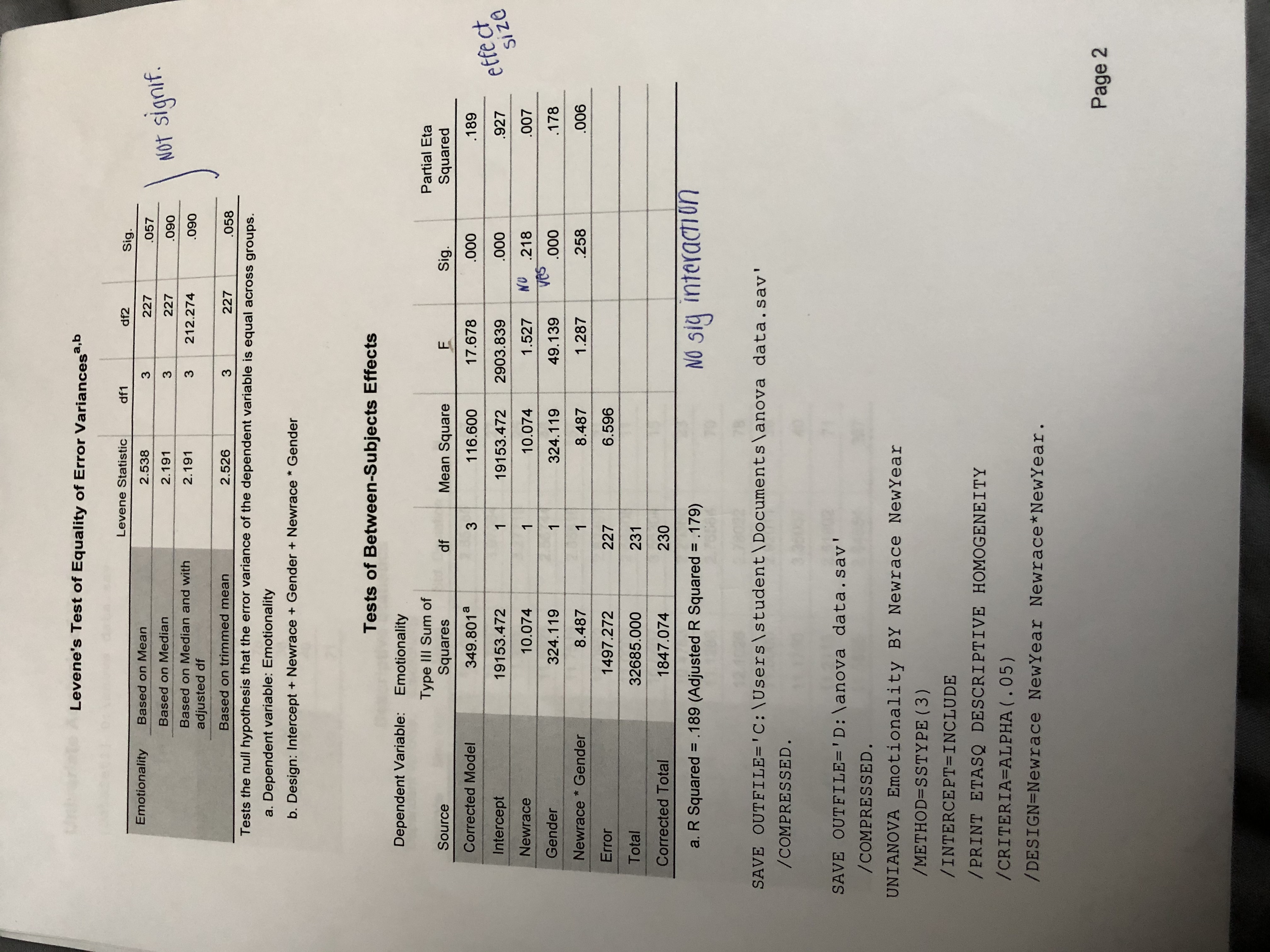
*****Using the results I provided, please fill in the Anova results with the correct information
first we are comparing gender and race (independent variables) dependent: emotionality
second, we are comparing year in school and race (independent variables) dependent: emotionality
for the interaction part, there wasn't an interaction. instead state, " there was no interaction, however if there were"
GET FILE='D: \\Abbie Bruner Data for Example (1) . sav' . DATASET NAME DataSet1 WINDOW=FRONT. UNIANOVA Emotionality BY Newrace Gender /METHOD=SSTYPE (3) / INTERCEPT=INCLUDE /PRINT ETASQ DESCRIPTIVE HOMOGENEITY /CRITERIA=ALPHA ( . 05) / DESIGN=Newrace Gender Newrace *Gender. Univariate Analysis of Variance [DataSet1] D: \\Abbie Bruner Data for Example (1) . sav Between-Subjects Factors Value Label N locis Effects Newrace 1.00 160 3.00 71 What is your gender? Male 60 2 Female 171 Descriptive Statistics Dependent Variable: Emotionality Newrace What is your gender? Mean Std. Deviation N cacause 1.00 Male 9.9143 3.01342 35 Female 12.2800 2.57970 125 Total 11.7625 2.84503 160 African 3,00 Male 8.9600 1.76730 25 American Female 12.2391 2.53144 46 Total 11.0845 2.77101 71 Total Male 9.5167 2.59394 60 Female 12.2690 2.55944 171 Total 11.5541 2.83386 231 As it race didn't exist Page 1Levene's Test of Equality of Error Variancesa,b Levene Statistic df1 df2 Sig. Emotionality Based on Mean 2.538 3 227 057 Based on Median 2.191 227 090 Not signif Based on Median and with 2. 191 3 212.274 090 adjusted df Based on trimmed mean 2.526 3 227 058 Tests the null hypothesis that the error variance of the dependent variable is equal across groups. a. Dependent variable: Emotionality b. Design: Intercept + Newrace + Gender + Newrace * Gender Tests of Between-Subjects Effects Dependent Variable: Emotionality Type Ill Sum of Partial Eta Source Squares df Mean Square Sig Squared Corrected Model 49.801a 3 116.600 17.678 .000 189 Intercept 19153.472 1 19153.472 2903.839 000 927 effect size Newrace 10.074 10.074 1.527 218 007 324.119 324.119 49.139 765 Gender 000 178 Newrace * Gender 8.487 8.487 1.287 258 006 Error 1497.272 227 6.596 Total 32685.000 231 Corrected Total 1847.074 230 a. R Squared = . 189 (Adjusted R Squared = .179) No sig interaction SAVE OUTFILE='C: \\Users\\student \\Documents \\anova data . sav' / COMPRESSED. SAVE OUTFILE='D: \\anova data . sav' /COMPRESSED. UNIANOVA Emotionality BY Newrace NewYear /METHOD=SSTYPE (3) /INTERCEPT=INCLUDE / PRINT ETASQ DESCRIPTIVE HOMOGENEITY /CRITERIA=ALPHA ( . 05) /DESIGN=Newrace NewYear Newrace* NewYear. Page 2ANOVA Levene's Test of Equality of Error Variancesa,b Levene Statistic df1 df2 Sig. Emotionality Based on Mean 1.022 7 219 417 Based on Median .821 219 571 Based on Median and with 821 7 199.969 571 adjusted df Based on trimmed mean 1.066 7 219 387 Tests the null hypothesis that the error variance of the dependent variable is equal across groups. a. Dependent variable: Emotionality b. Design: Intercept + Newrace + NewYear + Newrace * NewYear Tests of Between-Subjects Effects Dependent Variable: Emotionality Type Ill Sum of Partial Eta Source Squares df Mean Square F Sig Squared Corrected Model 62.095a 7 8.871 1.099 365 034 Intercept 22830.422 22830.422 2828.212 .000 928 Newrace 14.420 1 14.420 1.786 183 008 NewYear 41.954 3 13.985 1.732 161 023 Newrace * NewYear 9.117 3 3.039 376 770 005 second Error 1767.853 219 8.072 Total 32162.000 227 Corrected Total 1829.947 226 a. R Squared = .034 (Adjusted R Squared = .003) There was no interaction. However, if there were









 Study Help