





Question: ans A correlation coefficient is a number from -1.0 and +1.0 that gives us two important pieces of information: the direction of the relationship (positive

ans
ans A correlation coefficient is a number from
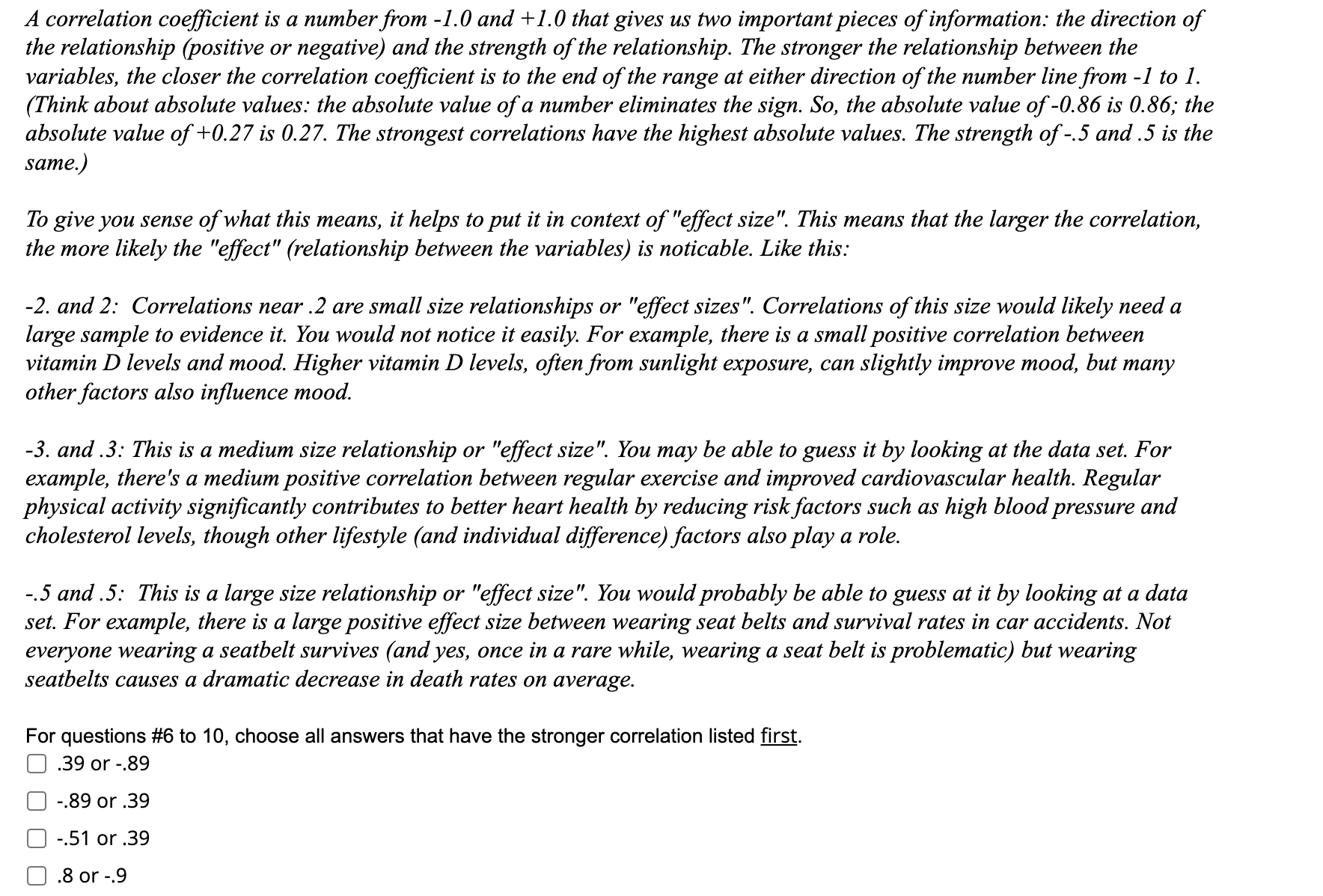
A correlation coefficient is a number from -1.0 and +1.0 that gives us two important pieces of information: the direction of the relationship (positive or negative) and the strength of the relationship. The stronger the relationship between the variables, the closer the correlation coefficient is to the end of the range at either direction of the number line from -1 to 1. (Think about absolute values: the absolute value of a number eliminates the sign. So, the absolute value of -0.86 is 0.86; the absolute value of +0.27 is 0.27. The strongest correlations have the highest absolute values. The strength of -.5 and .5 is the same.) To give you sense of what this means, it helps to put it in context of "effect size". This means that the larger the correlation, the more likely the "effect\" (velationship between the variables) is noticable. Like this: -2. and 2: Correlations near .2 are small size relationships or "effect sizes". Correlations of this size would likely need a large sample to evidence it. You would not nofice it easily. For example, there is a small positive correlation between vitamin D levels and mood. Higher vitamin D levels, often from sunlight exposure, can slightly improve mood, but many other factors also influence mood. -3. and .3: This is a medium size relationship or "effect size\". You may be able to guess it by looking at the data set. For example, there's a medium positive correlation between regular exercise and improved cardiovascular health. Regular Pphysical activity significantly contributes to better heart health by reducing risk factors such as high blood pressure and cholesterol levels, though other lifestyle (and individual difference) factors also play a role. - 5and.5: Thisis a large size relationship or "effect size". You would probably be able to guess at it by looking at a data set. For example, there is a large positive effect size between wearing seat belts and survival rates in car accidents. Not everyone wearing a seatbelt survives (and yes, once in a rare while, wearing a seat belt is problematic) but wearing seatbelts causes a dramatic decrease in death rates on average. For questions #6 to 10, choose all answers that have the stronger correlation listed first. () .39 0r-.89 (] -.890r.39 (J-510r.39 () .8or-9

Step by Step Solution

There are 3 Steps involved in it

1 Expert Approved Answer
Step: 1 Unlock blur-text-image

Question Has Been Solved by an Expert!

Get step-by-step solutions from verified subject matter experts

Step: 2 Unlock
Step: 3 Unlock

Students Have Also Explored These Related Finance Questions!