







Question: ans all step by step bt plese gives the ans properly..pls solved in papers.. do not gives hint do ans properly.. Define big-oh, big-omega and
ans all step by step bt plese gives the ans properly..pls solved in papers.. do not gives hint do ans properly..
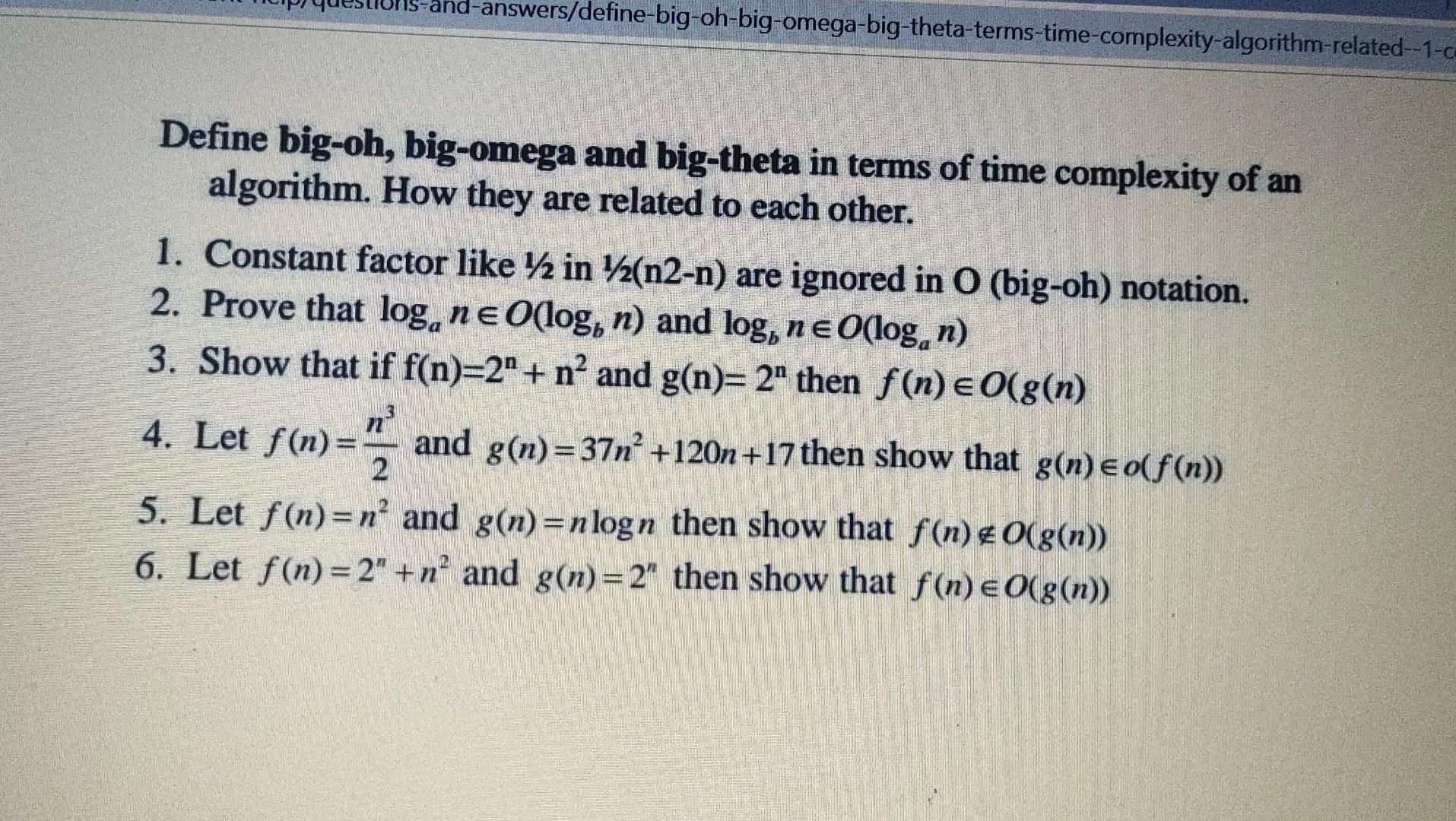
Define big-oh, big-omega and big-theta in terms of time complexity of an algorithm. How they are related to each other. 1. Constant factor like 1/2 in 1/2(n2n) are ignored in O (big-oh) notation. 2. Prove that loganO(logbn) and logbnO(logan) 3. Show that if f(n)=2n+n2 and g(n)=2n then f(n)O(g(n) 4. Let f(n)=2n3 and g(n)=37n2+120n+17 then show that g(n)O(f(n)) 5. Let f(n)=n2 and g(n)=nlogn then show that f(n)/O(g(n)) 6. Let f(n)=2n+n2 and g(n)=2n then show that f(n)O(g(n)) Define big-oh, big-omega and big-theta in terms of time complexity of an algorithm. How they are related to each other. 1. Constant factor like 1/2 in 1/2(n2n) are ignored in O (big-oh) notation. 2. Prove that loganO(logbn) and logbnO(logan) 3. Show that if f(n)=2n+n2 and g(n)=2n then f(n)O(g(n) 4. Let f(n)=2n3 and g(n)=37n2+120n+17 then show that g(n)O(f(n)) 5. Let f(n)=n2 and g(n)=nlogn then show that f(n)/O(g(n)) 6. Let f(n)=2n+n2 and g(n)=2n then show that f(n)O(g(n))
Step by Step Solution
There are 3 Steps involved in it

Get step-by-step solutions from verified subject matter experts
 Study Help