







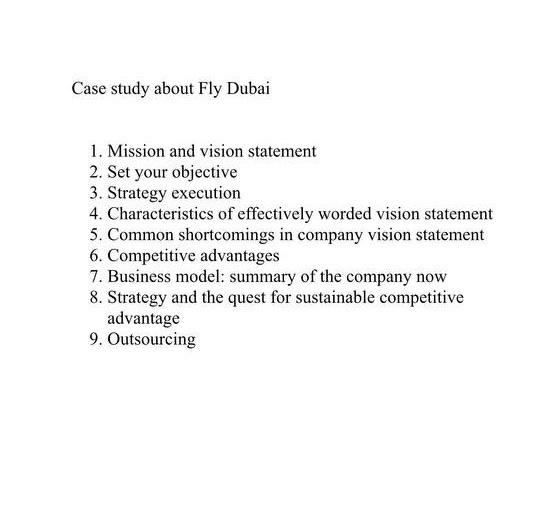
Question: answer 1. Mission and vision statement 2. Set your objective 3. Strategy execution 4. Characteristics of effectively worded vision statement 5. Common shortcomings in company
answer
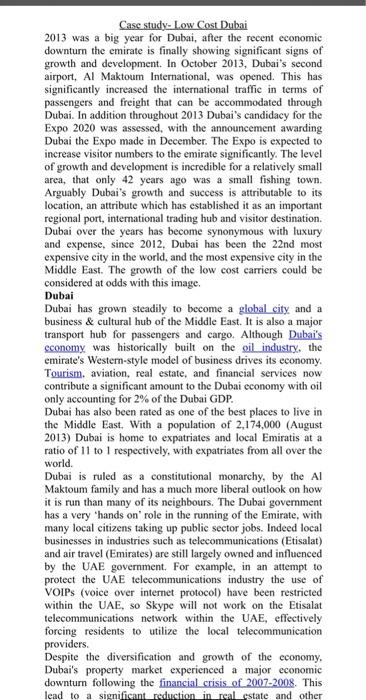
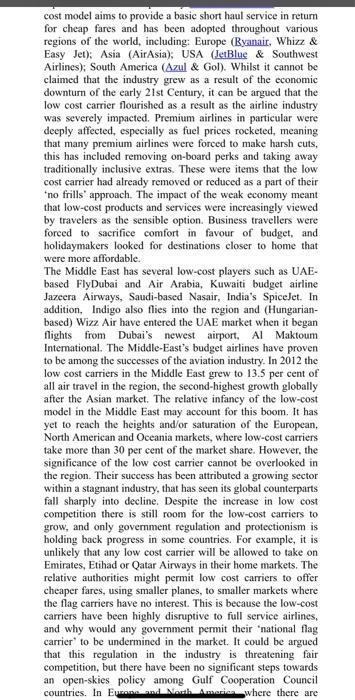
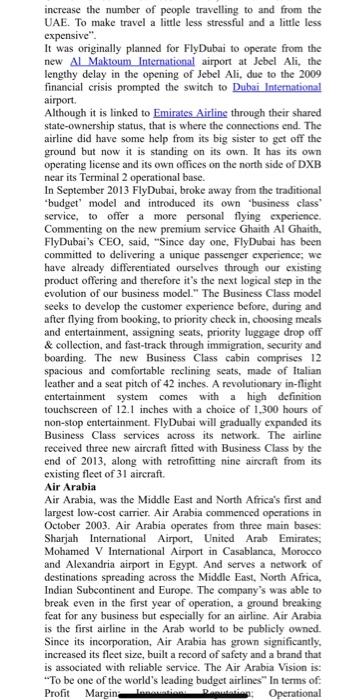
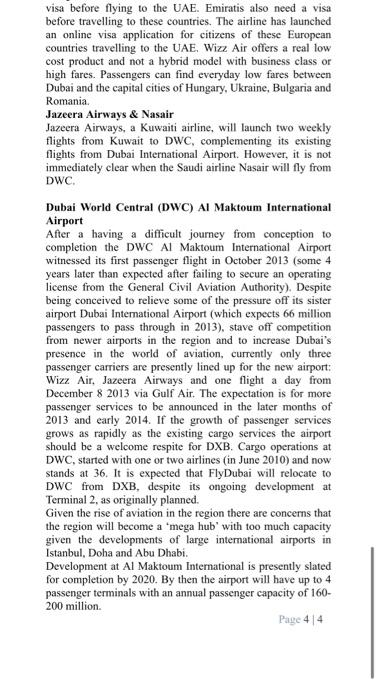
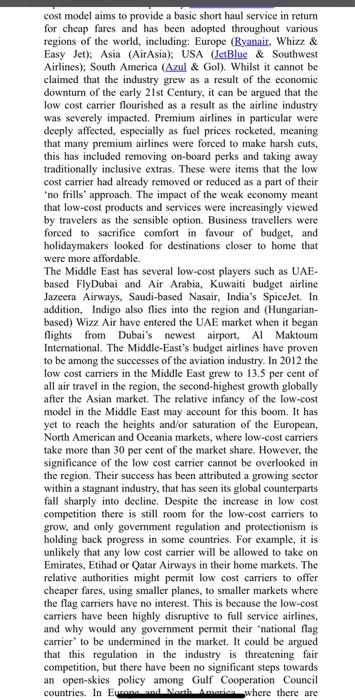
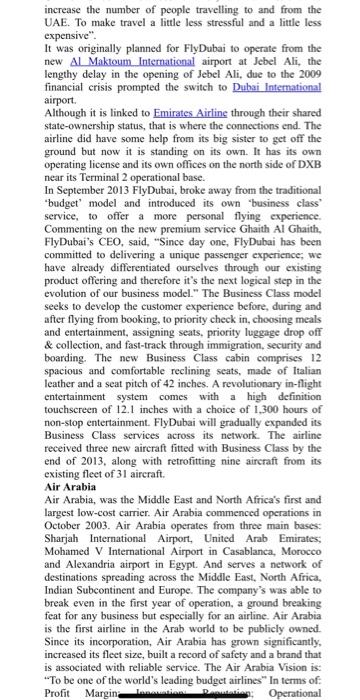
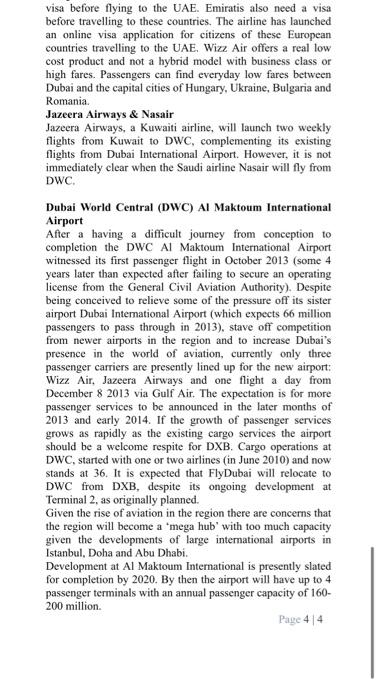
1. Mission and vision statement 2. Set your objective 3. Strategy execution 4. Characteristics of effectively worded vision statement 5. Common shortcomings in company vision statement 6. Competitive advantages 7. Business model: summary of the company now 8. Strategy and the quest for sustainable competitive advantage 9. Outsourcing Case study=Low Cost Dubai 2013 was a big year for Dubai, after the recent economic downturn the emirate is finally showing significant signs of growth and development. In October 2013, Dubai's second airport, Al Maktoum International, was opened. This has significantly increased the international traffic in terms of passengers and freight that can be accommodated through Dubai. In addition throughout 2013 Dubai's candidacy for the Expo 2020 was assessed, with the announcement awarding Dubai the Expo made in December. The Expo is expected to increase visitor numbers to the emirate significantly. The level of growth and development is incredible for a relatively small area, that only 42 years ago was a small fishing town. Arguably Dubai's growth and success is attributable to its location, an attribute which has established it as an important regional port, international trading hub and visitor destination. Dubai over the years has become synonymous with luxury and expense, since 2012, Dubai has been the 22nd most expensive city in the world, and the most expensive city in the Middle East. The growth of the low cost carriers could be considered at odds with this image. Dubai Dubai has grown steadily to become a global city and a business \& cultural hub of the Middle East. It is also a major transport hub for passengers and cargo. Although Dubai's cconomy was historically built on the gil industry. the emirate's Western-style model of business drives its economy. Tourism. aviation, real estate, and financial services now contribute a significant amount to the Dubai economy with oil only accounting for 2% of the Dubai GDP. Dubai has also been rated as one of the best places to live in the Middle East. With a population of 2,174,000 (August 2013) Dubai is home to expatriates and local Emiratis at a ratio of 11 to 1 respectively, with expatriates from all over the world. Dubai is ruled as a constitutional monarchy, by the Al Maktoum family and has a much more liberal outlook on how it is run than many of its neighbours. The Dubai government has a very 'hands on' role in the running of the Emirate, with many local citizens taking up public sector jobs. Indeed local businesses in industries such as telecommunications (Etisalat) and air travel (Emirates) are still largely owned and influenced by the UAE government. For example, in an attempt to protect the UAE telecommunications industry the use of VOIPs (voice over internet protocol) have been restricted within the UAE, so Skype will not work on the Etisalat telecommunications network within the UAE, effectively forcing residents to utilize the local telecommunication providers. Despite the diversification and growth of the economy. Dubai's property market experienced a major economic downturn following the financial crisis of 2007-2008. This lead to a significant reduction in real estate and other cost model aims to provide a basic short haul service in return for cheap fares and has been adopted throughout various regions of the world, including: Europe (Byamair, Whizz \& Easy Jet): Asia (AirAsia); USA (JetBlue \& Southwest Airlines); South America (Azul \& Gol). Whitst it cannot be claimed that the industry grew as a result of the economic downturn of the early 21 st Century, it can be argued that the low cost carrier flourished as a result as the airline industry was severely impacted. Premium airlines in particular were deeply affected, especially as fuel prices rocketed, meaning that many premium airlines were forced to make harsh cuts, this has included removing on-board perks and taking away traditionally inclusive extras. These were items that the low cost carrier had already removed or reduced as a part of their 'no frills' approach. The impact of the weak economy meant that low-cost products and services were increasingly viewed by travelers as the sensible option. Business travellers were forced to sacrifice comfort in favour of budget, and holidaymakers looked for destinations closer to home that were more affordable. The Middle East has several low-cost players such as UAEbased FlyDubai and Air Arabia, Kuwaiti budget airline Jazeera Airways, Saudi-based Nasair, India's Spicelet. In addition, Indigo also flies into the region and (Hungarianbased) Wizz Air have entered the UAE market when it began flights from Dubai's newest airport, Al Maktoum Intemational. The Middle-East's budget airlines have proven to be among the successes of the aviation industry. In 2012 the low cost carriers in the Middle East grew to 13.5 per cent of all air travel in the region, the second-highest growth globally after the Asian market. The relative infancy of the low-cost model in the Middle East may account for this boom. It has yet to reach the heights and/or saturation of the European, North American and Oceania markets, where low-cost carriers take more than 30 per cent of the market share. However, the significance of the low cost carrier cannot be overlooked in the region. Their success has been attributed a growing sector within a stagnant industry, that has seen its global counterparts fall sharply into decline. Despite the increase in low cost competition there is still room for the low-cost carriers to grow, and only government regulation and protectionism is holding back progress in some countries. For example, it is unlikely that any low cost carrier will be allowed to take on Emirates, Etihad or Qatar Airways in their home markets. The relative authorities might permit low cost carriers to offer cheaper fares, using smaller planes, to smaller markets where the flag carriers have no interest. This is because the low-cost carriers have been highly disruptive to full service airlines, and why would any govermment permit their 'national flag carrier' to be undermined in the market. It could be argued that this regulation in the industry is threatening fair competition, but there have been no significant steps towards an open-skies policy among Gulf Cooperation Council increase the number of people travelling to and from the UAE. To make travel a little less stressful and a little less expensive". It was originally planned for FlyDubai to operate from the new l Maktoum Intemational airport at Jebel Ali, the lengthy delay in the opening of Jebel Ali, due to the 2009 financial crisis prompted the switch to Dubai Intemational airport. Although it is linked to Emirates Airline through their shared state-ownership status, that is where the connections end. The airline did have some help from its big sister to get off the ground but now it is standing on its own. It has its own operating license and its own offices on the north side of DXB near its Terminal 2 operational base. In September 2013 FlyDubai, broke away from the traditional 'budget' model and introduced its own 'business class' service, to offer a more personal flying experience. Commenting on the new premium service Ghaith Al Ghaith. FlyDubai's CEO, said, "Since day one, FlyDubai has been committed to delivering a unique passenger experience; we have already differentiated ourselves through our existing product offering and therefore it's the next logical step in the evolution of our business model." The Business Class model seeks to develop the customer experience before, during and after flying from booking, to priority check in, choosing meals and entertainment, assigning seats, priority luggage drop off boarding. The new Business Class cabin comprises 12 spacious and comfortable reclining seats, made of ltalian leather and a seat pitch of 42 inches. A revolutionary in-flight entertainment system comes with a high definition touchscreen of 12.1 inches with a choice of 1,300 hours of non-stop entertainment. FlyDubai will gradually expanded its Business Class services across its network. The airline received three new aircraft fitted with Business Class by the end of 2013, along with retrofitting nine aircraft from its existing fleet of 31 aircraft. Air Arabia Air Arabia, was the Middle East and North Africa's first and largest low-cost carrier. Air Arabia commenced operations in October 2003. Air Arabia operates from three main bases: Sharjah International Airport, United Arab Emirates; Mohamed V International Airport in Casablanca, Morocco and Alexandria airport in Egypt. And serves a network of destinations spreading across the Middle East, North Africa, Indian Subcontinent and Europe. The company's was able to break even in the first year of operation, a ground breaking is the first airline in the Arab world to be publicly owned. Since its incorporation, Air Arabia has grown significantly, increased its fleet size, built a record of safety and a brand that is associated with reliable service. The Air Arabia Vision is: "To be one of the world's leading budget airlines" In terms of: Profit Margin momation Demantion: Operational visa before flying to the UAE. Emiratis also need a visa before travelling to these countries. The airline has launched an online visa application for citizens of these European countries travelling to the UAE. Wizz Air offers a real low cost product and not a hybrid model with business class or high fares. Passengers can find everyday low fares between Dubai and the capital cities of Hungary, Ukraine, Bulgaria and Romania. Jazeera Airways \& Nasair Jazeera Airways, a Kuwaiti airline, will launch two weekly flights from Kuwait to DWC, complementing its existing flights from Dubai International Airport. However, it is not immediately clear when the Saudi airline Nasair will fly from DWC. Dubai World Central (DWC) Al Maktoum International Airport After a having a difficult journey from conception to After a having a difficult journey from conception to completion the DWC Al Maktoum International Airport witnessed its first passenger flight in October 2013 (some 4 years later than expected after failing to secure an operating license from the General Civil Aviation Authority). Despite being conceived to relieve some of the pressure off its sister airport Dubai Intemational Airport (which expects 66 million passengers to pass through in 2013), stave off competition from newer airports in the region and to increase Dubai's presence in the world of aviation, currently only three Wizz Air, Jazeera Airways and one flight a day from Wizz Air, Jazeera Airways and one flight a day from December 82013 via Gulf Air. The expectation is for more 2013 and early 2014. If the growth of passenger services grows as rapidly as the existing cargo services the airport should be a welcome respite for DXB. Cargo operations at DWC, started with one or two airlines (in June 2010) and now stands at 36 . It is expected that FlyDubai will relocate to DWC from DXB, despite its ongoing development at Terminal 2 , as originally planned. Given the rise of aviation in the region there are concerns that the region will become a 'mega hub' with too much capacity given the developments of large international airports in Istanbul, Doha and Abu Dhabi. Development at AlMaktoum Intemational is presently slated for completion by 2020 . By then the airport will have up to 4 passenger terminals with an annual passenger capacity of 160 200 million. Page 44 cost model aims to provide a basic short haul service in return for cheap fares and has been adopted throughout various regions of the world, including: Europe (Byamair, Whizz \& Easy Jet); Asia (AirAsia); USA (JetBlue \& Southwest Airlines); South America (Azul \& Gol). Whilst it cannot be claimed that the industry grew as a result of the economic downturn of the early 21 st Century, it can be argued that the low cost carrier flourished as a result as the airline industry was severely impacted. Premium airlines in particular were deeply affected, especially as fuel prices rocketed, meaning that many premium airlines were forced to make harsh cuts, this has included removing on-board perks and taking away traditionally inclusive extras. These were items that the low cost carrier had already removed or reduced as a part of their 'no frills' approach. The impact of the weak economy meant that low-cost products and services were increasingly viewed by travelers as the sensible option. Business travellers were forced to sacrifice comfort in favour of budget, and holidaymakers looked for destinations closer to home that were more affordable. The Middle East has several low-cost players such as UAEbased FlyDubai and Air Arabia, Kuwaiti budget airline Jazeera Airways, Saudi-based Nasair, India's Spicelet. In addition, Indigo also flies into the region and (Hungarianbased) Wizz Air have entered the UAE market when it began flights from Dubai's newest airport. Al Maktoum Intemational. The Middle-East's budget airlines have proven to be among the successes of the aviation industry. In 2012 the low cost carriers in the Middle East grew to 13.5 per cent of all air travel in the region, the second-highest growth globally after the Asian market. The relative infancy of the low-cost model in the Middle East may account for this boom. It has yet to reach the heights and/or saturation of the European, North American and Oceania markets, where low-cost carriers take more than 30 per cent of the market share. However, the significance of the low cost carrier cannot be overlooked in the region. Their success has been attributed a growing sector within a stagnant industry, that has seen its global counterparts fall sharply into decline. Despite the increase in low cost competition there is still room for the low-cost carriers to grow, and only government regulation and protectionism is holding back progress in some countries. For example, it is unlikely that any low cost carrier will be allowed to take on Emirates, Etihad or Qatar Airways in their home markets. The relative authorities might permit low cost carriers to offer cheaper fares, using smaller planes, to smaller markets where the flag carriers have no interest. This is because the low-cost carriers have been highly disruptive to full service airlines, and why would any govemment permit their "national flag carrier' to be undermined in the market. It could be argued that this regulation in the industry is threatening fair competition, but there have been no significant steps towards an open-skies policy among Gulf Cooperation Council increase the number of people travelling to and from the UAE. To make travel a little less stressful and a little less expensive". It was originally planned for FlyDubai to operate from the new Al Maktoum Intemational airport at Jebel Ali, the lengthy delay in the opening of Jebel Ali, due to the 2009 financial crisis prompted the switch to Dubai Intemational airport. Although it is linked to Emirates Airline through their shared state-ownership status, that is where the connections end. The airline did have some help from its big sister to get off the ground but now it is standing on its own. It has its own operating license and its own offices on the north side of DXB near its Terminal 2 operational base. In September 2013 FlyDubai, broke away from the traditional 'budget' model and introduced its own 'business class' service, to offer a more personal flying experience. Commenting on the new premium service Ghaith Al Ghaith, FlyDubai's CEO, said, "Since day one, FlyDubai has been committed to delivering a unique passenger experience; we have already differentiated ourselves through our existing product offering and therefore it's the next logical step in the evolution of our business model." The Business Class model seeks to develop the customer experience before, during and after flying from booking, to priority check in, choosing meals and entertainment, assigning seats, priority luggage drop off boarding. The new Business Class cabin comprises 12 spacious and comfortable reclining seats, made of ltalian leather and a seat pitch of 42 inches. A revolutionary in-flight entertainment system comes with a high definition touchscreen of 12.1 inches with a choice of 1,300 hours of non-stop entertainment. FlyDubai will gradually expanded its Business Class services across its network. The airline received three new aircraft fitted with Business Class by the end of 2013, along with retrofitting nine aircraft from its existing fleet of 31 aircraft. Air Arabia Air Arabia, was the Middle East and North Africa's first and largest low-cost carrier. Air Arabia commenced operations in October 2003. Air Arabia operates from three main bases: Sharjah International Airport, United Arab Emirates; Mohamed V International Airport in Casablanca, Morocco and Alexandria airport in Egypt. And serves a network of destinations spreading across the Middle East, North Africa, Indian Subcontinent and Europe. The company's was able to break even in the first year of operation, a ground breaking is the first airline in the Arab world to be publicly owned. Since its incorporation, Air Arabia has grown significantly, increased its fleet size, built a record of safety and a brand that is associated with reliable service. The Air Arabia Vision is: "To be one of the world's leading budget airlines" In terms of: visa before flying to the UAE. Emiratis also need a visa before travelling to these countries. The airline has launched an online visa application for ctizens of these European countries travelling to the UAE. Wizz Air offers a real low cost product and not a hybrid model with business class or high fares. Passengers can find everyday low fares between Dubai and the capital cities of Hungary, Ukraine, Bulgaria and Romania. Jazeera Airways \& Nasair Jazeera Airways, a Kuwaiti airline, will launch two weekly flights from Kuwait to DWC, complementing its existing flights from Dubai International Airport. However, it is not immediately clear when the Saudi airline Nasair will fly from DWC. Dubai World Central (DWC) Al Maktoum International Airport After a having a difficult journey from conception to After a having a difficult journey from conception to completion the DWC Al Maktoum International Airport witnessed its first passenger flight in October 2013 (some 4 years later than expected after failing to secure an operating license from the General Civil Aviation Authority). Despite being conceived to relieve some of the pressure off its sister airport Dubai Intemational Airport (which expects 66 million passengers to pass through in 2013), stave off competition from newer airports in the region and to increase Dubai's presence in the world of aviation, currently only three passenger carriers are presently lined up for the new airport: Wizz Air, Jazeera Airways and one flight a day from December 82013 via Gulf Air. The expectation is for more 2013 and early 2014. If the growth of passenger services grows as rapidly as the existing cargo services the airport should be a welcome respite for DXB. Cargo operations at DWC, started with one or two airlines (in June 2010 ) and now DWC, started with one or two airlines (in June 2010 ) and now DWC from DXB, despite its ongoing development at Terminal 2, as originally planned. Given the rise of aviation in the region there are concerns that the region will become a 'mega hub' with too much capacity given the developments of large international airports in Istanbul, Doha and Abu Dhabi. Development at Al Maktoum International is presently slated for completion by 2020 . By then the airport will have up to 4 passenger terminals with an annual passenger capacity of 160 200 million. Page 44 Step by Step Solution
There are 3 Steps involved in it
1 Expert Approved Answer
Step: 1 Unlock

Question Has Been Solved by an Expert!
Get step-by-step solutions from verified subject matter experts
Step: 2 Unlock
Step: 3 Unlock
 Study Help