







Question: Answer: 1=59.742=83.46,3=113.05, 4=150.89 Code in MATLAB Numerical Methods for Engineers Chapter 12: Problem 38 The answer that I am getting is different than the values
Answer: 1=59.742=83.46,3=113.05, 4=150.89
Code in MATLAB
Numerical Methods for Engineers Chapter 12: Problem 38
The answer that I am getting is different than the values I typed above. Could you please help?
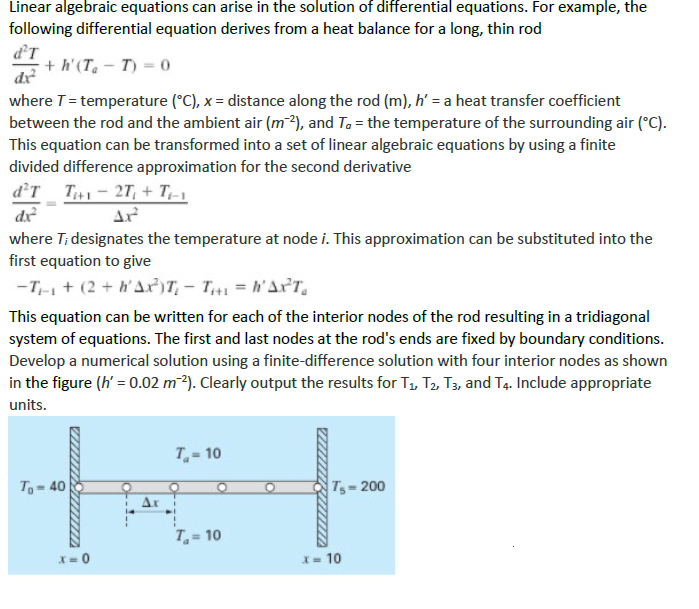
Linear algebraic equations can arise in the solution of differential equations. For example, the following differential equation derives from a heat balance for a long, thin rod +' (T-T) = 0 dr where T = temperature (C), x= distance along the rod (m), h' = a heat transfer coefficient between the rod and the ambient air (m2), and To = the temperature of the surrounding air (C). This equation can be transformed into a set of linear algebraic equations by using a finite divided difference approximation for the second derivative dT T+1 - 2T + T-1 dx Ar where Ti designates the temperature at node i. This approximation can be substituted into the first equation to give -T-1 + (2 + "'Art - T:+1 = l'Art, This equation can be written for each of the interior nodes of the rod resulting in a tridiagonal system of equations. The first and last nodes at the rod's ends are fixed by boundary conditions. Develop a numerical solution using a finite-difference solution with four interior nodes as shown in the figure (h' = 0.02 m 2). Clearly output the results for T1, T2, T3, and T4. Include appropriate units. T. -10 T, -40 t Ts - 200 A - T. - 10 I=0 X = 10 Linear algebraic equations can arise in the solution of differential equations. For example, the following differential equation derives from a heat balance for a long, thin rod +' (T-T) = 0 dr where T = temperature (C), x= distance along the rod (m), h' = a heat transfer coefficient between the rod and the ambient air (m2), and To = the temperature of the surrounding air (C). This equation can be transformed into a set of linear algebraic equations by using a finite divided difference approximation for the second derivative dT T+1 - 2T + T-1 dx Ar where Ti designates the temperature at node i. This approximation can be substituted into the first equation to give -T-1 + (2 + "'Art - T:+1 = l'Art, This equation can be written for each of the interior nodes of the rod resulting in a tridiagonal system of equations. The first and last nodes at the rod's ends are fixed by boundary conditions. Develop a numerical solution using a finite-difference solution with four interior nodes as shown in the figure (h' = 0.02 m 2). Clearly output the results for T1, T2, T3, and T4. Include appropriate units. T. -10 T, -40 t Ts - 200 A - T. - 10 I=0 X = 10
Step by Step Solution
There are 3 Steps involved in it

Get step-by-step solutions from verified subject matter experts
 Study Help