







Question: ANSWER 2-6 PLEASE PLEASE PLEASE!!!! 2. (5 points) for what values of n is mac{f(n), o(f(n))} = f(n) true? Assume f(n) is asymptotically positive 3.
 ANSWER 2-6 PLEASE PLEASE PLEASE!!!!
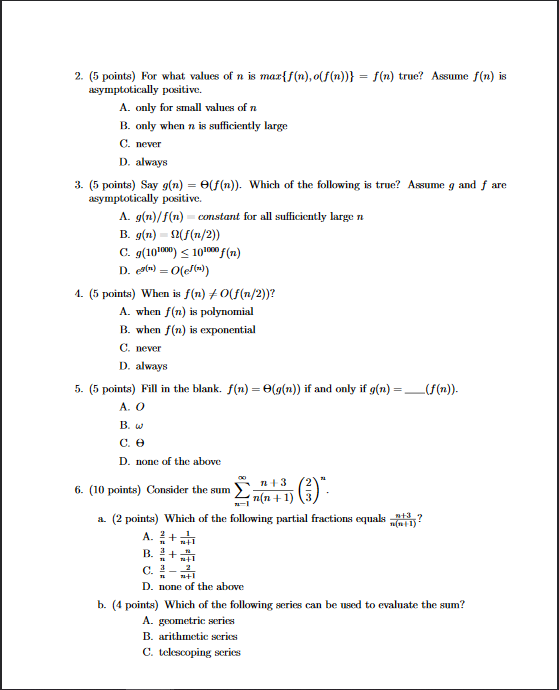
2. (5 points) for what values of n is mac{f(n), o(f(n))} = f(n) true? Assume f(n) is asymptotically positive
3. Say g(n) = (f(n)). Which of the following is true? Assume g and f are asymptotically positive.
4. When is f(n) O(f(n/2))?
5. Fill in the blank. f(n)=(g(n)) if and only if g(n) = ____(f(n)).
6. Consider the sum E (n+3)/(n(n+1)) * ()^n
a. Which of the following partial fractions equals (n+3)/(n(n+1))?
b. Which of the following series can be used to evaluate the sum?
2. (5 points) For what values of n is mar{f(n), f(n))} = f(n) true? Assume f(n) is asymptotically positive. A. only for small values of n B. only when n is sufficiently large C. never D. always 3. (5 points) Say g(n) = e(f(n)). Which of the following is true? Assume , and f are asymptotically positive. A. g(n)/f(n) - constant for all sufficiently large n B. g(n)-1(f(n/2)) C. g(10) S 101000f(n) D. *) = 0(en)) 1. (5 points) When is f(n) +0(f(n/2))? A. when f(n) is polynomial B. when f(n) is exponential C. never D. always 5. (5 points) Fill in the blank. f(n) = (g(n)) if and only if g(n)=__(f(n)). A. O B. w C. D. none of the above ()" 6. (10 points) Consider the sum +3 n(n+1) a. (2 points) Which of the following partial fractions equals lui? A++ B. + TE c. 1 2 w+I D. none of the above b. (4 points) Which of the following series can be used to evaluate the sum? A. geometric miris B. arithmetic series C. telescoping series
Step by Step Solution
There are 3 Steps involved in it

Get step-by-step solutions from verified subject matter experts
 Study Help