







Question: Answer 3 & 6 A machine stores floating point number in a (1 + 1 + 5 - 4)-bit word. The first bit is for
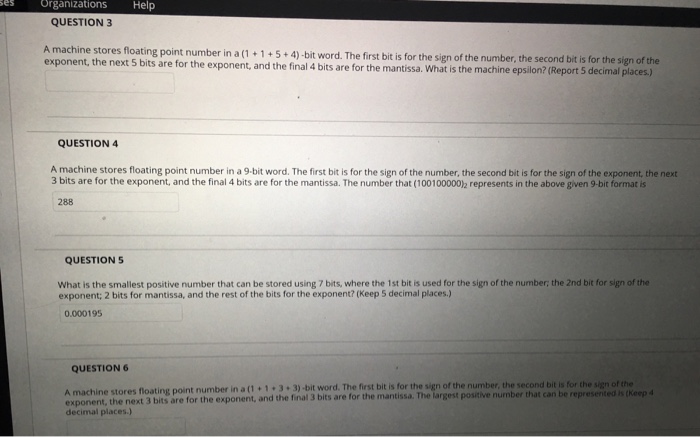
A machine stores floating point number in a (1 + 1 + 5 - 4)-bit word. The first bit is for the sign of the number, the second bit is for the sign of the exponent, the next 5 bit for the exponent, and the final 4 bit are the for the mantissa. What is the machine epsilon?(Report 5 decimal places.) A machine stores floating point number in a 9-bit word. The first bit is for the sign of the number, the second bit is for the sign of the exponent, the next 3 bits are for the exponent, and the final 4 bits are for the mantissa. The number that (100100000)_2 represents in the above given 9-bit format is 288 What is the smallest positive number that can be stored using 7 bits, where the 1st bit is used for the sign of the number: the 2nd bit for sign of the exponent: 2 bits for mantissa, and the rest of the bits for the exponent? (Keep 9 decimal places.) 0.000195 A machine stores floating point number in a (1 + 1 + 3 + 3)-bit word. The first bit is for the sign of the number, the second bit is for the sign of the exponent, the next 3 bit are for the exponent, and the final 3 bits are for the mantissa. The largest positive number that can be representing (Keep 4 decimal places.)
Step by Step Solution
There are 3 Steps involved in it

Get step-by-step solutions from verified subject matter experts
 Study Help