







Question: answer #3 please :) Alibaba and Global Supply Chains carries over into how customers interact with the com- pany. Alibaba has seamlessly adapted its e-commerce
answer #3 please :)
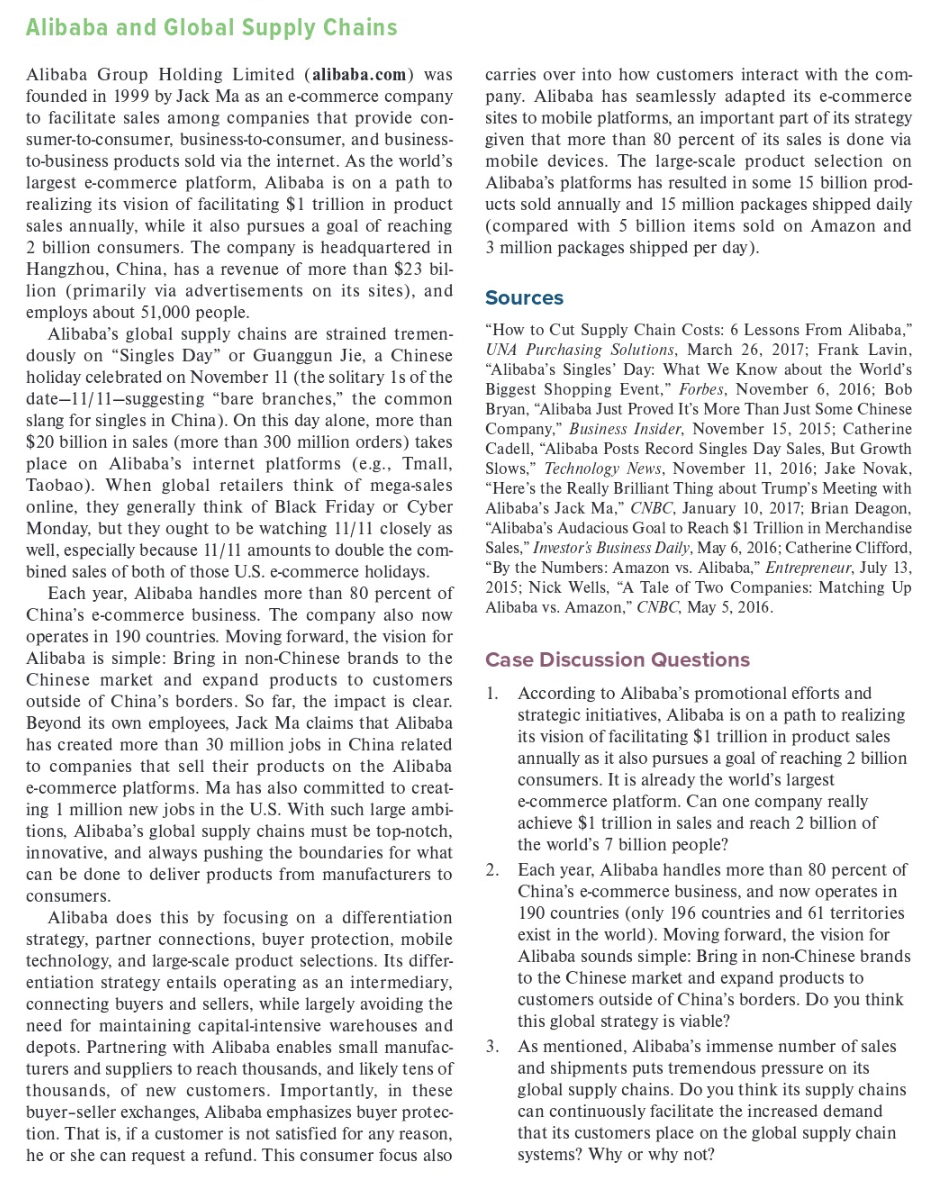
Alibaba and Global Supply Chains carries over into how customers interact with the com- pany. Alibaba has seamlessly adapted its e-commerce sites to mobile platforms, an important part of its strategy given that more than 80 percent of its sales is done via mobile devices. The large-scale product selection on Alibaba's platforms has resulted in some 15 billion prod- ucts sold annually and 15 million packages shipped daily (compared with 5 billion items sold on Amazon and 3 million packages shipped per day). Sources Alibaba Group Holding Limited (alibaba.com) was founded in 1999 by Jack Ma as an e-commerce company to facilitate sales among companies that provide con- sumer-to-consumer, business-to-consumer, and business- to-business products sold via the internet. As the world's largest e-commerce platform, Alibaba is on a path to realizing its vision of facilitating $1 trillion in product sales annually, while it also pursues a goal of reaching 2 billion consumers. The company is headquartered in Hangzhou, China, has a revenue of more than $23 bil- lion (primarily via advertisements on its sites), and employs about 51,000 people. Alibaba's global supply chains are strained tremen- dously on "Singles Day" or Guanggun Jie, a Chinese holiday celebrated on November 11 (the solitary 1s of the date-11/11-suggesting "bare branches," the common slang for singles in China). On this day alone, more than $20 billion in sales (more than 300 million orders) takes place on Alibaba's internet platforms (e.g., Tmall, Taobao). When global retailers think of mega-sales online, they generally think of Black Friday or Cyber Monday, but they ought to be watching 11/11 closely as well, especially because 11/11 amounts to double the com- bined sales of both of those U.S. e-commerce holidays. Each year, Alibaba handles more than 80 percent of China's e-commerce business. The company also now operates in 190 countries. Moving forward, the vision for Alibaba is simple: Bring in non-Chinese brands to the Chinese market and expand products to customers outside of China's borders. So far, the impact is clear. Beyond its own employees, Jack Ma claims that Alibaba has created more than 30 million jobs in China related to companies that sell their products on the Alibaba e-commerce platforms. Ma has also committed to creat- ing 1 million new jobs in the U.S. With such large ambi- tions, Alibaba's global supply chains must be top-notch, innovative, and always pushing the boundaries for what can be done to deliver products from manufacturers to consumers. Alibaba does this by focusing on a differentiation strategy, partner connections, buyer protection, mobile technology, and large-scale product selections. Its differ- entiation strategy entails operating as an intermediary, connecting buyers and sellers, while largely avoiding the need for maintaining capital-intensive warehouses and depots. Partnering with Alibaba enables small manufac- turers and suppliers to reach thousands, and likely tens of thousands, of new customers. Importantly, in these buyer-seller exchanges, Alibaba emphasizes buyer protec- tion. That is, if a customer is not satisfied for any reason, he or she can request a refund. This consumer focus also "How to Cut Supply Chain Costs: 6 Lessons From Alibaba," UNA Purchasing Solutions, March 26, 2017; Frank Lavin, "Alibaba's Singles' Day: What We Know about the World's Biggest Shopping Event," Forbes, November 6, 2016; Bob Bryan, "Alibaba Just Proved It's More Than Just Some Chinese Company, Business Insider, November 15, 2015; Catherine Cadell, Alibaba Posts Record Singles Day Sales, But Growth Slows," Technology News, November 11, 2016; Jake Novak, "Here's the Really Brilliant Thing about Trump's Meeting with Alibaba's Jack Ma," CNBC, January 10, 2017; Brian Deagon, "Alibaba's Audacious Goal to Reach $1 Trillion in Merchandise Sales," Investor's Business Daily, May 6, 2016; Catherine Clifford, "By the Numbers: Amazon vs. Alibaba," Entrepreneur, July 13, 2015; Nick Wells, "A Tale of Two Companies: Matching Up Alibaba vs. Amazon," CNBC, May 5, 2016. Case Discussion Questions 1. According to Alibaba's promotional efforts and strategic initiatives, Alibaba is on a path to realizing its vision of facilitating $1 trillion in product sales annually as it also pursues a goal of reaching 2 billion consumers. It is already the world's largest e-commerce platform. Can one company really achieve $1 trillion in sales and reach 2 billion of the world's 7 billion people? 2. Each year, Alibaba handles more than 80 percent of China's e-commerce business, and now operates in 190 countries (only 196 countries and 61 territories exist in the world). Moving forward, the vision for Alibaba sounds simple: Bring in non-Chinese brands to the Chinese market and expand products to customers outside of China's borders. Do you think this global strategy is viable? 3. As mentioned, Alibaba's immense number of sales and shipments puts tremendous pressure on its global supply chains. Do you think its supply chains can continuously facilitate the increased demand that its customers place on the global supply chain systems? Why or why notStep by Step Solution
There are 3 Steps involved in it
1 Expert Approved Answer
Step: 1 Unlock

Question Has Been Solved by an Expert!
Get step-by-step solutions from verified subject matter experts
Step: 2 Unlock
Step: 3 Unlock
 Study Help