







Question: Answer 4 question at the end (minimum 100-words per question) Case study questions 1. List and describe the technologies used in this case study. 2.

Answer 4 question at the end (minimum 100-words per question)
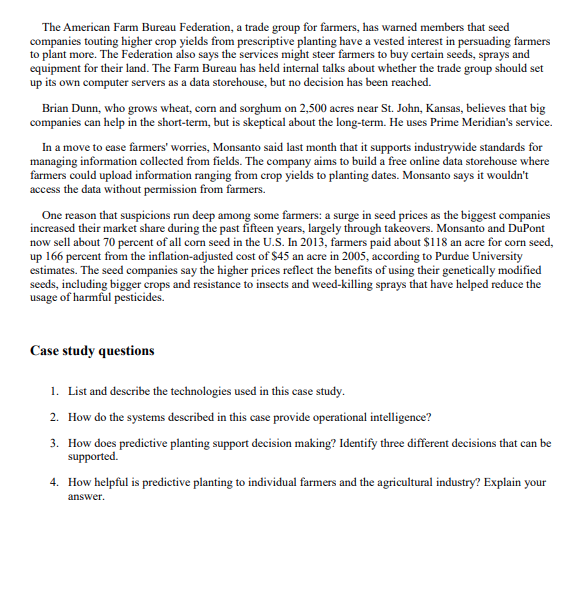
Case study questions
1. List and describe the technologies used in this case study.
2. How do the systems described in this case provide operational intelligence?
3. How does predictive planting support decision-making? Identify three different decisions that can be supported.
4. How helpful is predictive planting to individual farmers and the agricultural industry? Explain your answer.
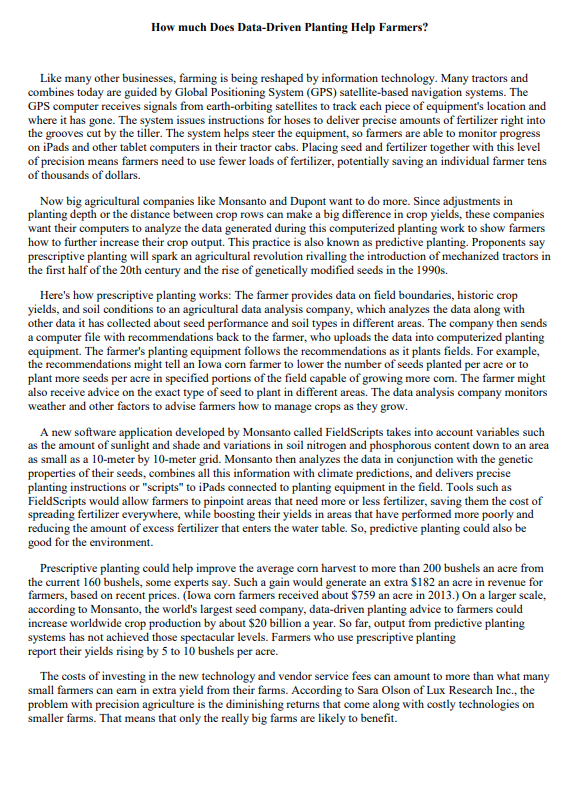
How much Does Data-Driven Planting Help Farmers? Like many other businesses, farming is being reshaped by information technology. Many tractors and combines today are guided by Global Positioning System (GPS) satellite-based navigation systems. The GPS computer receives signals from earth-orbiting satellites to track each piece of equipment's location and where it has gone. The system issues instructions for hoses to deliver precise amounts of fertilizer right into the grooves cut by the tiller. The system helps steer the equipment, so farmers are able to monitor progress on iPads and other tablet computers in their tractor cabs. Placing seed and fertilizer together with this level of precision means farmers need to use fewer loads of fertilizer, potentially saving an individual farmer tens of thousands of dollars. Now big agricultural companies like Monsanto and Dupont want to do more. Since adjustments in planting depth or the distance between crop rows can make a big difference in crop yields, these companies want their computers to analyze the data generated during this computerized planting work to show farmers how to further increase their crop output. This practice is also known as predictive planting. Proponents say prescriptive planting will spark an agricultural revolution rivalling the introduction of mechanized tractors in the first half of the 20th century and the rise of genetically modified seeds in the 1990s. Here's how prescriptive planting works: The farmer provides data on field boundaries, historic crop yields, and soil conditions to an agricultural data analysis company, which analyzes the data along with other data it has collected about seed performance and soil types in different areas. The company then sends a computer file with recommendations back to the farmer, who uploads the data into computerized planting equipment. The farmer's planting equipment follows the recommendations as it plants fields. For example, the recommendations might tell an lowa corn farmer to lower the number of seeds planted per acre or to plant more seeds per acre in specified portions of the field capable of growing more com. The farmer might also receive advice on the exact type of seed to plant in different areas. The data analysis company monitors weather and other factors to advise farmers how to manage crops as they grow. A new software application developed by Monsanto called FieldScripts takes into account variables such as the amount of sunlight and shade and variations in soil nitrogen and phosphorous content down to an area as small as a 10-meter by 10-meter grid. Monsanto then analyzes the data in conjunction with the genetic properties of their seeds, combines all this information with climate predictions, and delivers precise planting instructions or "scripts" to iPads connected to planting equipment in the field. Tools such as FieldScripts would allow farmers to pinpoint areas that need more or less fertilizer, saving them the cost of spreading fertilizer everywhere, while boosting their yields in areas that have performed more poorly and reducing the amount of excess fertilizer that enters the water table. So, predictive planting could also be good for the environment. Prescriptive planting could help improve the average corn harvest to more than 200 bushels an acre from the current 160 bushels, some experts say. Such a gain would generate an extra $182 an acre in revenue for farmers, based on recent prices. (Iowa corn farmers received about $759 an acre in 2013.) On a larger scale, according to Monsanto, the world's largest seed company, data-driven planting advice to farmers could increase worldwide crop production by about $20 billion a year. So far, output from predictive planting systems has not achieved those spectacular levels. Farmers who use prescriptive planting report their yields rising by 5 to 10 bushels per acre. The costs of investing in the new technology and vendor service fees can amount to more than what many small farmers can eam in extra yield from their farms. According to Sara Olson of Lux Research Inc., the problem with precision agriculture is the diminishing returns that come along with costly technologies on smaller farms. That means that only the really big farms are likely to benefit. Monsanto estimates that FieldScripts will improve yields by 5 to 10 bushels per acre. With corn at around $4 per bushel, that's an increase of $20-$40 per acre. A small farm, of about 500 acres, could get anywhere from $10,000 to $20,000 in extra revenue. Monsanto charges around $10 per acre for the service, so the farm will wind up paying around addition to paying tens of thousands of dollars to either retrofit its existing planting equipment or buy more modern tractors that include the electronics gear that synes the "scripts" provided by the Monsanto online service with the planter's onboard navigation systems. Monsanto also charges an extra $15 per acre for its local climate prediction service. A small farm will most likely lose money or break even for the first two years of using a service like FieldScripts, according to Olson. For large farm of about 5,000 acres, FieldScripts could increase revenues increase by between $100,000 and $200,000. With Monsanto's service costing around $50,000, that farm's total profits will run between $50,000 to $150,000, more than sufficient to offset the cost of updating farm machinery. Whether a farm is big or small the impact of FieldScripts would be minimal in good years because yields would be high regardless. Steve Pitstick, who owns a 2,600-acre corn and soybean farm near DeKalb, Ill., said that the technology is likely to have a bigger impact in years when conditions aren't so good. Since Midwest farming conditions were good in 2013, Pitstick found that yields from fields that he managed using FieldScripts were only between 1 percent and 2 percent higher than fields where he didn't use the service. A spokesperson for Monsanto stated that the outcome of predictive planting is less about the size of the farm and more about the farmer's technology know-how. A wide range of farmers are currently using various types of precision agriculture technology. Both small-and large-scale farmers dealing with various crops and production methods are increasingly looking for new technologies and tools that can improve their yields while managing their overall risk. According to Michael Cox, co-director of investment research at securities firm Piper Jaffray Cos., revenue from FieldScripts and other technology-driven products and services could account for 20 percent of Monsanto's projected growth in per-share earnings by 2018. Although some farmers have embraced predictive planting, others are critical. Many farmers are worried about the intrusion of big data into their once-insular businesses and are especially suspicious of what Monsanto and DuPont might do with the collected data. Others worry about seed prices rising too much, since the companies that developed predictive planting technology are the same ones that sell seeds. Farmers also fear that rivals could use the data to their own advantage. For instance, if nearby farmers saw crop-yield information, they might rush to rent farmland, pushing land and other costs higher. Other farmers worry that Wall Street traders could use the data to make bets on futures contracts. If such bets push futures-contract prices lower early in the growing season, it might squeeze the profits farmers could lock in for their crops by selling futures. There are not yet any publicly known examples where a farmer's prescriptive-planting information has been misused. Monsanto and DuPont officials say the companies have no plans to sell data gathered from farmers. Deere & Co., which working with DuPont and Dow Chemical Co. to formulate specialized seed- planting recommendations based on data from its tractors, combines and other machinery, says it obtains consent from customers before sharing any of their data. Kip Tom has been testing Monsanto's system on his 20,000-acre farm near Leesburg, Indiana, for about three years. He claims he would not plant a single acre without it. But he keeps close tabs on how data flow from and to his farm machinery. In 2013 Mr. Tom unplugged a cable inside one of his combine to prevent it from capturing details of his planting algorithm as he harvested corn. The combine's manufacturer didn't develop that information, so Tom didn't believe it should have access to it. Some farmers have discussed aggregating planting data on their own so they could decide what information to sell and at what price. Other farmers are working with smaller technology companies that are trying to keep agricultural giants from dominating the prescriptive-planting business. Steve Cubbage, owner of Prime Meridian LLC in Nevada, Missouri, one of these small companies, says his company's independence from the seed, machinery and chemical industry adds credibility. About one hundred farmers use Prime Meridian's precision-seeding service, and Cubbage expects the number to increase dramatically. The company is developing a system to store farm-by-farm information on an online Web-based service that could give access to seed dealers, financial advisers and other outsiders approved by farmers. The American Farm Bureau Federation, a trade group for farmers, has warned members that seed companies touting higher crop yields from prescriptive planting have a vested interest in persuading farmers to plant more. The Federation also says the services might steer farmers to buy certain seeds, sprays and equipment for their land. The Farm Bureau has held internal talks about whether the trade group should set up its own computer servers as a data storehouse, but no decision has been reached. Brian Dunn, who grows wheat, corn and sorghum on 2,500 acres near St. John, Kansas, believes that big companies can help in the short-term, but is skeptical about the long-term. He uses Prime Meridian's service. In a move to ease farmers' worries, Monsanto said last month that it supports industrywide standards for managing information collected from fields. The company aims to build a free online data storehouse where farmers could upload information ranging from crop yields to planting dates. Monsanto says it wouldn't access the data without permission from farmers. One reason that suspicions run deep among some farmers: a surge in seed prices as the biggest companies increased their market share during the past fifteen years, largely through takeovers. Monsanto and DuPont now sell about 70 percent of all corn seed in the U.S. In 2013, farmers paid about $118 an acre for corn seed, up 166 percent from the inflation-adjusted cost of $45 an acre in 2005, according to Purdue University estimates. The seed companies say the higher prices reflect the benefits of using their genetically modified seeds, including bigger crops and resistance to insects and weed-killing sprays that have helped reduce the usage of harmful pesticides. Case study questions 1. List and describe the technologies used in this case study. 2. How do the systems described in this case provide operational intelligence? 3. How does predictive planting support decision making? Identify three different decisions that can be supported. 4. How helpful is predictive planting to individual farmers and the agricultural industry? Explain yourStep by Step Solution
There are 3 Steps involved in it
1 Expert Approved Answer
Step: 1 Unlock

Question Has Been Solved by an Expert!
Get step-by-step solutions from verified subject matter experts
Step: 2 Unlock
Step: 3 Unlock
 Study Help