Question: answer 5. Understanding partial effects of a variable depending on unobserved factors that vary by population unit Consider the following general model for a random
answer
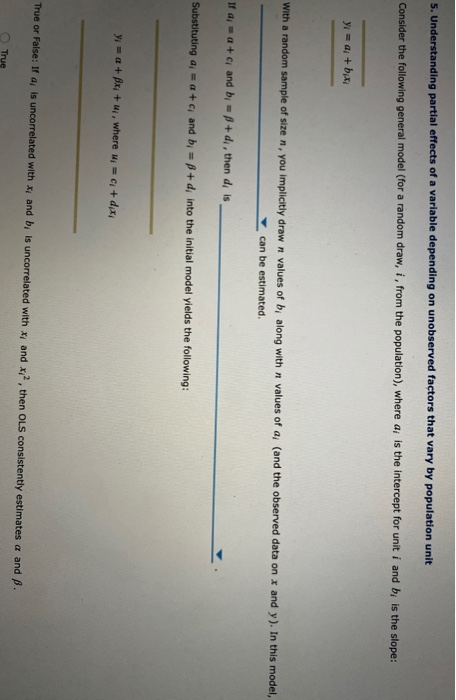
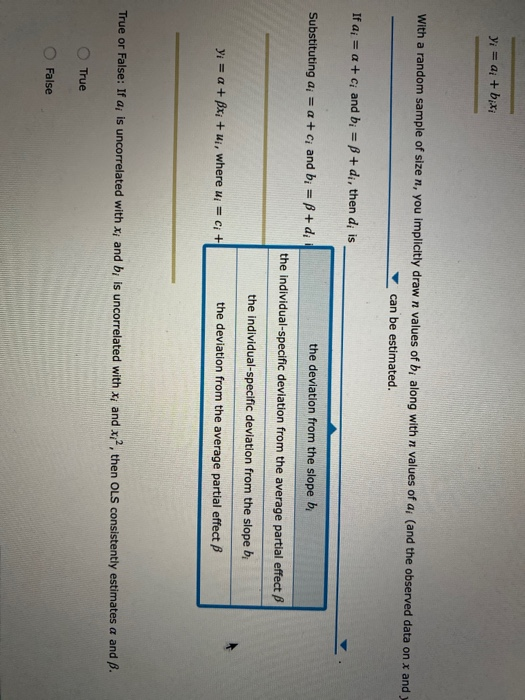
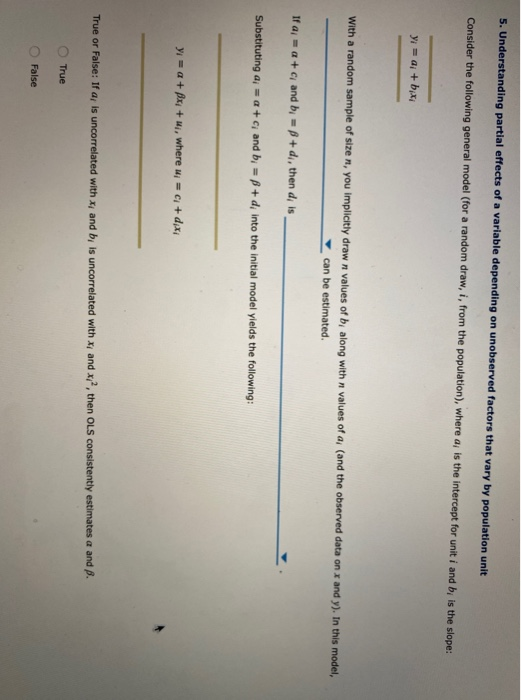
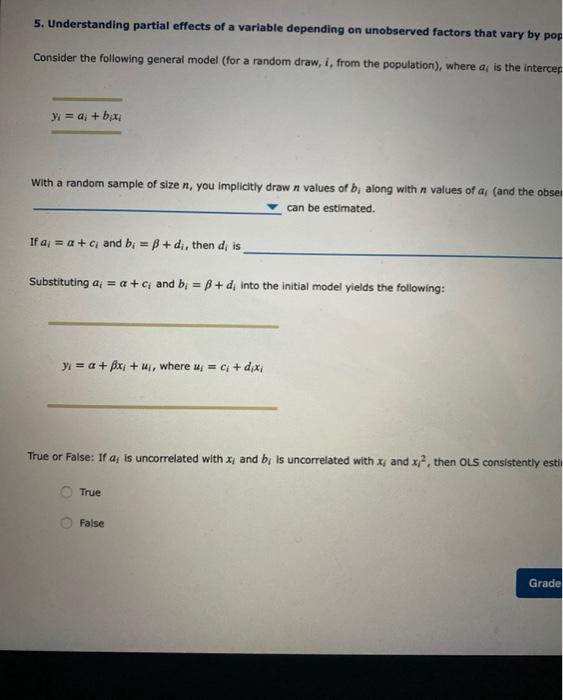
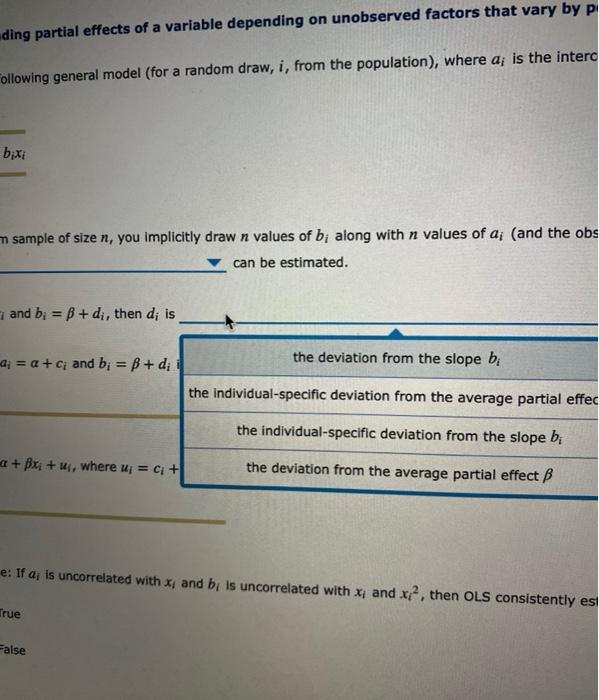
5. Understanding partial effects of a variable depending on unobserved factors that vary by population unit Consider the following general model for a random draw, i, from the population), where a, is the intercept for unit i and b; is the slope: y = a + bx with a random sample of size n, you implicitly drawn values of b, along with a values of a, (and the observed data on x and y). In this model, can be estimated. If a = a + ci and bi+d, then d, is Substituting a = a +c and b = P + d into the initial model yields the following: y = a + Baxi + where wi= c + dix True or False: If ay is uncorrelated with x and b, is uncorrelated with x and x/?, then OLS consistently estimates a and B. True yi = a; + bx; With a random sample of size n, you implicitly draw n values of b; along with n values of a: (and the observed data on x and can be estimated. If a = a + C and bi = B+ di, then di is Substituting a = a + ci and b; = 3 + di the deviation from the slope b the individual-specific deviation from the average partial effect B the individual-specific deviation from the slope bi y = a + 8x + , where I = i + the deviation from the average partial effect B True or False: If a, is uncorrelated with x and b is uncorrelated with x; and x2, then OLS consistently estimates a and B. True False 5. Understanding partial effects of a variable depending on unobserved factors that vary by population unit Consider the following general model (for a random draw, i, from the population), where a, is the intercept for unit i and by is the slope: y = a + bx With a random sample of size n, you implicitly drawn values of b, along with n values of a, (and the observed data on r and y). In this model, can be estimated If a = a + c and b; = + d, then dis Substituting a = a + ci and b= 3 + d into the initial model yields the following: y = a + x + Wi, where = c + dex True or False: If a, is uncorrelated with x and b, is uncorrelated with X and X, then OLS consistently estimates a and B. True False 5. Understanding partial effects of a variable depending on unobserved factors that vary by pop Consider the following general model (for a random draw, i, from the population), where a is the intercer y = 0; + b x with a random sample of size n, you implicitly drawn values of b along with n values of a, (and the obse can be estimated If a = a + c and b; = + di, then d, is Substituting a = a + c; and b: = B+ d into the initial model yields the following: y = a + px + Mi, where u = Ci + dx True or False: If a; is uncorrelated with x and b, is uncorrelated with x and x, then OLS consistently esti True False Grade ding partial effects of a variable depending on unobserved factors that vary by P Following general model (for a random draw, i, from the population), where a; is the interc bixi 1 sample of size n, you implicitly draw n values of b; along with n values of a; (and the obs can be estimated. and b = B+ di, then di is the deviation from the slope b: a = a + and b; = B+ di i the individual-specific deviation from the average partial effec the individual-specific deviation from the slope b; a+ Bi + M, where i = i + the deviation from the average partial effect B e: If a; is uncorrelated with x and b is uncorrelated with xi and x2, then OLS consistently es True False 5. Understanding partial effects of a variable depending on unobserved factors that vary by population unit Consider the following general model for a random draw, i, from the population), where a, is the intercept for unit i and b; is the slope: y = a + bx with a random sample of size n, you implicitly drawn values of b, along with a values of a, (and the observed data on x and y). In this model, can be estimated. If a = a + ci and bi+d, then d, is Substituting a = a +c and b = P + d into the initial model yields the following: y = a + Baxi + where wi= c + dix True or False: If ay is uncorrelated with x and b, is uncorrelated with x and x/?, then OLS consistently estimates a and B. True yi = a; + bx; With a random sample of size n, you implicitly draw n values of b; along with n values of a: (and the observed data on x and can be estimated. If a = a + C and bi = B+ di, then di is Substituting a = a + ci and b; = 3 + di the deviation from the slope b the individual-specific deviation from the average partial effect B the individual-specific deviation from the slope bi y = a + 8x + , where I = i + the deviation from the average partial effect B True or False: If a, is uncorrelated with x and b is uncorrelated with x; and x2, then OLS consistently estimates a and B. True False 5. Understanding partial effects of a variable depending on unobserved factors that vary by population unit Consider the following general model (for a random draw, i, from the population), where a, is the intercept for unit i and by is the slope: y = a + bx With a random sample of size n, you implicitly drawn values of b, along with n values of a, (and the observed data on r and y). In this model, can be estimated If a = a + c and b; = + d, then dis Substituting a = a + ci and b= 3 + d into the initial model yields the following: y = a + x + Wi, where = c + dex True or False: If a, is uncorrelated with x and b, is uncorrelated with X and X, then OLS consistently estimates a and B. True False 5. Understanding partial effects of a variable depending on unobserved factors that vary by pop Consider the following general model (for a random draw, i, from the population), where a is the intercer y = 0; + b x with a random sample of size n, you implicitly drawn values of b along with n values of a, (and the obse can be estimated If a = a + c and b; = + di, then d, is Substituting a = a + c; and b: = B+ d into the initial model yields the following: y = a + px + Mi, where u = Ci + dx True or False: If a; is uncorrelated with x and b, is uncorrelated with x and x, then OLS consistently esti True False Grade ding partial effects of a variable depending on unobserved factors that vary by P Following general model (for a random draw, i, from the population), where a; is the interc bixi 1 sample of size n, you implicitly draw n values of b; along with n values of a; (and the obs can be estimated. and b = B+ di, then di is the deviation from the slope b: a = a + and b; = B+ di i the individual-specific deviation from the average partial effec the individual-specific deviation from the slope b; a+ Bi + M, where i = i + the deviation from the average partial effect B e: If a; is uncorrelated with x and b is uncorrelated with xi and x2, then OLS consistently es True False









 Study Help